

0
0
20
40
60
80
100
2
4
6
Methyl ester yield (%)
8
1 0
1 2
1 4
t(hr)
Biodiesel
55
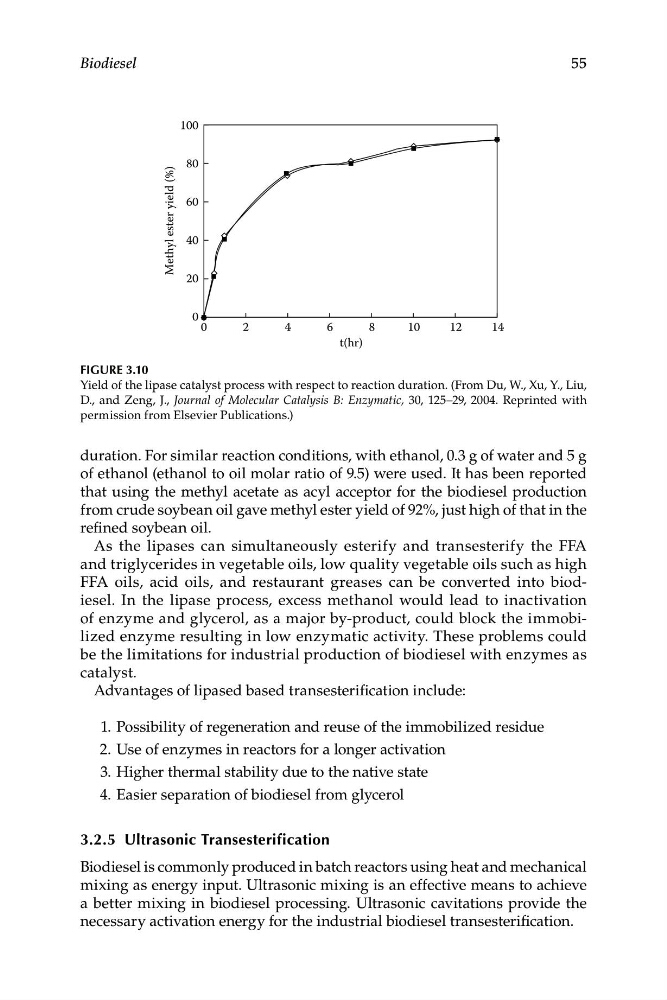
Figure 3.10
Yield of the lipase catalyst process with respect to reaction duration. (From Du, W., Xu, Y., Liu,
D., and Zeng, J., Journal of Molecular Catalysis B: Enzymatic, 30, 125–29, 2004. Reprinted with
permission from Elsevier Publications.)
duration. For similar reaction conditions, with ethanol, 0.3 g of water and 5 g
of ethanol (ethanol to oil molar ratio of 9.5) were used. It has been reported
that using the methyl acetate as acyl acceptor for the biodiesel production
from crude soybean oil gave methyl ester yield of 92%, just high of that in the
refined soybean oil.
As the lipases can simultaneously esterify and transesterify the FFA
and triglycerides in vegetable oils, low quality vegetable oils such as high
FFA oils, acid oils, and restaurant greases can be converted into biodiesel. In the lipase process, excess methanol would lead to inactivation
of enzyme and glycerol, as a major by-product, could block the immobilized enzyme resulting in low enzymatic activity. These problems could
be the limitations for industrial production of biodiesel with enzymes as
catalyst.
Advantages of lipased based transesterification include:
1. Possibility of regeneration and reuse of the immobilized residue
2. Use of enzymes in reactors for a longer activation
3. Higher thermal stability due to the native state
4. Easier separation of biodiesel from glycerol
3.2.5 ultrasonic Transesterification
Biodiesel is commonly produced in batch reactors using heat and mechanical
mixing as energy input. Ultrasonic mixing is an effective means to achieve
a better mixing in biodiesel processing. Ultrasonic cavitations provide the
necessary activation energy for the industrial biodiesel transesterification.
0
20
40
60
80
100
2
4
6
Methyl ester yield (%)
8
1 0
1 2
1 4
t(hr)
Biodiesel
55
Figure 3.10
Yield of the lipase catalyst process with respect to reaction duration. (From Du, W., Xu, Y., Liu,
D., and Zeng, J., Journal of Molecular Catalysis B: Enzymatic, 30, 125–29, 2004. Reprinted with
permission from Elsevier Publications.)
duration. For similar reaction conditions, with ethanol, 0.3 g of water and 5 g
of ethanol (ethanol to oil molar ratio of 9.5) were used. It has been reported
that using the methyl acetate as acyl acceptor for the biodiesel production
from crude soybean oil gave methyl ester yield of 92%, just high of that in the
refined soybean oil.
As the lipases can simultaneously esterify and transesterify the FFA
and triglycerides in vegetable oils, low quality vegetable oils such as high
FFA oils, acid oils, and restaurant greases can be converted into biodiesel. In the lipase process, excess methanol would lead to inactivation
of enzyme and glycerol, as a major by-product, could block the immobilized enzyme resulting in low enzymatic activity. These problems could
be the limitations for industrial production of biodiesel with enzymes as
catalyst.
Advantages of lipased based transesterification include:
1. Possibility of regeneration and reuse of the immobilized residue
2. Use of enzymes in reactors for a longer activation
3. Higher thermal stability due to the native state
4. Easier separation of biodiesel from glycerol
3.2.5 ultrasonic Transesterification
Biodiesel is commonly produced in batch reactors using heat and mechanical
mixing as energy input. Ultrasonic mixing is an effective means to achieve
a better mixing in biodiesel processing. Ultrasonic cavitations provide the
necessary activation energy for the industrial biodiesel transesterification.