

48
Alternative Fuels for Transportation
3.2.1.3 Catalyst
As a catalyst in the process of alkaline methanolysis, mostly sodium hydroxide or potassium hydroxide have been used, both in concentration from
0.4 to 2% w/w of oil. Refined and crude oils with 1% or less either sodium
hydroxide or potassium hydroxide catalyst will be sufficient (Tomasevic
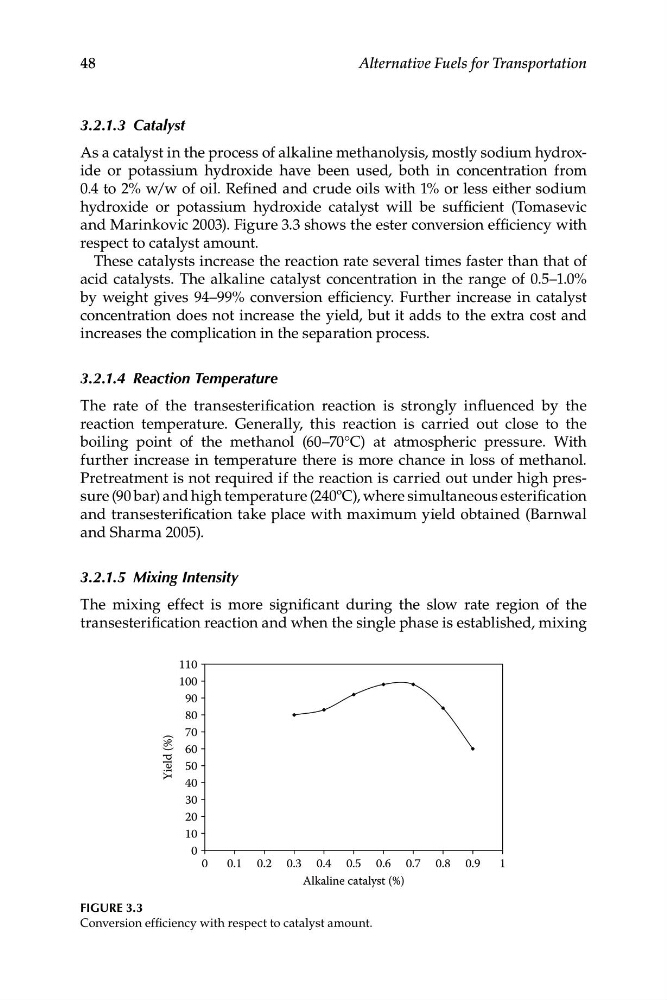
and Marinkovic 2003). Figure 3.3 shows the ester conversion efficiency with
respect to catalyst amount.
These catalysts increase the reaction rate several times faster than that of
acid catalysts. The alkaline catalyst concentration in the range of 0.5–1.0%
by weight gives 94–99% conversion efficiency. Further increase in catalyst
concentration does not increase the yield, but it adds to the extra cost and
increases the complication in the separation process.
3.2.1.4 Reaction Temperature
The rate of the transesterification reaction is strongly influenced by the
reaction temperature. Generally, this reaction is carried out close to the
boiling point of the methanol (60–70°C) at atmospheric pressure. With
further increase in temperature there is more chance in loss of methanol.
Pretreatment is not required if the reaction is carried out under high pressure (90 bar) and high temperature (240ºC), where simultaneous esterification
and transesterification take place with maximum yield obtained (Barnwal
and Sharma 2005).
3.2.1.5 Mixing Intensity
The mixing effect is more significant during the slow rate region of the
transesterification reaction and when the single phase is established, mixing
Alkaline catalyst (%)
0
10
20
30
40
50
60
70
80
90
100
110
0.2 0.3 0.4 0.5 0.6 0.7 0.8 0.9
0
0.1
1
Yield (%)
Figure 3.3
Conversion efficiency with respect to catalyst amount.
Alternative Fuels for Transportation
3.2.1.3 Catalyst
As a catalyst in the process of alkaline methanolysis, mostly sodium hydroxide or potassium hydroxide have been used, both in concentration from
0.4 to 2% w/w of oil. Refined and crude oils with 1% or less either sodium
hydroxide or potassium hydroxide catalyst will be sufficient (Tomasevic
and Marinkovic 2003). Figure 3.3 shows the ester conversion efficiency with
respect to catalyst amount.
These catalysts increase the reaction rate several times faster than that of
acid catalysts. The alkaline catalyst concentration in the range of 0.5–1.0%
by weight gives 94–99% conversion efficiency. Further increase in catalyst
concentration does not increase the yield, but it adds to the extra cost and
increases the complication in the separation process.
3.2.1.4 Reaction Temperature
The rate of the transesterification reaction is strongly influenced by the
reaction temperature. Generally, this reaction is carried out close to the
boiling point of the methanol (60–70°C) at atmospheric pressure. With
further increase in temperature there is more chance in loss of methanol.
Pretreatment is not required if the reaction is carried out under high pressure (90 bar) and high temperature (240ºC), where simultaneous esterification
and transesterification take place with maximum yield obtained (Barnwal
and Sharma 2005).
3.2.1.5 Mixing Intensity
The mixing effect is more significant during the slow rate region of the
transesterification reaction and when the single phase is established, mixing
Alkaline catalyst (%)
0
10
20
30
40
50
60
70
80
90
100
110
0.2 0.3 0.4 0.5 0.6 0.7 0.8 0.9
0
0.1
1
Yield (%)
Figure 3.3
Conversion efficiency with respect to catalyst amount.