

Biodiesel
47
The free fatty acid (FFA) and moisture content are key parameters for
determining the suitability of the vegetable oil transesterification process.
To carry the alkaline-catalyzed reaction to completion, a FFA value lower
than 2% (i.e., acid value of less than four) is needed. The higher acidity of
the oil reduces biodiesel production efficiency. Ma, Clements, and Hanna
(1998) studied the transesterification of beef tallow catalyzed by NaOH in
the presence of FFAs and water. Without adding FFA and water, the apparent yield of beef tallow methyl esters (BTME) was the highest. When 0.6%
of FFA was added, the apparent yield of BTME reached the lowest, less
than 5%, with any level of water added (Meher, Vidya Sagar, and Naik
2006).
3.2.1.2 Alcohol to Oil Molar Ratio
The stoichiometric transesterification requires 3 mol of the alcohol per mol
of the triglyceride to yield 3 mol of the fatty esters and 1 mol of the glycerol. However, the transesterification reaction is an equilibrium reaction in
which a large excess of the alcohol is required to drive the reaction close to
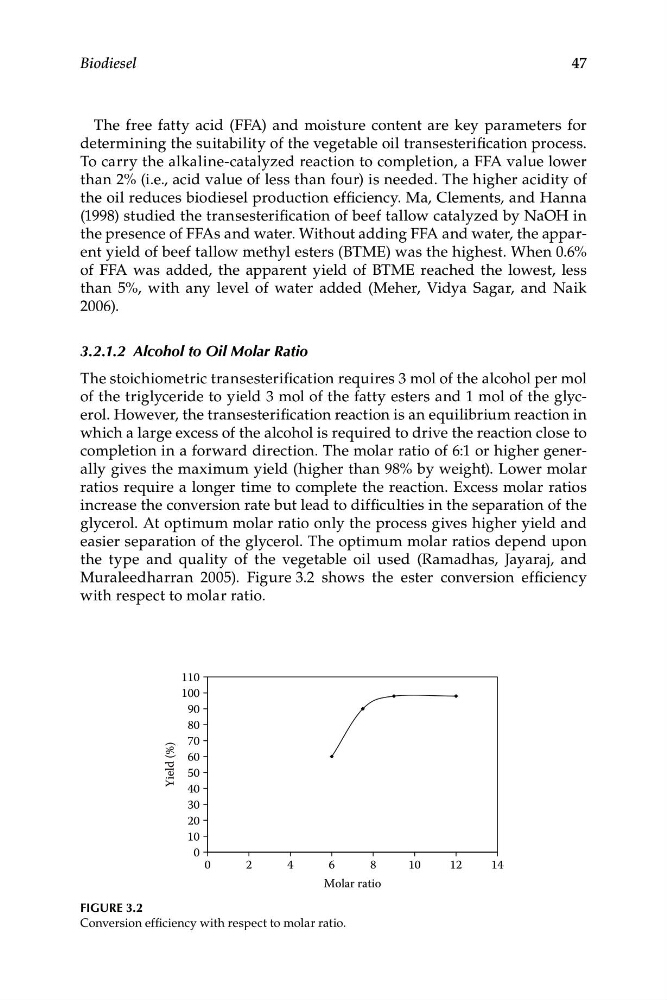
completion in a forward direction. The molar ratio of 6:1 or higher generally gives the maximum yield (higher than 98% by weight). Lower molar
ratios require a longer time to complete the reaction. Excess molar ratios
increase the conversion rate but lead to difficulties in the separation of the
glycerol. At optimum molar ratio only the process gives higher yield and
easier separation of the glycerol. The optimum molar ratios depend upon
the type and quality of the vegetable oil used (Ramadhas, Jayaraj, and
Muraleedharran 2005). Figure 3.2 shows the ester conversion efficiency
with respect to molar ratio.
Yield (%)
110
100
90
80
70
60
50
40
30
20
10
0
14
0
2
4
6
8
10
12
Molar ratio
Figure 3.2
Conversion efficiency with respect to molar ratio.
47
The free fatty acid (FFA) and moisture content are key parameters for
determining the suitability of the vegetable oil transesterification process.
To carry the alkaline-catalyzed reaction to completion, a FFA value lower
than 2% (i.e., acid value of less than four) is needed. The higher acidity of
the oil reduces biodiesel production efficiency. Ma, Clements, and Hanna
(1998) studied the transesterification of beef tallow catalyzed by NaOH in
the presence of FFAs and water. Without adding FFA and water, the apparent yield of beef tallow methyl esters (BTME) was the highest. When 0.6%
of FFA was added, the apparent yield of BTME reached the lowest, less
than 5%, with any level of water added (Meher, Vidya Sagar, and Naik
2006).
3.2.1.2 Alcohol to Oil Molar Ratio
The stoichiometric transesterification requires 3 mol of the alcohol per mol
of the triglyceride to yield 3 mol of the fatty esters and 1 mol of the glycerol. However, the transesterification reaction is an equilibrium reaction in
which a large excess of the alcohol is required to drive the reaction close to
completion in a forward direction. The molar ratio of 6:1 or higher generally gives the maximum yield (higher than 98% by weight). Lower molar
ratios require a longer time to complete the reaction. Excess molar ratios
increase the conversion rate but lead to difficulties in the separation of the
glycerol. At optimum molar ratio only the process gives higher yield and
easier separation of the glycerol. The optimum molar ratios depend upon
the type and quality of the vegetable oil used (Ramadhas, Jayaraj, and
Muraleedharran 2005). Figure 3.2 shows the ester conversion efficiency
with respect to molar ratio.
Yield (%)
110
100
90
80
70
60
50
40
30
20
10
0
14
0
2
4
6
8
10
12
Molar ratio
Figure 3.2
Conversion efficiency with respect to molar ratio.