

36
Alternative Fuels for Transportation
as a diesel fuel substitute exhibited encouraging results. Power outputs were
nearly the same for palm oil, blends of palm oil and diesel fuel, and 100%
diesel fuel. Short-term tests using palm oil fuels showed no signs of adverse
combustion chamber wear, increase in carbon deposits, or lubricating oil
contamination.
The Southwest Research Institute (Reid, Hansen, and Goering 1989) evaluated the chemical and physical properties of 14 vegetable oils. The injection
studies pointed out that the oils behave very differently from petroleumbased fuels. These changes in behavior were attributed to the high viscosity
of vegetable oils. However, preheating vegetable oils before injection reduced
the carbon deposits. Moreover, it has been reported that oils with similar viscosities offered different levels of carbon deposits.
2.4.3 Lube Oil Analysis
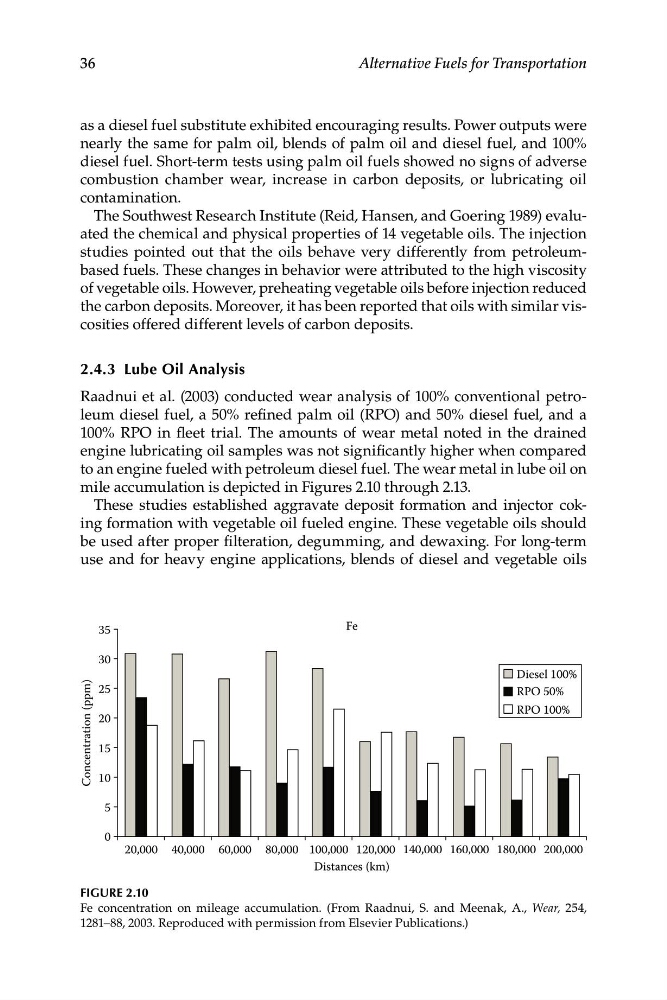
Raadnui et al. (2003) conducted wear analysis of 100% conventional petroleum diesel fuel, a 50% refined palm oil (RPO) and 50% diesel fuel, and a
100% RPO in fleet trial. The amounts of wear metal noted in the drained
engine lubricating oil samples was not significantly higher when compared
to an engine fueled with petroleum diesel fuel. The wear metal in lube oil on
mile accumulation is depicted in Figures 2.10 through 2.13.
These studies established aggravate deposit formation and injector coking formation with vegetable oil fueled engine. These vegetable oils should
be used after proper filteration, degumming, and dewaxing. For long-term
use and for heavy engine applications, blends of diesel and vegetable oils
Concentration (ppm)
35
30
25
20
15
10
5
0
20,000 40,000 60,000 80,000 100,000 120,000 140,000 160,000 180,000 200,000
Fe
Diesel 100%
RPO 50%
RPO 100%
Distances (km)
Figure 2.10
Fe concentration on mileage accumulation. (From Raadnui, S. and Meenak, A., Wear, 254,
1281–88, 2003. Reproduced with permission from Elsevier Publications.)
Alternative Fuels for Transportation
as a diesel fuel substitute exhibited encouraging results. Power outputs were
nearly the same for palm oil, blends of palm oil and diesel fuel, and 100%
diesel fuel. Short-term tests using palm oil fuels showed no signs of adverse
combustion chamber wear, increase in carbon deposits, or lubricating oil
contamination.
The Southwest Research Institute (Reid, Hansen, and Goering 1989) evaluated the chemical and physical properties of 14 vegetable oils. The injection
studies pointed out that the oils behave very differently from petroleumbased fuels. These changes in behavior were attributed to the high viscosity
of vegetable oils. However, preheating vegetable oils before injection reduced
the carbon deposits. Moreover, it has been reported that oils with similar viscosities offered different levels of carbon deposits.
2.4.3 Lube Oil Analysis
Raadnui et al. (2003) conducted wear analysis of 100% conventional petroleum diesel fuel, a 50% refined palm oil (RPO) and 50% diesel fuel, and a
100% RPO in fleet trial. The amounts of wear metal noted in the drained
engine lubricating oil samples was not significantly higher when compared
to an engine fueled with petroleum diesel fuel. The wear metal in lube oil on
mile accumulation is depicted in Figures 2.10 through 2.13.
These studies established aggravate deposit formation and injector coking formation with vegetable oil fueled engine. These vegetable oils should
be used after proper filteration, degumming, and dewaxing. For long-term
use and for heavy engine applications, blends of diesel and vegetable oils
Concentration (ppm)
35
30
25
20
15
10
5
0
20,000 40,000 60,000 80,000 100,000 120,000 140,000 160,000 180,000 200,000
Fe
Diesel 100%
RPO 50%
RPO 100%
Distances (km)
Figure 2.10
Fe concentration on mileage accumulation. (From Raadnui, S. and Meenak, A., Wear, 254,
1281–88, 2003. Reproduced with permission from Elsevier Publications.)