

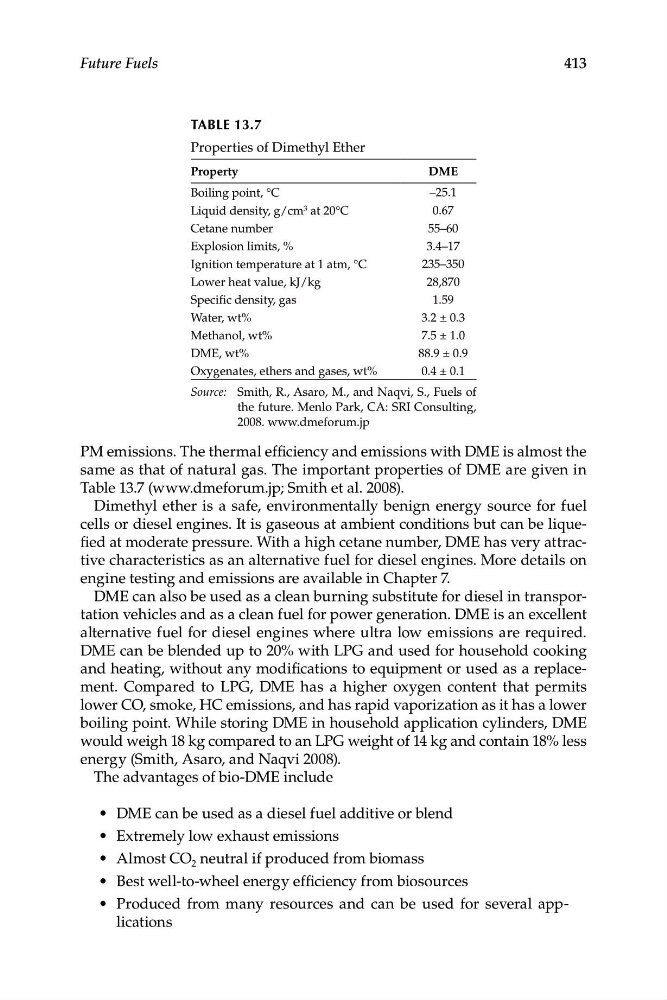
TABLe 13.7
Properties of Dimethyl Ether
Property
DME
Boiling point, °C
Liquid density, g/cm 3 at 20°C
Cetane number
Explosion limits, %
Ignition temperature at 1 atm, °C
Lower heat value, kJ/kg
Specific density, gas
Water, wt%
Methanol, wt%
DME, wt%
Oxygenates, ethers and gases, wt%
–25.1
0.67
55–60
3.4–17
235–350
28,870
1.59
3.2 ± 0.3
7.5 ± 1.0
88.9 ± 0.9
0.4 ± 0.1
Source: Smith, R., Asaro, M., and Naqvi, S., Fuels of
the future. Menlo Park, CA: SRI Consulting,
2008. www.dmeforum.jp
Future Fuels
413
PM emissions. The thermal efficiency and emissions with DME is almost the
same as that of natural gas. The important properties of DME are given in
Table 1 3.7 (www.dmeforum.jp; Smith et al. 2008).
Dimethyl ether is a safe, environmentally benign energy source for fuel
cells or diesel engines. It is gaseous at ambient conditions but can be liquefied at moderate pressure. With a high cetane number, DME has very attractive characteristics as an alternative fuel for diesel engines. More details on
engine testing and emissions are available in Chapter 7.
DME can also be used as a clean burning substitute for diesel in transportation vehicles and as a clean fuel for power generation. DME is an excellent
alternative fuel for diesel engines where ultra low emissions are required.
DME can be blended up to 20% with LPG and used for household cooking
and heating, without any modifications to equipment or used as a replacement. Compared to LPG, DME has a higher oxygen content that permits
lower CO, smoke, HC emissions, and has rapid vaporization as it has a lower
boiling point. While storing DME in household application cylinders, DME
would weigh 18 kg compared to an LPG weight of 14 kg and contain 18% less
energy (Smith, Asaro, and Naqvi 2008).
The advantages of bio-DME include
• DME can be used as a diesel fuel additive or blend
• Extremely low exhaust emissions
• Almost CO 2 neutral if produced from biomass
• Best well-to-wheel energy efficiency from biosources
• Produced from many resources and can be used for several applications
Properties of Dimethyl Ether
Property
DME
Boiling point, °C
Liquid density, g/cm 3 at 20°C
Cetane number
Explosion limits, %
Ignition temperature at 1 atm, °C
Lower heat value, kJ/kg
Specific density, gas
Water, wt%
Methanol, wt%
DME, wt%
Oxygenates, ethers and gases, wt%
–25.1
0.67
55–60
3.4–17
235–350
28,870
1.59
3.2 ± 0.3
7.5 ± 1.0
88.9 ± 0.9
0.4 ± 0.1
Source: Smith, R., Asaro, M., and Naqvi, S., Fuels of
the future. Menlo Park, CA: SRI Consulting,
2008. www.dmeforum.jp
Future Fuels
413
PM emissions. The thermal efficiency and emissions with DME is almost the
same as that of natural gas. The important properties of DME are given in
Table 1 3.7 (www.dmeforum.jp; Smith et al. 2008).
Dimethyl ether is a safe, environmentally benign energy source for fuel
cells or diesel engines. It is gaseous at ambient conditions but can be liquefied at moderate pressure. With a high cetane number, DME has very attractive characteristics as an alternative fuel for diesel engines. More details on
engine testing and emissions are available in Chapter 7.
DME can also be used as a clean burning substitute for diesel in transportation vehicles and as a clean fuel for power generation. DME is an excellent
alternative fuel for diesel engines where ultra low emissions are required.
DME can be blended up to 20% with LPG and used for household cooking
and heating, without any modifications to equipment or used as a replacement. Compared to LPG, DME has a higher oxygen content that permits
lower CO, smoke, HC emissions, and has rapid vaporization as it has a lower
boiling point. While storing DME in household application cylinders, DME
would weigh 18 kg compared to an LPG weight of 14 kg and contain 18% less
energy (Smith, Asaro, and Naqvi 2008).
The advantages of bio-DME include
• DME can be used as a diesel fuel additive or blend
• Extremely low exhaust emissions
• Almost CO 2 neutral if produced from biomass
• Best well-to-wheel energy efficiency from biosources
• Produced from many resources and can be used for several applications