

412
Alternative Fuels for Transportation
production of 1 ton of DME, 1.4 tons of methanol are required (Smith, Asaro,
and Naqvi 2008).
13.5.4.2 DME from Coal/Biomass
Gasification processes that produce synthesis gases can use a high sulfur
content coal or biomass feedstock. A typical schematic of production of DME
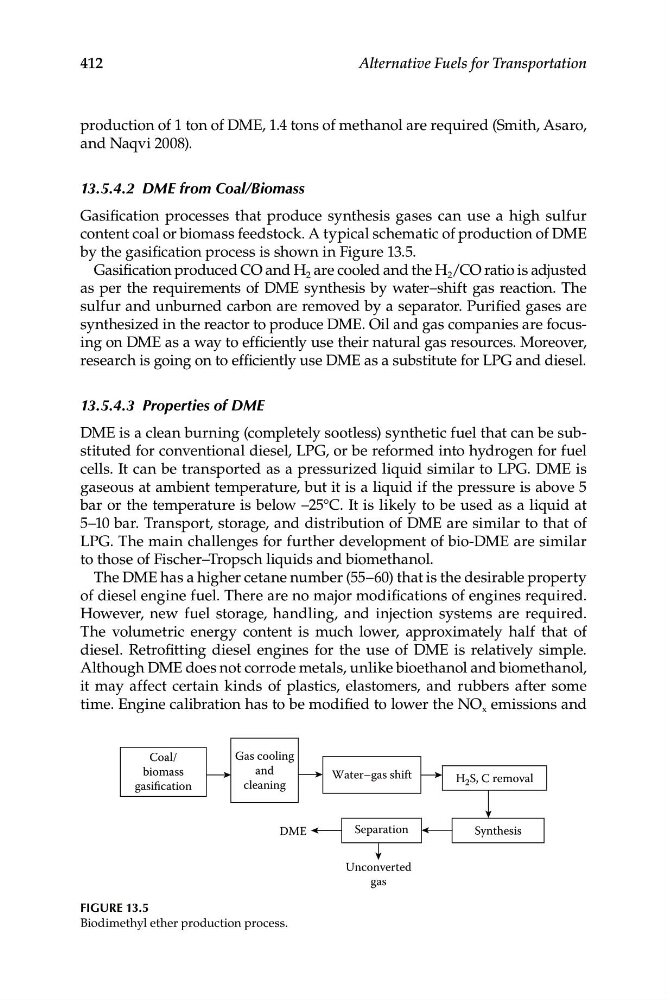
by the gasification process is shown in Figure 13.5.
Gasification produced CO and H 2 are cooled and the H 2 /CO ratio is adjusted
as per the requirements of DME synthesis by water–shift gas reaction. The
sulfur and unburned carbon are removed by a separator. Purified gases are
synthesized in the reactor to produce DME. Oil and gas companies are focusing on DME as a way to efficiently use their natural gas resources. Moreover,
research is going on to efficiently use DME as a substitute for LPG and diesel.
13.5.4.3 Properties of DME
DME is a clean burning (completely sootless) synthetic fuel that can be substituted for conventional diesel, LPG, or be reformed into hydrogen for fuel
cells. It can be transported as a pressurized liquid similar to LPG. DME is
gaseous at ambient temperature, but it is a liquid if the pressure is above 5
bar or the temperature is below –25°C. It is likely to be used as a liquid at
5–10 bar. Transport, storage, and distribution of DME are similar to that of
LPG. The main challenges for further development of bio-DME are similar
to those of Fischer–Tropsch liquids and biomethanol.
The DME has a higher cetane number (55–60) that is the desirable property
of diesel engine fuel. There are no major modifications of engines required.
However, new fuel storage, handling, and injection systems are required.
The volumetric energy content is much lower, approximately half that of
diesel. Retrofitting diesel engines for the use of DME is relatively simple.
Although DME does not corrode metals, unlike bioethanol and biomethanol,
it may affect certain kinds of plastics, elastomers, and rubbers after some
time. Engine calibration has to be modified to lower the NO x emissions and
Coal/
biomass
gasification
Gas cooling
and
cleaning
Water–gas shift
H 2 S, C removal
Synthesis
Separation
Unconverted
DME
gas
Figure 13.5
Biodimethyl ether production process.
Alternative Fuels for Transportation
production of 1 ton of DME, 1.4 tons of methanol are required (Smith, Asaro,
and Naqvi 2008).
13.5.4.2 DME from Coal/Biomass
Gasification processes that produce synthesis gases can use a high sulfur
content coal or biomass feedstock. A typical schematic of production of DME
by the gasification process is shown in Figure 13.5.
Gasification produced CO and H 2 are cooled and the H 2 /CO ratio is adjusted
as per the requirements of DME synthesis by water–shift gas reaction. The
sulfur and unburned carbon are removed by a separator. Purified gases are
synthesized in the reactor to produce DME. Oil and gas companies are focusing on DME as a way to efficiently use their natural gas resources. Moreover,
research is going on to efficiently use DME as a substitute for LPG and diesel.
13.5.4.3 Properties of DME
DME is a clean burning (completely sootless) synthetic fuel that can be substituted for conventional diesel, LPG, or be reformed into hydrogen for fuel
cells. It can be transported as a pressurized liquid similar to LPG. DME is
gaseous at ambient temperature, but it is a liquid if the pressure is above 5
bar or the temperature is below –25°C. It is likely to be used as a liquid at
5–10 bar. Transport, storage, and distribution of DME are similar to that of
LPG. The main challenges for further development of bio-DME are similar
to those of Fischer–Tropsch liquids and biomethanol.
The DME has a higher cetane number (55–60) that is the desirable property
of diesel engine fuel. There are no major modifications of engines required.
However, new fuel storage, handling, and injection systems are required.
The volumetric energy content is much lower, approximately half that of
diesel. Retrofitting diesel engines for the use of DME is relatively simple.
Although DME does not corrode metals, unlike bioethanol and biomethanol,
it may affect certain kinds of plastics, elastomers, and rubbers after some
time. Engine calibration has to be modified to lower the NO x emissions and
Coal/
biomass
gasification
Gas cooling
and
cleaning
Water–gas shift
H 2 S, C removal
Synthesis
Separation
Unconverted
DME
gas
Figure 13.5
Biodimethyl ether production process.