

Future Fuels
401
Air
Producer gas
Fuel
Drying
Pyrolysis
Oxidation
Reduction
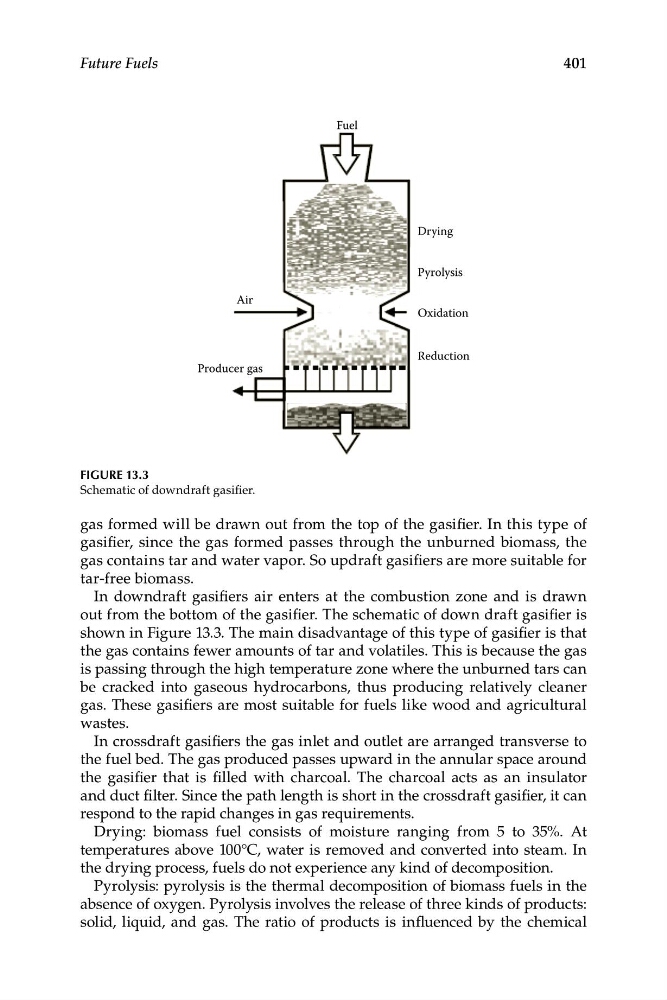
Figure 13.3
Schematic of downdraft gasifier.
gas formed will be drawn out from the top of the gasifier. In this type of
gasifier, since the gas formed passes through the unburned biomass, the
gas contains tar and water vapor. So updraft gasifiers are more suitable for
tar-free biomass.
In downdraft gasifiers air enters at the combustion zone and is drawn
out from the bottom of the gasifier. The schematic of down draft gasifier is
shown in Figure 13.3. The main disadvantage of this type of gasifier is that
the gas contains fewer amounts of tar and volatiles. This is because the gas
is passing through the high temperature zone where the unburned tars can
be cracked into gaseous hydrocarbons, thus producing relatively cleaner
gas. These gasifiers are most suitable for fuels like wood and agricultural
wastes.
In crossdraft gasifiers the gas inlet and outlet are arranged transverse to
the fuel bed. The gas produced passes upward in the annular space around
the gasifier that is filled with charcoal. The charcoal acts as an insulator
and duct filter. Since the path length is short in the crossdraft gasifier, it can
respond to the rapid changes in gas requirements.
Drying: biomass fuel consists of moisture ranging from 5 to 35%. At
temperatures above 100°C, water is removed and converted into steam. In
the drying process, fuels do not experience any kind of decomposition.
Pyrolysis: pyrolysis is the thermal decomposition of biomass fuels in the
absence of oxygen. Pyrolysis involves the release of three kinds of products:
solid, liquid, and gas. The ratio of products is influenced by the chemical
401
Air
Producer gas
Fuel
Drying
Pyrolysis
Oxidation
Reduction
Figure 13.3
Schematic of downdraft gasifier.
gas formed will be drawn out from the top of the gasifier. In this type of
gasifier, since the gas formed passes through the unburned biomass, the
gas contains tar and water vapor. So updraft gasifiers are more suitable for
tar-free biomass.
In downdraft gasifiers air enters at the combustion zone and is drawn
out from the bottom of the gasifier. The schematic of down draft gasifier is
shown in Figure 13.3. The main disadvantage of this type of gasifier is that
the gas contains fewer amounts of tar and volatiles. This is because the gas
is passing through the high temperature zone where the unburned tars can
be cracked into gaseous hydrocarbons, thus producing relatively cleaner
gas. These gasifiers are most suitable for fuels like wood and agricultural
wastes.
In crossdraft gasifiers the gas inlet and outlet are arranged transverse to
the fuel bed. The gas produced passes upward in the annular space around
the gasifier that is filled with charcoal. The charcoal acts as an insulator
and duct filter. Since the path length is short in the crossdraft gasifier, it can
respond to the rapid changes in gas requirements.
Drying: biomass fuel consists of moisture ranging from 5 to 35%. At
temperatures above 100°C, water is removed and converted into steam. In
the drying process, fuels do not experience any kind of decomposition.
Pyrolysis: pyrolysis is the thermal decomposition of biomass fuels in the
absence of oxygen. Pyrolysis involves the release of three kinds of products:
solid, liquid, and gas. The ratio of products is influenced by the chemical