

369
Hybrid Vehicles
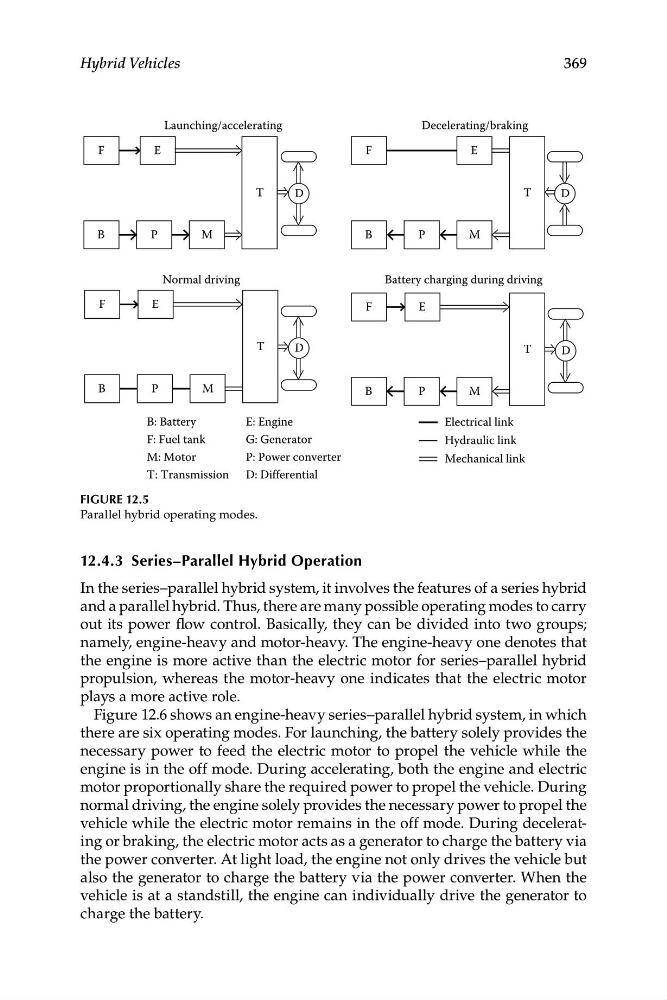
Launching/accelerating
Decelerating/braking
M
T
B
E
F
P
D
M
T
B
E
F
P
D
Normal driving
Battery charging during driving
B: Battery
E: Engine
F: Fuel tank
G: Generator
M: Motor
P: Power converter
Electrical link
Hydraulic link
Mechanical link
M
T
B
E
F
P
D
M
T
B
E
F
P
D
T: Transmission D: Differential
Figure 12.5
Parallel hybrid operating modes.
12.4.3 Series–Parallel Hybrid Operation
In the series–parallel hybrid system, it involves the features of a series hybrid
and a parallel hybrid. Thus, there are many possible operating modes to carry
out its power flow control. Basically, they can be divided into two groups;
namely, engine-heavy and motor-heavy. The engine-heavy one denotes that
the engine is more active than the electric motor for series–parallel hybrid
propulsion, whereas the motor-heavy one indicates that the electric motor
plays a more active role.
Figure 12.6 shows an engine-heavy series–parallel hybrid system, in which
there are six operating modes. For launching, the battery solely provides the
necessary power to feed the electric motor to propel the vehicle while the
engine is in the off mode. During accelerating, both the engine and electric
motor proportionally share the required power to propel the vehicle. During
normal driving, the engine solely provides the necessary power to propel the
vehicle while the electric motor remains in the off mode. During decelerating or braking, the electric motor acts as a generator to charge the battery via
the power converter. At light load, the engine not only drives the vehicle but
also the generator to charge the battery via the power converter. When the
vehicle is at a standstill, the engine can individually drive the generator to
charge the battery.
Hybrid Vehicles
Launching/accelerating
Decelerating/braking
M
T
B
E
F
P
D
M
T
B
E
F
P
D
Normal driving
Battery charging during driving
B: Battery
E: Engine
F: Fuel tank
G: Generator
M: Motor
P: Power converter
Electrical link
Hydraulic link
Mechanical link
M
T
B
E
F
P
D
M
T
B
E
F
P
D
T: Transmission D: Differential
Figure 12.5
Parallel hybrid operating modes.
12.4.3 Series–Parallel Hybrid Operation
In the series–parallel hybrid system, it involves the features of a series hybrid
and a parallel hybrid. Thus, there are many possible operating modes to carry
out its power flow control. Basically, they can be divided into two groups;
namely, engine-heavy and motor-heavy. The engine-heavy one denotes that
the engine is more active than the electric motor for series–parallel hybrid
propulsion, whereas the motor-heavy one indicates that the electric motor
plays a more active role.
Figure 12.6 shows an engine-heavy series–parallel hybrid system, in which
there are six operating modes. For launching, the battery solely provides the
necessary power to feed the electric motor to propel the vehicle while the
engine is in the off mode. During accelerating, both the engine and electric
motor proportionally share the required power to propel the vehicle. During
normal driving, the engine solely provides the necessary power to propel the
vehicle while the electric motor remains in the off mode. During decelerating or braking, the electric motor acts as a generator to charge the battery via
the power converter. At light load, the engine not only drives the vehicle but
also the generator to charge the battery via the power converter. When the
vehicle is at a standstill, the engine can individually drive the generator to
charge the battery.