

368
Alternative Fuels for Transportation
Launching/normal driving/accelerating
Decelerating/braking
M
T
B
E
F
P
G
D
M
T
B
E
F
P
G
D
Battery charging during driving
Battery charging
M
T
B
E
F
P
G
D
M
T
B
E
F
P
G
D
B: Battery
E: Engine
F: Fuel tank
G: Generator
M: Motor
P: Power converter
Electrical link
Hydraulic link
Mechanical link
T: Transmission
D: Differential
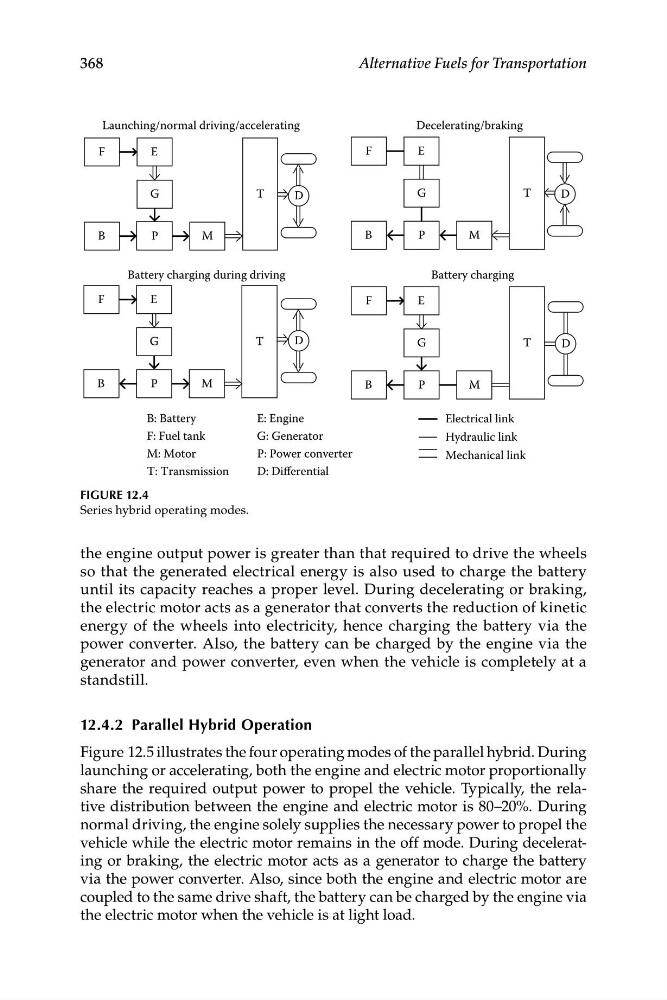
Figure 12.4
Series hybrid operating modes.
the engine output power is greater than that required to drive the wheels
so that the generated electrical energy is also used to charge the battery
until its capacity reaches a proper level. During decelerating or braking,
the electric motor acts as a generator that converts the reduction of kinetic
energy of the wheels into electricity, hence charging the battery via the
power converter. Also, the battery can be charged by the engine via the
generator and power converter, even when the vehicle is completely at a
standstill.
12.4.2 Parallel Hybrid Operation
Figure 12.5 illustrates the four operating modes of the parallel hybrid. During
launching or accelerating, both the engine and electric motor proportionally
share the required output power to propel the vehicle. Typically, the relative distribution between the engine and electric motor is 80–20%. During
normal driving, the engine solely supplies the necessary power to propel the
vehicle while the electric motor remains in the off mode. During decelerating or braking, the electric motor acts as a generator to charge the battery
via the power converter. Also, since both the engine and electric motor are
coupled to the same drive shaft, the battery can be charged by the engine via
the electric motor when the vehicle is at light load.
Alternative Fuels for Transportation
Launching/normal driving/accelerating
Decelerating/braking
M
T
B
E
F
P
G
D
M
T
B
E
F
P
G
D
Battery charging during driving
Battery charging
M
T
B
E
F
P
G
D
M
T
B
E
F
P
G
D
B: Battery
E: Engine
F: Fuel tank
G: Generator
M: Motor
P: Power converter
Electrical link
Hydraulic link
Mechanical link
T: Transmission
D: Differential
Figure 12.4
Series hybrid operating modes.
the engine output power is greater than that required to drive the wheels
so that the generated electrical energy is also used to charge the battery
until its capacity reaches a proper level. During decelerating or braking,
the electric motor acts as a generator that converts the reduction of kinetic
energy of the wheels into electricity, hence charging the battery via the
power converter. Also, the battery can be charged by the engine via the
generator and power converter, even when the vehicle is completely at a
standstill.
12.4.2 Parallel Hybrid Operation
Figure 12.5 illustrates the four operating modes of the parallel hybrid. During
launching or accelerating, both the engine and electric motor proportionally
share the required output power to propel the vehicle. Typically, the relative distribution between the engine and electric motor is 80–20%. During
normal driving, the engine solely supplies the necessary power to propel the
vehicle while the electric motor remains in the off mode. During decelerating or braking, the electric motor acts as a generator to charge the battery
via the power converter. Also, since both the engine and electric motor are
coupled to the same drive shaft, the battery can be charged by the engine via
the electric motor when the vehicle is at light load.