

Fuel Cells
355
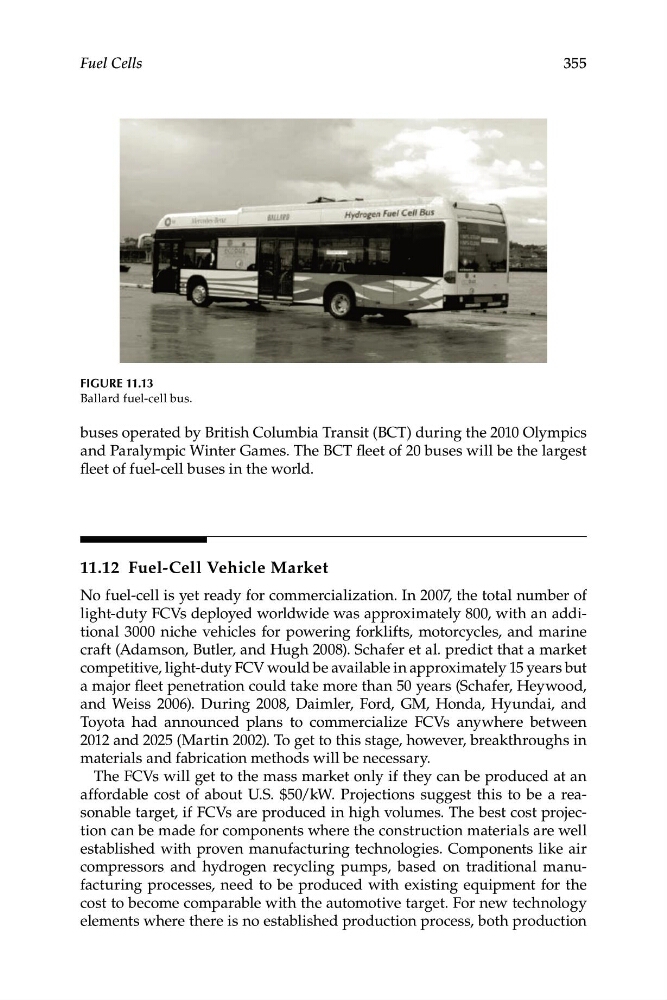
Figure 11.13
Ballard fuel-cell bus.
buses operated by British Columbia Transit (BCT) during the 2010 Olympics
and Paralympic Winter Games. The BCT fleet of 20 buses will be the largest
fleet of fuel-cell buses in the world.
11.12 Fuel-Cell Vehicle Market
No fuel-cell is yet ready for commercialization. In 2007, the total number of
light-duty FCVs deployed worldwide was approximately 800, with an additional 3000 niche vehicles for powering forklifts, motorcycles, and marine
craft (Adamson, Butler, and Hugh 2008). Schafer et al. predict that a market
competitive, light-duty FCV would be available in approximately 15 years but
a major fleet penetration could take more than 50 years (Schafer, Heywood,
and Weiss 2006). During 2008, Daimler, Ford, GM, Honda, Hyundai, and
Toyota had announced plans to commercialize FCVs anywhere between
2012 and 2025 (Martin 2002). To get to this stage, however, breakthroughs in
materials and fabrication methods will be necessary.
The FCVs will get to the mass market only if they can be produced at an
affordable cost of about U.S. $50/kW. Projections suggest this to be a reasonable target, if FCVs are produced in high volumes. The best cost projection can be made for components where the construction materials are well
established with proven manufacturing technologies. Components like air
compressors and hydrogen recycling pumps, based on traditional manufacturing processes, need to be produced with existing equipment for the
cost to become comparable with the automotive target. For new technology
elements where there is no established production process, both production
355
Figure 11.13
Ballard fuel-cell bus.
buses operated by British Columbia Transit (BCT) during the 2010 Olympics
and Paralympic Winter Games. The BCT fleet of 20 buses will be the largest
fleet of fuel-cell buses in the world.
11.12 Fuel-Cell Vehicle Market
No fuel-cell is yet ready for commercialization. In 2007, the total number of
light-duty FCVs deployed worldwide was approximately 800, with an additional 3000 niche vehicles for powering forklifts, motorcycles, and marine
craft (Adamson, Butler, and Hugh 2008). Schafer et al. predict that a market
competitive, light-duty FCV would be available in approximately 15 years but
a major fleet penetration could take more than 50 years (Schafer, Heywood,
and Weiss 2006). During 2008, Daimler, Ford, GM, Honda, Hyundai, and
Toyota had announced plans to commercialize FCVs anywhere between
2012 and 2025 (Martin 2002). To get to this stage, however, breakthroughs in
materials and fabrication methods will be necessary.
The FCVs will get to the mass market only if they can be produced at an
affordable cost of about U.S. $50/kW. Projections suggest this to be a reasonable target, if FCVs are produced in high volumes. The best cost projection can be made for components where the construction materials are well
established with proven manufacturing technologies. Components like air
compressors and hydrogen recycling pumps, based on traditional manufacturing processes, need to be produced with existing equipment for the
cost to become comparable with the automotive target. For new technology
elements where there is no established production process, both production