

354
Alternative Fuels for Transportation
fuel-cell bus introduced in 1997, was designed for city and regional transportation of up to 58 passengers. The power output from the 250 kW FCS is
similar to conventional diesel engines.
11.11.4 FCV Activities at Nissan
Nissan developed a methanol reformer integrated FCV, R’nessa FCV, in
1999. In the year 2000, Nissan developed X-TRAIL FCV with a 63 kW UTC
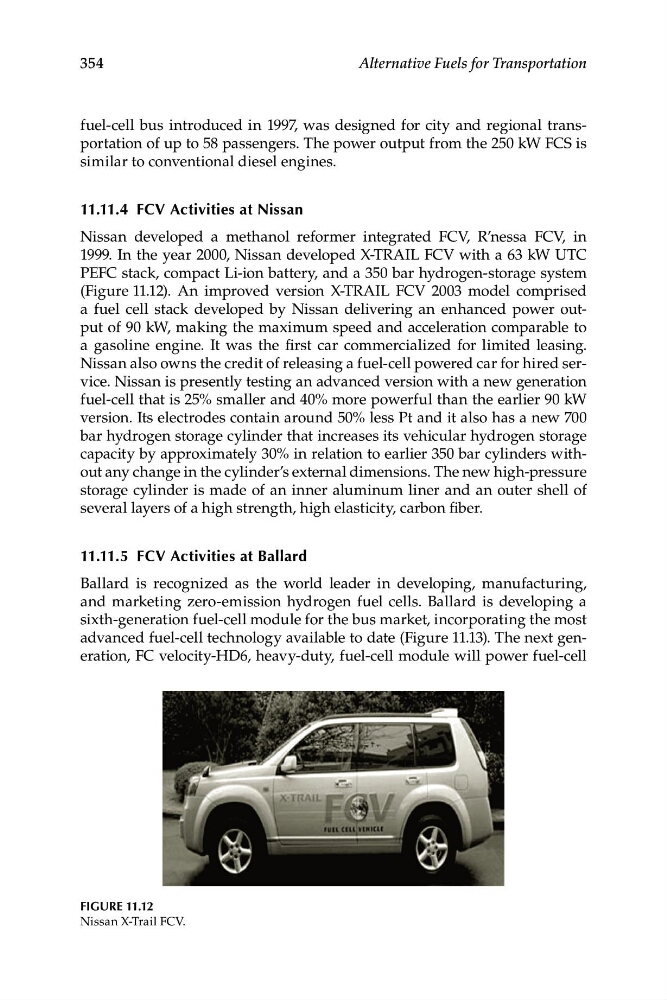
PEFC stack, compact Li-ion battery, and a 350 bar hydrogen-storage system
(Figure 11.12). An improved version X-TRAIL FCV 2003 model comprised
a fuel cell stack developed by Nissan delivering an enhanced power output of 90 kW, making the maximum speed and acceleration comparable to
a gasoline engine. It was the first car commercialized for limited leasing.
Nissan also owns the credit of releasing a fuel-cell powered car for hired service. Nissan is presently testing an advanced version with a new generation
fuel-cell that is 25% smaller and 40% more powerful than the earlier 90 kW
version. Its electrodes contain around 50% less Pt and it also has a new 700
bar hydrogen storage cylinder that increases its vehicular hydrogen storage
capacity by approximately 30% in relation to earlier 350 bar cylinders without any change in the cylinder’s external dimensions. The new high-pressure
storage cylinder is made of an inner aluminum liner and an outer shell of
several layers of a high strength, high elasticity, carbon fiber.
11.11.5 FCV Activities at Ballard
Ballard is recognized as the world leader in developing, manufacturing,
and marketing zero-emission hydrogen fuel cells. Ballard is developing a
sixth-generation fuel-cell module for the bus market, incorporating the most
advanced fuel-cell technology available to date (Figure 11.13). The next generation, FC velocity-HD6, heavy-duty, fuel-cell module will power fuel-cell
Figure 11.12
Nissan X-Trail FCV.
Alternative Fuels for Transportation
fuel-cell bus introduced in 1997, was designed for city and regional transportation of up to 58 passengers. The power output from the 250 kW FCS is
similar to conventional diesel engines.
11.11.4 FCV Activities at Nissan
Nissan developed a methanol reformer integrated FCV, R’nessa FCV, in
1999. In the year 2000, Nissan developed X-TRAIL FCV with a 63 kW UTC
PEFC stack, compact Li-ion battery, and a 350 bar hydrogen-storage system
(Figure 11.12). An improved version X-TRAIL FCV 2003 model comprised
a fuel cell stack developed by Nissan delivering an enhanced power output of 90 kW, making the maximum speed and acceleration comparable to
a gasoline engine. It was the first car commercialized for limited leasing.
Nissan also owns the credit of releasing a fuel-cell powered car for hired service. Nissan is presently testing an advanced version with a new generation
fuel-cell that is 25% smaller and 40% more powerful than the earlier 90 kW
version. Its electrodes contain around 50% less Pt and it also has a new 700
bar hydrogen storage cylinder that increases its vehicular hydrogen storage
capacity by approximately 30% in relation to earlier 350 bar cylinders without any change in the cylinder’s external dimensions. The new high-pressure
storage cylinder is made of an inner aluminum liner and an outer shell of
several layers of a high strength, high elasticity, carbon fiber.
11.11.5 FCV Activities at Ballard
Ballard is recognized as the world leader in developing, manufacturing,
and marketing zero-emission hydrogen fuel cells. Ballard is developing a
sixth-generation fuel-cell module for the bus market, incorporating the most
advanced fuel-cell technology available to date (Figure 11.13). The next generation, FC velocity-HD6, heavy-duty, fuel-cell module will power fuel-cell
Figure 11.12
Nissan X-Trail FCV.