

352
Alternative Fuels for Transportation
FCV was developed by replacing the battery box with a FCS and related components. This accelerated the early FCS development and helped Honda in
realizing a high level of vehicle and system performance over a short period.
FCX-V1, Honda’s first FCV, had a simple hydrogen storage system with a
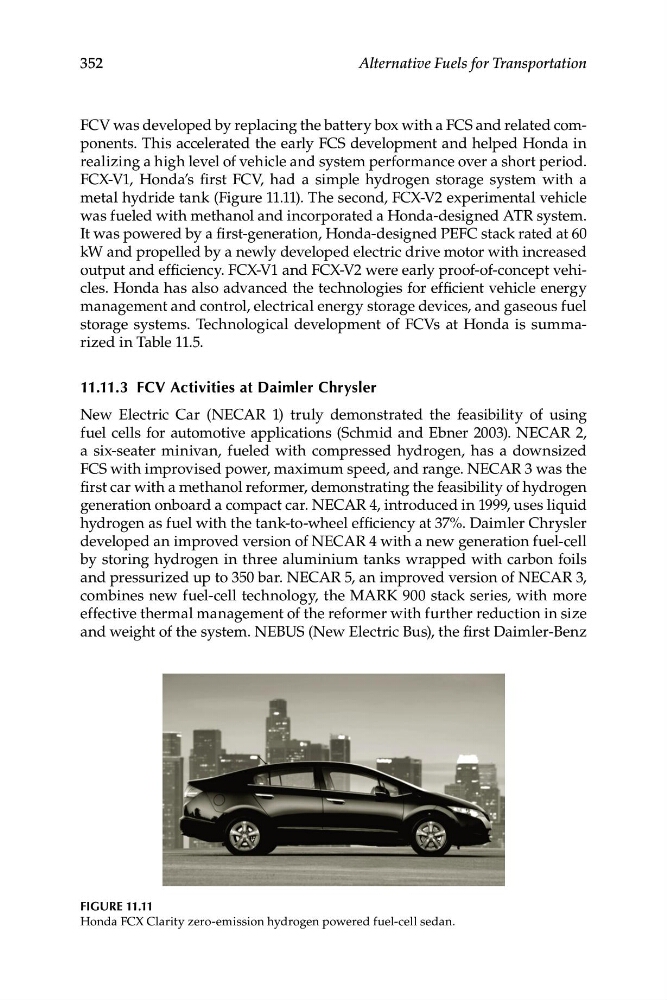
metal hydride tank (Figure 11.11). The second, FCX-V2 experimental vehicle
was fueled with methanol and incorporated a Honda-designed ATR system.
It was powered by a first-generation, Honda-designed PEFC stack rated at 60
kW and propelled by a newly developed electric drive motor with increased
output and efficiency. FCX-V1 and FCX-V2 were early proof-of-concept vehicles. Honda has also advanced the technologies for efficient vehicle energy
management and control, electrical energy storage devices, and gaseous fuel
storage systems. Technological development of FCVs at Honda is summarized in Table 11.5.
11.11.3 FCV Activities at Daimler Chrysler
New Electric Car (NECAR 1) truly demonstrated the feasibility of using
fuel cells for automotive applications (Schmid and Ebner 2003). NECAR 2,
a six-seater minivan, fueled with compressed hydrogen, has a downsized
FCS with improvised power, maximum speed, and range. NECAR 3 was the
first car with a methanol reformer, demonstrating the feasibility of hydrogen
generation onboard a compact car. NECAR 4, introduced in 1999, uses liquid
hydrogen as fuel with the tank-to-wheel efficiency at 37%. Daimler Chrysler
developed an improved version of NECAR 4 with a new generation fuel-cell
by storing hydrogen in three aluminium tanks wrapped with carbon foils
and pressurized up to 350 bar. NECAR 5, an improved version of NECAR 3,
combines new fuel-cell technology, the MARK 900 stack series, with more
effective thermal management of the reformer with further reduction in size
and weight of the system. NEBUS (New Electric Bus), the first Daimler-Benz
Figure 11.11
Honda FCX Clarity zero-emission hydrogen powered fuel-cell sedan.
Alternative Fuels for Transportation
FCV was developed by replacing the battery box with a FCS and related components. This accelerated the early FCS development and helped Honda in
realizing a high level of vehicle and system performance over a short period.
FCX-V1, Honda’s first FCV, had a simple hydrogen storage system with a
metal hydride tank (Figure 11.11). The second, FCX-V2 experimental vehicle
was fueled with methanol and incorporated a Honda-designed ATR system.
It was powered by a first-generation, Honda-designed PEFC stack rated at 60
kW and propelled by a newly developed electric drive motor with increased
output and efficiency. FCX-V1 and FCX-V2 were early proof-of-concept vehicles. Honda has also advanced the technologies for efficient vehicle energy
management and control, electrical energy storage devices, and gaseous fuel
storage systems. Technological development of FCVs at Honda is summarized in Table 11.5.
11.11.3 FCV Activities at Daimler Chrysler
New Electric Car (NECAR 1) truly demonstrated the feasibility of using
fuel cells for automotive applications (Schmid and Ebner 2003). NECAR 2,
a six-seater minivan, fueled with compressed hydrogen, has a downsized
FCS with improvised power, maximum speed, and range. NECAR 3 was the
first car with a methanol reformer, demonstrating the feasibility of hydrogen
generation onboard a compact car. NECAR 4, introduced in 1999, uses liquid
hydrogen as fuel with the tank-to-wheel efficiency at 37%. Daimler Chrysler
developed an improved version of NECAR 4 with a new generation fuel-cell
by storing hydrogen in three aluminium tanks wrapped with carbon foils
and pressurized up to 350 bar. NECAR 5, an improved version of NECAR 3,
combines new fuel-cell technology, the MARK 900 stack series, with more
effective thermal management of the reformer with further reduction in size
and weight of the system. NEBUS (New Electric Bus), the first Daimler-Benz
Figure 11.11
Honda FCX Clarity zero-emission hydrogen powered fuel-cell sedan.