

328
Alternative Fuels for Transportation
11.4 Polymer Electrolyte Fuel Cell
11.4.1 PeFC Operating Principle
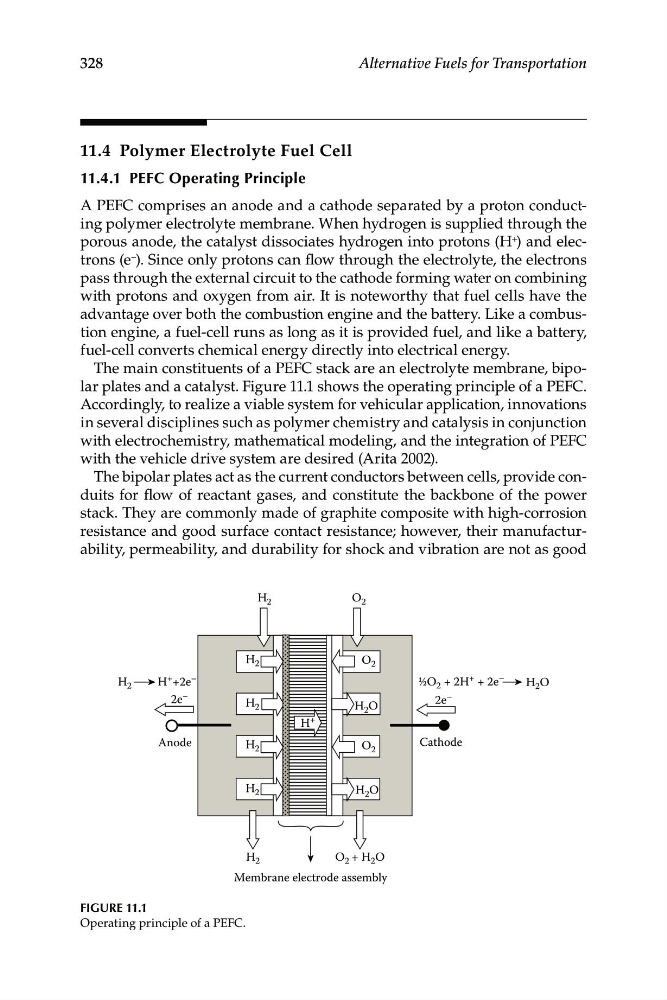
A PEFC comprises an anode and a cathode separated by a proton conducting polymer electrolyte membrane. When hydrogen is supplied through the
porous anode, the catalyst dissociates hydrogen into protons (H + ) and electrons (e – ). Since only protons can flow through the electrolyte, the electrons
pass through the external circuit to the cathode forming water on combining
with protons and oxygen from air. It is noteworthy that fuel cells have the
advantage over both the combustion engine and the battery. Like a combustion engine, a fuel-cell runs as long as it is provided fuel, and like a battery,
fuel-cell converts chemical energy directly into electrical energy.
The main constituents of a PEFC stack are an electrolyte membrane, bipolar plates and a catalyst. Figure 11.1 shows the operating principle of a PEFC.
Accordingly, to realize a viable system for vehicular application, innovations
in several disciplines such as polymer chemistry and catalysis in conjunction
with electrochemistry, mathematical modeling, and the integration of PEFC
with the vehicle drive system are desired (Arita 2002).
The bipolar plates act as the current conductors between cells, provide conduits for flow of reactant gases, and constitute the backbone of the power
stack. They are commonly made of graphite composite with high-corrosion
resistance and good surface contact resistance; however, their manufacturability, permeability, and durability for shock and vibration are not as good
H 2
O 2
H 2 O
H 2
O 2 + H 2 O
H 2
H 2
H 2
H 2
H 2
H
+ +2e
–
H 2 O
Cathode
H 2 O
O 2
O 2
2e –
Anode
Membrane electrode assembly
H +
2e
–
½O 2 + 2H
+ + 2e
–
Figure 11.1
Operating principle of a PEFC.
Alternative Fuels for Transportation
11.4 Polymer Electrolyte Fuel Cell
11.4.1 PeFC Operating Principle
A PEFC comprises an anode and a cathode separated by a proton conducting polymer electrolyte membrane. When hydrogen is supplied through the
porous anode, the catalyst dissociates hydrogen into protons (H + ) and electrons (e – ). Since only protons can flow through the electrolyte, the electrons
pass through the external circuit to the cathode forming water on combining
with protons and oxygen from air. It is noteworthy that fuel cells have the
advantage over both the combustion engine and the battery. Like a combustion engine, a fuel-cell runs as long as it is provided fuel, and like a battery,
fuel-cell converts chemical energy directly into electrical energy.
The main constituents of a PEFC stack are an electrolyte membrane, bipolar plates and a catalyst. Figure 11.1 shows the operating principle of a PEFC.
Accordingly, to realize a viable system for vehicular application, innovations
in several disciplines such as polymer chemistry and catalysis in conjunction
with electrochemistry, mathematical modeling, and the integration of PEFC
with the vehicle drive system are desired (Arita 2002).
The bipolar plates act as the current conductors between cells, provide conduits for flow of reactant gases, and constitute the backbone of the power
stack. They are commonly made of graphite composite with high-corrosion
resistance and good surface contact resistance; however, their manufacturability, permeability, and durability for shock and vibration are not as good
H 2
O 2
H 2 O
H 2
O 2 + H 2 O
H 2
H 2
H 2
H 2
H 2
H
+ +2e
–
H 2 O
Cathode
H 2 O
O 2
O 2
2e –
Anode
Membrane electrode assembly
H +
2e
–
½O 2 + 2H
+ + 2e
–
Figure 11.1
Operating principle of a PEFC.