

NO
1000
900
800
700
500
600
400
300
200
100
0
x emission (ppm)
Gasoline
Hydrogen
2000
2500
3000
3500
4000
Engine speed (rpm)
270
Alternative Fuels for Transportation
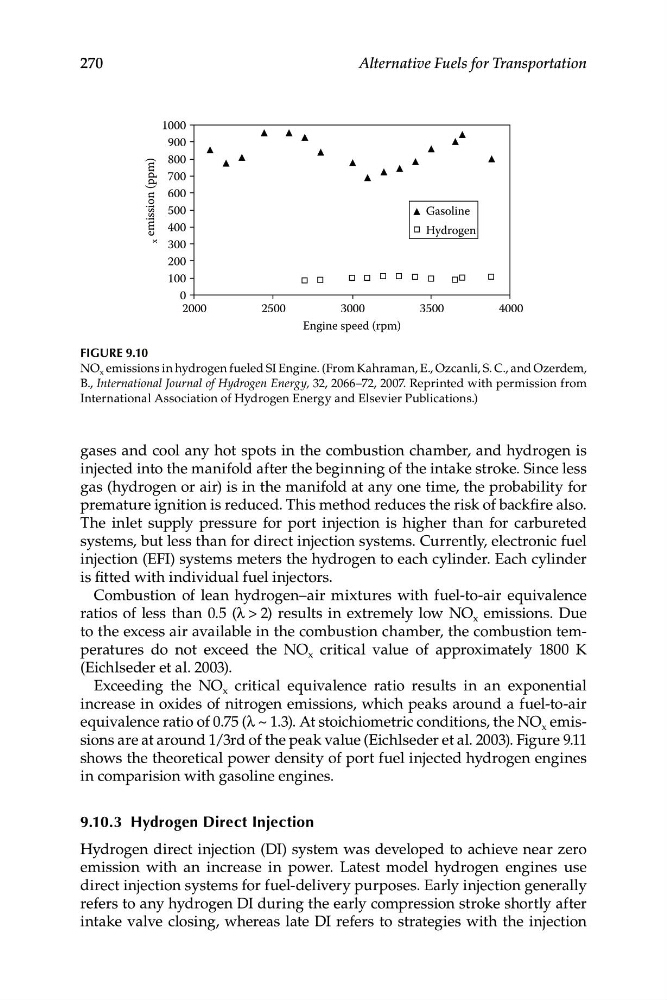
Figure 9.10
NO x emissions in hydrogen fueled SI Engine. (From Kahraman, E., Ozcanli, S. C., and Ozerdem,
B., International Journal of Hydrogen Energy, 32, 2066–72, 2007. Reprinted with permission from
International Association of Hydrogen Energy and Elsevier Publications.)
gases and cool any hot spots in the combustion chamber, and hydrogen is
injected into the manifold after the beginning of the intake stroke. Since less
gas (hydrogen or air) is in the manifold at any one time, the probability for
premature ignition is reduced. This method reduces the risk of backfire also.
The inlet supply pressure for port injection is higher than for carbureted
systems, but less than for direct injection systems. Currently, electronic fuel
injection (EFI) systems meters the hydrogen to each cylinder. Each cylinder
is fitted with individual fuel injectors.
Combustion of lean hydrogen–air mixtures with fuel-to-air equivalence
ratios of less than 0.5 (λ > 2) results in extremely low NO x emissions. Due
to the excess air available in the combustion chamber, the combustion temperatures do not exceed the NO x critical value of approximately 1800 K
(Eichlseder et al. 2003).
Exceeding the NO x critical equivalence ratio results in an exponential
increase in oxides of nitrogen emissions, which peaks around a fuel-to-air
equivalence ratio of 0.75 (λ ~ 1.3). At stoichiometric conditions, the NO x emissions are at around 1/3rd of the peak value (Eichlseder et al. 2003). Figure 9.11
shows the theoretical power density of port fuel injected hydrogen engines
in comparision with gasoline engines.
9.10.3 Hydrogen Direct injection
Hydrogen direct injection (DI) system was developed to achieve near zero
emission with an increase in power. Latest model hydrogen engines use
direct injection systems for fuel-delivery purposes. Early injection generally
refers to any hydrogen DI during the early compression stroke shortly after
intake valve closing, whereas late DI refers to strategies with the injection
1000
900
800
700
500
600
400
300
200
100
0
x emission (ppm)
Gasoline
Hydrogen
2000
2500
3000
3500
4000
Engine speed (rpm)
270
Alternative Fuels for Transportation
Figure 9.10
NO x emissions in hydrogen fueled SI Engine. (From Kahraman, E., Ozcanli, S. C., and Ozerdem,
B., International Journal of Hydrogen Energy, 32, 2066–72, 2007. Reprinted with permission from
International Association of Hydrogen Energy and Elsevier Publications.)
gases and cool any hot spots in the combustion chamber, and hydrogen is
injected into the manifold after the beginning of the intake stroke. Since less
gas (hydrogen or air) is in the manifold at any one time, the probability for
premature ignition is reduced. This method reduces the risk of backfire also.
The inlet supply pressure for port injection is higher than for carbureted
systems, but less than for direct injection systems. Currently, electronic fuel
injection (EFI) systems meters the hydrogen to each cylinder. Each cylinder
is fitted with individual fuel injectors.
Combustion of lean hydrogen–air mixtures with fuel-to-air equivalence
ratios of less than 0.5 (λ > 2) results in extremely low NO x emissions. Due
to the excess air available in the combustion chamber, the combustion temperatures do not exceed the NO x critical value of approximately 1800 K
(Eichlseder et al. 2003).
Exceeding the NO x critical equivalence ratio results in an exponential
increase in oxides of nitrogen emissions, which peaks around a fuel-to-air
equivalence ratio of 0.75 (λ ~ 1.3). At stoichiometric conditions, the NO x emissions are at around 1/3rd of the peak value (Eichlseder et al. 2003). Figure 9.11
shows the theoretical power density of port fuel injected hydrogen engines
in comparision with gasoline engines.
9.10.3 Hydrogen Direct injection
Hydrogen direct injection (DI) system was developed to achieve near zero
emission with an increase in power. Latest model hydrogen engines use
direct injection systems for fuel-delivery purposes. Early injection generally
refers to any hydrogen DI during the early compression stroke shortly after
intake valve closing, whereas late DI refers to strategies with the injection