

B k h m
n
ra e t er al efficie cy (%)
40.0
30.0
20.0
10.0
0.0
2000
2500
3000
3500
4000
Gasoline
Hydrogen
Engine speed (rpm)
Hydrogen
269
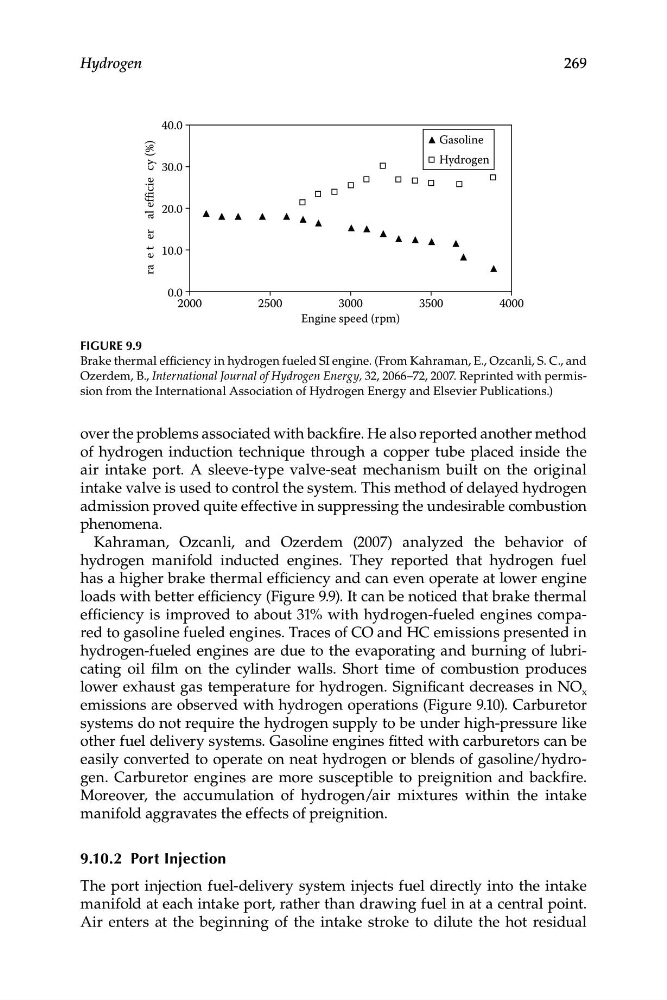
Figure 9.9
Brake thermal efficiency in hydrogen fueled SI engine. (From Kahraman, E., Ozcanli, S. C., and
Ozerdem, B., International Journal of Hydrogen Energy, 32, 2066–72, 2007. Reprinted with permission from the International Association of Hydrogen Energy and Elsevier Publications.)
over the problems associated with backfire. He also reported another method
of hydrogen induction technique through a copper tube placed inside the
air intake port. A sleeve-type valve-seat mechanism built on the original
intake valve is used to control the system. This method of delayed hydrogen
admission proved quite effective in suppressing the undesirable combustion
phenomena.
Kahraman, Ozcanli, and Ozerdem (2007) analyzed the behavior of
hydrogen manifold inducted engines. They reported that hydrogen fuel
has a higher brake thermal efficiency and can even operate at lower engine
loads with better efficiency (Figure 9.9). It can be noticed that brake thermal
efficiency is improved to about 31% with hydrogen-fueled engines compared to gasoline fueled engines. Traces of CO and HC emissions presented in
hydrogen-fueled engines are due to the evaporating and burning of lubricating oil film on the cylinder walls. Short time of combustion produces
lower exhaust gas temperature for hydrogen. Significant decreases in NO x
emissions are observed with hydrogen operations (Figure 9.10). Carburetor
systems do not require the hydrogen supply to be under high-pressure like
other fuel delivery systems. Gasoline engines fitted with carburetors can be
easily converted to operate on neat hydrogen or blends of gasoline/hydrogen. Carburetor engines are more susceptible to preignition and backfire.
Moreover, the accumulation of hydrogen/air mixtures within the intake
manifold aggravates the effects of preignition.
9.10.2 Port injection
The port injection fuel-delivery system injects fuel directly into the intake
manifold at each intake port, rather than drawing fuel in at a central point.
Air enters at the beginning of the intake stroke to dilute the hot residual
n
ra e t er al efficie cy (%)
40.0
30.0
20.0
10.0
0.0
2000
2500
3000
3500
4000
Gasoline
Hydrogen
Engine speed (rpm)
Hydrogen
269
Figure 9.9
Brake thermal efficiency in hydrogen fueled SI engine. (From Kahraman, E., Ozcanli, S. C., and
Ozerdem, B., International Journal of Hydrogen Energy, 32, 2066–72, 2007. Reprinted with permission from the International Association of Hydrogen Energy and Elsevier Publications.)
over the problems associated with backfire. He also reported another method
of hydrogen induction technique through a copper tube placed inside the
air intake port. A sleeve-type valve-seat mechanism built on the original
intake valve is used to control the system. This method of delayed hydrogen
admission proved quite effective in suppressing the undesirable combustion
phenomena.
Kahraman, Ozcanli, and Ozerdem (2007) analyzed the behavior of
hydrogen manifold inducted engines. They reported that hydrogen fuel
has a higher brake thermal efficiency and can even operate at lower engine
loads with better efficiency (Figure 9.9). It can be noticed that brake thermal
efficiency is improved to about 31% with hydrogen-fueled engines compared to gasoline fueled engines. Traces of CO and HC emissions presented in
hydrogen-fueled engines are due to the evaporating and burning of lubricating oil film on the cylinder walls. Short time of combustion produces
lower exhaust gas temperature for hydrogen. Significant decreases in NO x
emissions are observed with hydrogen operations (Figure 9.10). Carburetor
systems do not require the hydrogen supply to be under high-pressure like
other fuel delivery systems. Gasoline engines fitted with carburetors can be
easily converted to operate on neat hydrogen or blends of gasoline/hydrogen. Carburetor engines are more susceptible to preignition and backfire.
Moreover, the accumulation of hydrogen/air mixtures within the intake
manifold aggravates the effects of preignition.
9.10.2 Port injection
The port injection fuel-delivery system injects fuel directly into the intake
manifold at each intake port, rather than drawing fuel in at a central point.
Air enters at the beginning of the intake stroke to dilute the hot residual