

Property
Hydrogen Methane Propane Gasoline
Minimum ignition energy (mJ)
0.02
0.28
0.25
0.25
Ignition temperature (K)
858
810
783
530
Adiabatic flame temperature (K)
2384
2227
2268
2270
Limits of flammability (% in air)
4.1–75
4.3–15
2.2–9.5
1.5–7.6
Maximum laminar flame velocity (cm/s)
270
38
40
30
Diffusivity (cm 2 /s)
0.63
0.20
—
0.08
Minimum quenching distance at 1 atm (cm)
0.06
0.25
0.19
—
Normalized flame emissivity (200 K and 1 atm)
1.00
1.7
1.7
1.7
254
Alternative Fuels for Transportation
TABLe 9.3
Ignition and Flammability Properties of Hydrogen in Comparison with
Other Fuels
Source: From Das, L. M., International Journal of Hydrogen Energy, 21, 703–15, 1996. Reprinted
with permission from the International Association of Hydrogen Energy and Elsevier
Publications.
Carburetor
Manifold
Manifold
manifold
Gasoline
Liquid
hydrogen
Gaseous
hydrogen
Air
Air
Air
Air
H 2
H 2
Air
Air
A ir
Liquid
gasoline
1.04 in 3 (17 cc)
60 in 3 (983 cc)
840 cal (3.5 kJ)
(100)
18.3 in
3 (300 cc)
42.7 in 3 (700 cc)
710 cal (3.0 kJ)
(85)
24.7 in
3 (405 cc)
58.9 in 3 (965 cc)
970 cal (4.0 kJ)
(115)
25.6 in
3 (420 cc)
61.0 in 3 (1000 cc)
1010 cal (4.2 kJ)
(120)
Gaseous
hydrogen
premixed
Liquid
hydrogen
premixed
High pressure
gaseous
hydrogen
injection
H 2
Gasoline
vapor
Fuel
air
energy
(%)
High pressure
gaseous hydrogen
Insulated
A ir
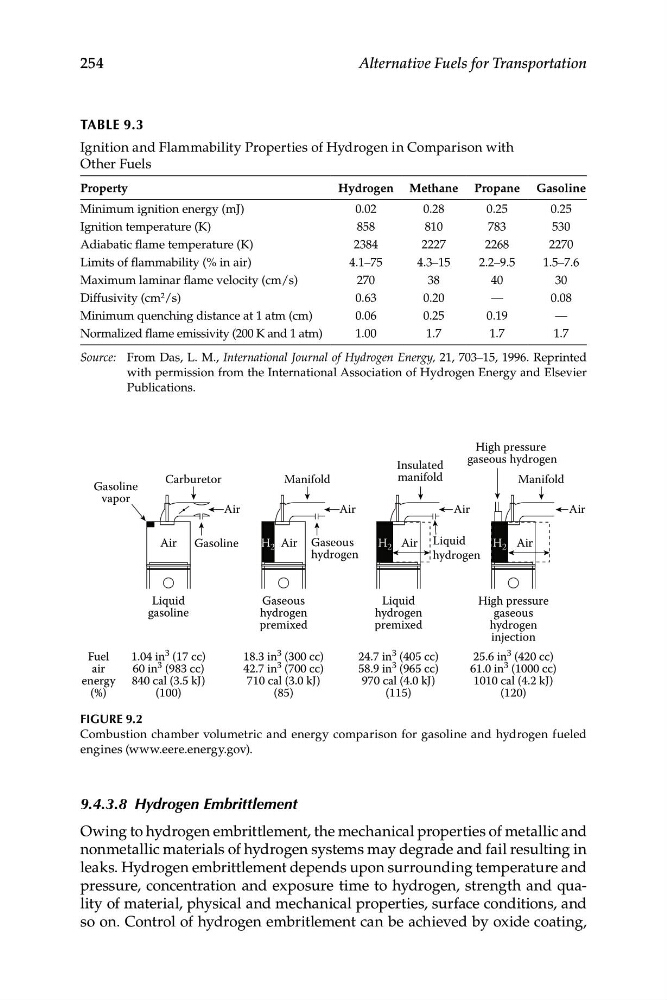
Figure 9.2
Combustion chamber volumetric and energy comparison for gasoline and hydrogen fueled
engines (www.eere.energy.gov).
9.4.3.8 Hydrogen Embrittlement
Owing to hydrogen embrittlement, the mechanical properties of metallic and
nonmetallic materials of hydrogen systems may degrade and fail resulting in
leaks. Hydrogen embrittlement depends upon surrounding temperature and
pressure, concentration and exposure time to hydrogen, strength and quality of material, physical and mechanical properties, surface conditions, and
so on. Control of hydrogen embritlement can be achieved by oxide coating,
Hydrogen Methane Propane Gasoline
Minimum ignition energy (mJ)
0.02
0.28
0.25
0.25
Ignition temperature (K)
858
810
783
530
Adiabatic flame temperature (K)
2384
2227
2268
2270
Limits of flammability (% in air)
4.1–75
4.3–15
2.2–9.5
1.5–7.6
Maximum laminar flame velocity (cm/s)
270
38
40
30
Diffusivity (cm 2 /s)
0.63
0.20
—
0.08
Minimum quenching distance at 1 atm (cm)
0.06
0.25
0.19
—
Normalized flame emissivity (200 K and 1 atm)
1.00
1.7
1.7
1.7
254
Alternative Fuels for Transportation
TABLe 9.3
Ignition and Flammability Properties of Hydrogen in Comparison with
Other Fuels
Source: From Das, L. M., International Journal of Hydrogen Energy, 21, 703–15, 1996. Reprinted
with permission from the International Association of Hydrogen Energy and Elsevier
Publications.
Carburetor
Manifold
Manifold
manifold
Gasoline
Liquid
hydrogen
Gaseous
hydrogen
Air
Air
Air
Air
H 2
H 2
Air
Air
A ir
Liquid
gasoline
1.04 in 3 (17 cc)
60 in 3 (983 cc)
840 cal (3.5 kJ)
(100)
18.3 in
3 (300 cc)
42.7 in 3 (700 cc)
710 cal (3.0 kJ)
(85)
24.7 in
3 (405 cc)
58.9 in 3 (965 cc)
970 cal (4.0 kJ)
(115)
25.6 in
3 (420 cc)
61.0 in 3 (1000 cc)
1010 cal (4.2 kJ)
(120)
Gaseous
hydrogen
premixed
Liquid
hydrogen
premixed
High pressure
gaseous
hydrogen
injection
H 2
Gasoline
vapor
Fuel
air
energy
(%)
High pressure
gaseous hydrogen
Insulated
A ir
Figure 9.2
Combustion chamber volumetric and energy comparison for gasoline and hydrogen fueled
engines (www.eere.energy.gov).
9.4.3.8 Hydrogen Embrittlement
Owing to hydrogen embrittlement, the mechanical properties of metallic and
nonmetallic materials of hydrogen systems may degrade and fail resulting in
leaks. Hydrogen embrittlement depends upon surrounding temperature and
pressure, concentration and exposure time to hydrogen, strength and quality of material, physical and mechanical properties, surface conditions, and
so on. Control of hydrogen embritlement can be achieved by oxide coating,