

198
Alternative Fuels for Transportation
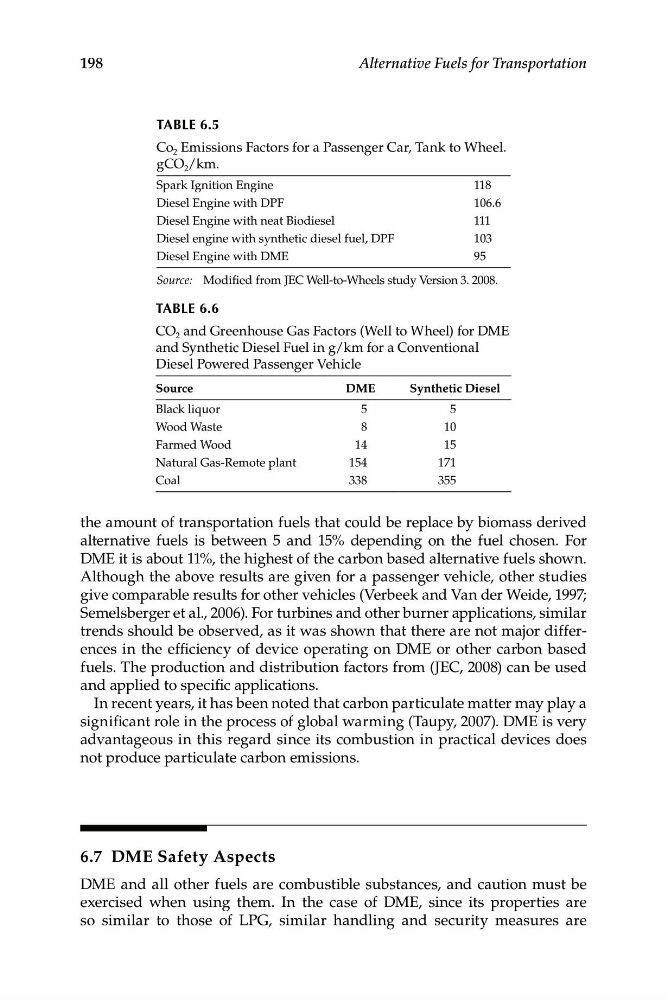
TABLe 6.5
Co 2 Emissions Factors for a Passenger Car, Tank to Wheel.
gCO 2 /km.
Spark Ignition Engine
118
Diesel Engine with DPF
106.6
Diesel Engine with neat Biodiesel
111
Diesel engine with synthetic diesel fuel, DPF
103
Diesel Engine with DME
95
Source: Modified from JEC Well-to-Wheels study Version 3. 2008.
TABLe 6.6
CO 2 and Greenhouse Gas Factors (Well to Wheel) for DME
and Synthetic Diesel Fuel in g/km for a Conventional
Diesel Powered Passenger Vehicle
Source
DME
Synthetic Diesel
Black liquor
5
5
Wood Waste
8
10
Farmed Wood
14
15
Natural Gas-Remote plant
154
171
Coal
338
355
the amount of transportation fuels that could be replace by biomass derived
alternative fuels is between 5 and 15% depending on the fuel chosen. For
DME it is about 11%, the highest of the carbon based alternative fuels shown.
Although the above results are given for a passenger vehicle, other studies
give comparable results for other vehicles (Verbeek and Van der Weide, 1997;
Semelsberger et al., 2006). For turbines and other burner applications, similar
trends should be observed, as it was shown that there are not major differences in the efficiency of device operating on DME or other carbon based
fuels. The production and distribution factors from (JEC, 2008) can be used
and applied to specific applications.
In recent years, it has been noted that carbon particulate matter may play a
significant role in the process of global warming (Taupy, 2007). DME is very
advantageous in this regard since its combustion in practical devices does
not produce particulate carbon emissions.
6.7 DME Safety Aspects
DME and all other fuels are combustible substances, and caution must be
exercised when using them. In the case of DME, since its properties are
so similar to those of LPG, similar handling and security measures are
Alternative Fuels for Transportation
TABLe 6.5
Co 2 Emissions Factors for a Passenger Car, Tank to Wheel.
gCO 2 /km.
Spark Ignition Engine
118
Diesel Engine with DPF
106.6
Diesel Engine with neat Biodiesel
111
Diesel engine with synthetic diesel fuel, DPF
103
Diesel Engine with DME
95
Source: Modified from JEC Well-to-Wheels study Version 3. 2008.
TABLe 6.6
CO 2 and Greenhouse Gas Factors (Well to Wheel) for DME
and Synthetic Diesel Fuel in g/km for a Conventional
Diesel Powered Passenger Vehicle
Source
DME
Synthetic Diesel
Black liquor
5
5
Wood Waste
8
10
Farmed Wood
14
15
Natural Gas-Remote plant
154
171
Coal
338
355
the amount of transportation fuels that could be replace by biomass derived
alternative fuels is between 5 and 15% depending on the fuel chosen. For
DME it is about 11%, the highest of the carbon based alternative fuels shown.
Although the above results are given for a passenger vehicle, other studies
give comparable results for other vehicles (Verbeek and Van der Weide, 1997;
Semelsberger et al., 2006). For turbines and other burner applications, similar
trends should be observed, as it was shown that there are not major differences in the efficiency of device operating on DME or other carbon based
fuels. The production and distribution factors from (JEC, 2008) can be used
and applied to specific applications.
In recent years, it has been noted that carbon particulate matter may play a
significant role in the process of global warming (Taupy, 2007). DME is very
advantageous in this regard since its combustion in practical devices does
not produce particulate carbon emissions.
6.7 DME Safety Aspects
DME and all other fuels are combustible substances, and caution must be
exercised when using them. In the case of DME, since its properties are
so similar to those of LPG, similar handling and security measures are