

DME
Synthetic Diesel
Source
GHG
CO 2
GHG
CO 2
Natural Gas-Remote plant
21.1
18.0
22.5
19.1
Natural Gas-Remote plant CO 2 capture
11.1
8.1
13.2
9.7
Wood Waste
4.6
4.3
4.8
4.6
Farmed Wood
6.5
4.1
6.9
4.3
Black Liquor
2.2
2.1
2.4
2.4
Source: Modified from JEC Well-to-Wheels study Version 3. 2008.
Note: GHG = Green House Gas Equivalent.
197
Dimethyl Ether
6.6 Greenhouse Gas Emissions
When DME burns in a combustion device, it produces CO 2 , just like any
other carbon containing fuel. There are many aspects involved in the CO 2
production and use of a fuel, and in order to compare fuel and feedstocks,
a well-to-wheel approach is needed. A life cycle analysis of many alternate
fuels was performed by the European automobile and fuel industry, in conjunction with the European Union (JEC, 2008) using alternative fuels with a
light duty vehicle. Two factors are involved, the first the production of the
fuel (well to tank) and the second the use of the fuel in the vehicle (tank to
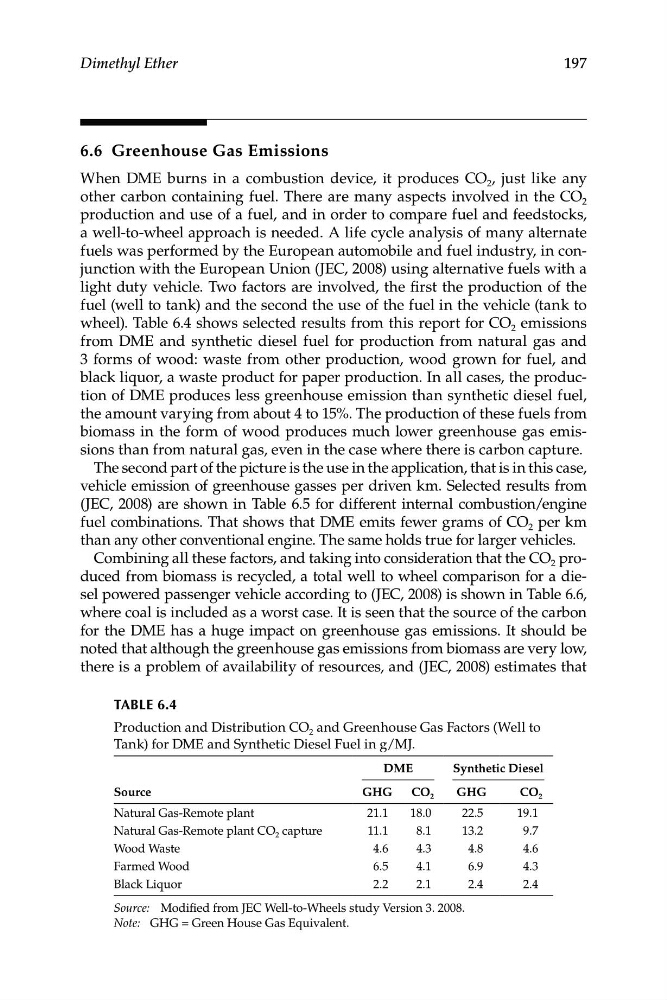
wheel). Table 6.4 shows selected results from this report for CO 2 emissions
from DME and synthetic diesel fuel for production from natural gas and
3 forms of wood: waste from other production, wood grown for fuel, and
black liquor, a waste product for paper production. In all cases, the production of DME produces less greenhouse emission than synthetic diesel fuel,
the amount varying from about 4 to 15%. The production of these fuels from
biomass in the form of wood produces much lower greenhouse gas emissions than from natural gas, even in the case where there is carbon capture.
The second part of the picture is the use in the application, that is in this case,
vehicle emission of greenhouse gasses per driven km. Selected results from
(JEC, 2008) are shown in Table 6.5 for different internal combustion/engine
fuel combinations. That shows that DME emits fewer grams of CO 2 per km
than any other conventional engine. The same holds true for larger vehicles.
Combining all these factors, and taking into consideration that the CO 2 produced from biomass is recycled, a total well to wheel comparison for a diesel powered passenger vehicle according to (JEC, 2008) is shown in Table 6.6,
where coal is included as a worst case. It is seen that the source of the carbon
for the DME has a huge impact on greenhouse gas emissions. It should be
noted that although the greenhouse gas emissions from biomass are very low,
there is a problem of availability of resources, and (JEC, 2008) estimates that
TABLe 6.4
Production and Distribution CO 2 and Greenhouse Gas Factors (Well to
Tank) for DME and Synthetic Diesel Fuel in g/MJ.
Synthetic Diesel
Source
GHG
CO 2
GHG
CO 2
Natural Gas-Remote plant
21.1
18.0
22.5
19.1
Natural Gas-Remote plant CO 2 capture
11.1
8.1
13.2
9.7
Wood Waste
4.6
4.3
4.8
4.6
Farmed Wood
6.5
4.1
6.9
4.3
Black Liquor
2.2
2.1
2.4
2.4
Source: Modified from JEC Well-to-Wheels study Version 3. 2008.
Note: GHG = Green House Gas Equivalent.
197
Dimethyl Ether
6.6 Greenhouse Gas Emissions
When DME burns in a combustion device, it produces CO 2 , just like any
other carbon containing fuel. There are many aspects involved in the CO 2
production and use of a fuel, and in order to compare fuel and feedstocks,
a well-to-wheel approach is needed. A life cycle analysis of many alternate
fuels was performed by the European automobile and fuel industry, in conjunction with the European Union (JEC, 2008) using alternative fuels with a
light duty vehicle. Two factors are involved, the first the production of the
fuel (well to tank) and the second the use of the fuel in the vehicle (tank to
wheel). Table 6.4 shows selected results from this report for CO 2 emissions
from DME and synthetic diesel fuel for production from natural gas and
3 forms of wood: waste from other production, wood grown for fuel, and
black liquor, a waste product for paper production. In all cases, the production of DME produces less greenhouse emission than synthetic diesel fuel,
the amount varying from about 4 to 15%. The production of these fuels from
biomass in the form of wood produces much lower greenhouse gas emissions than from natural gas, even in the case where there is carbon capture.
The second part of the picture is the use in the application, that is in this case,
vehicle emission of greenhouse gasses per driven km. Selected results from
(JEC, 2008) are shown in Table 6.5 for different internal combustion/engine
fuel combinations. That shows that DME emits fewer grams of CO 2 per km
than any other conventional engine. The same holds true for larger vehicles.
Combining all these factors, and taking into consideration that the CO 2 produced from biomass is recycled, a total well to wheel comparison for a diesel powered passenger vehicle according to (JEC, 2008) is shown in Table 6.6,
where coal is included as a worst case. It is seen that the source of the carbon
for the DME has a huge impact on greenhouse gas emissions. It should be
noted that although the greenhouse gas emissions from biomass are very low,
there is a problem of availability of resources, and (JEC, 2008) estimates that
TABLe 6.4
Production and Distribution CO 2 and Greenhouse Gas Factors (Well to
Tank) for DME and Synthetic Diesel Fuel in g/MJ.