

178
Alternative Fuels for Transportation
It is seen that conversion of both DME and methanol is best at lower temperatures and higher pressures. But the temperatures in actual systems must
not be too low, or else reaction rates will be too slow and the products will be
far from the equilibrium condition. In practice, the higher the temperatures,
the closer the reaction comes to equilibrium, but the lower the equilibrium
conversion rate. So a compromise temperature must be found. The conversion of syngas to DME is much higher than that of methanol at lower pressures, which could be considered an advantage to the direct process, as the
reactor need not be pressurized as high for making DME. The lower pressure
may, though, result in lower reaction rates. A lower reactor pressure would
lower construction and investment costs, though the economic analysis later
will show that the major cost is that of the feedstock when using natural gas.
Temperatures on the order of 260–280°C and pressures between 50 and 80
bar are seen in practice for the achievement of useful reaction rates.
The effectiveness of the conversion of syngas to DME or methanol also
depends on the ratio of hydrogen to carbon monoxide in the DME reactor.
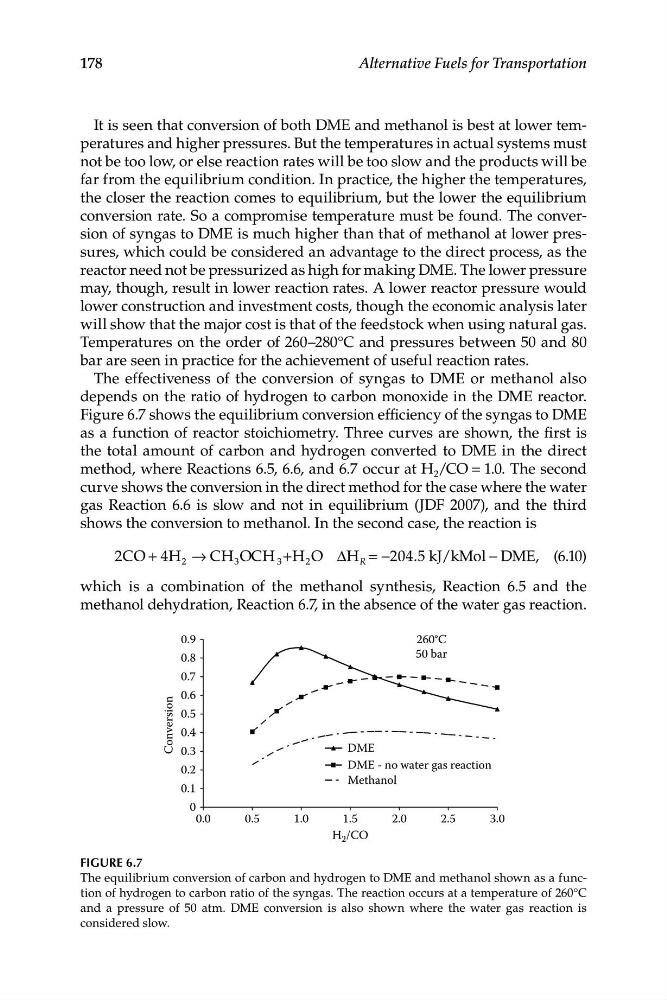
Figure 6.7 shows the equilibrium conversion efficiency of the syngas to DME
as a function of reactor stoichiometry. Three curves are shown, the first is
the total amount of carbon and hydrogen converted to DME in the direct
method, where Reactions 6.5, 6.6, and 6.7 occur at H 2 /CO = 1.0. The second
curve shows the conversion in the direct method for the case where the water
gas Reaction 6.6 is slow and not in equilibrium (JDF 2007), and the third
shows the conversion to methanol. In the second case, the reaction is
2CO + 4H → CH OCH +H O ∆H =−
. k J/kMol − DME,
204 5
(6.10)
2
3
3
2
R
which is a combination of the methanol synthesis, Reaction 6.5 and the
methanol dehydration, Reaction 6.7, in the absence of the water gas reaction.
260°C
50 bar
0
0.1
0.2
0.3
0.4
0.5
0.6
0.7
0.8
0.9
Conversion
DME
DME - no water gas reaction
Methanol
0.0
0.5
1.0
1.5
2 .0
2.5
3 .0
H 2 /CO
Figure 6.7
The equilibrium conversion of carbon and hydrogen to DME and methanol shown as a function of hydrogen to carbon ratio of the syngas. The reaction occurs at a temperature of 260°C
and a pressure of 50 atm. DME conversion is also shown where the water gas reaction is
considered slow.
Alternative Fuels for Transportation
It is seen that conversion of both DME and methanol is best at lower temperatures and higher pressures. But the temperatures in actual systems must
not be too low, or else reaction rates will be too slow and the products will be
far from the equilibrium condition. In practice, the higher the temperatures,
the closer the reaction comes to equilibrium, but the lower the equilibrium
conversion rate. So a compromise temperature must be found. The conversion of syngas to DME is much higher than that of methanol at lower pressures, which could be considered an advantage to the direct process, as the
reactor need not be pressurized as high for making DME. The lower pressure
may, though, result in lower reaction rates. A lower reactor pressure would
lower construction and investment costs, though the economic analysis later
will show that the major cost is that of the feedstock when using natural gas.
Temperatures on the order of 260–280°C and pressures between 50 and 80
bar are seen in practice for the achievement of useful reaction rates.
The effectiveness of the conversion of syngas to DME or methanol also
depends on the ratio of hydrogen to carbon monoxide in the DME reactor.
Figure 6.7 shows the equilibrium conversion efficiency of the syngas to DME
as a function of reactor stoichiometry. Three curves are shown, the first is
the total amount of carbon and hydrogen converted to DME in the direct
method, where Reactions 6.5, 6.6, and 6.7 occur at H 2 /CO = 1.0. The second
curve shows the conversion in the direct method for the case where the water
gas Reaction 6.6 is slow and not in equilibrium (JDF 2007), and the third
shows the conversion to methanol. In the second case, the reaction is
2CO + 4H → CH OCH +H O ∆H =−
. k J/kMol − DME,
204 5
(6.10)
2
3
3
2
R
which is a combination of the methanol synthesis, Reaction 6.5 and the
methanol dehydration, Reaction 6.7, in the absence of the water gas reaction.
260°C
50 bar
0
0.1
0.2
0.3
0.4
0.5
0.6
0.7
0.8
0.9
Conversion
DME
DME - no water gas reaction
Methanol
0.0
0.5
1.0
1.5
2 .0
2.5
3 .0
H 2 /CO
Figure 6.7
The equilibrium conversion of carbon and hydrogen to DME and methanol shown as a function of hydrogen to carbon ratio of the syngas. The reaction occurs at a temperature of 260°C
and a pressure of 50 atm. DME conversion is also shown where the water gas reaction is
considered slow.