

Conversion
1.0
0.9
0.8
0.7
0.6
0.5
0.4
0.3
0.2
0.1
0.0
0
10
20
30
40
50
60
70
80
90
Pressure - atmosphere
DME - 240°C
DME - 270°C
DME - 300°C
MeOH - 240°C
MeOH - 270°C
MeOH - 300°C
177
Dimethyl Ether
under ideal circumstances. When the efficiencies of the various processes
involved in a production plant and the recovery of process energy are taken
into account, an actual overall process efficiency of about 71% is achievable
using natural gas as a feedstock in large scale DME production (Hansen
et al. 1995). A cold gas efficiency of 68% has been achieved in testing on a
pilot plant scale of 100 tons/day. Scaled up to full size, this gives an efficiency
of about 72% (JDF 2007). The scale is on the order of 5000–7000 tons of DME
per day through a single reactor. A limiting factor in the maximum size of
a DME or methanol production string is the size of the autothermal reactor.
The unit has a high thermal loading, and durability is determined by its
size. Similarly, technical limitations on the gasifier with coal feedstock result
in similar optimum capacities for production of DME. Production facilities
at one location for producing more DME would most likely make use of multiple product streams, each with its separate autothermal reactor or gasifier.
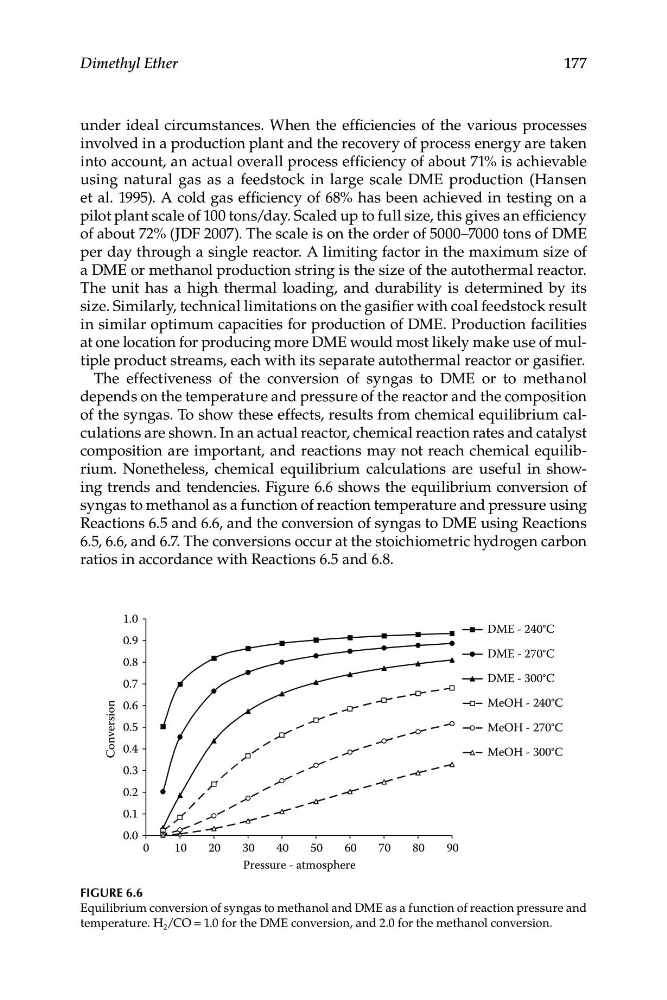
The effectiveness of the conversion of syngas to DME or to methanol
depends on the temperature and pressure of the reactor and the composition
of the syngas. To show these effects, results from chemical equilibrium calculations are shown. In an actual reactor, chemical reaction rates and catalyst
composition are important, and reactions may not reach chemical equilibrium. Nonetheless, chemical equilibrium calculations are useful in showing trends and tendencies. Figure 6.6 shows the equilibrium conversion of
syngas to methanol as a function of reaction temperature and pressure using
Reactions 6.5 and 6.6, and the conversion of syngas to DME using Reactions
6.5, 6.6, and 6.7. The conversions occur at the stoichiometric hydrogen carbon
ratios in accordance with Reactions 6.5 and 6.8.
Figure 6.6
Equilibrium conversion of syngas to methanol and DME as a function of reaction pressure and
temperature. H 2 /CO = 1.0 for the DME conversion, and 2.0 for the methanol conversion.
1.0
0.9
0.8
0.7
0.6
0.5
0.4
0.3
0.2
0.1
0.0
0
10
20
30
40
50
60
70
80
90
Pressure - atmosphere
DME - 240°C
DME - 270°C
DME - 300°C
MeOH - 240°C
MeOH - 270°C
MeOH - 300°C
177
Dimethyl Ether
under ideal circumstances. When the efficiencies of the various processes
involved in a production plant and the recovery of process energy are taken
into account, an actual overall process efficiency of about 71% is achievable
using natural gas as a feedstock in large scale DME production (Hansen
et al. 1995). A cold gas efficiency of 68% has been achieved in testing on a
pilot plant scale of 100 tons/day. Scaled up to full size, this gives an efficiency
of about 72% (JDF 2007). The scale is on the order of 5000–7000 tons of DME
per day through a single reactor. A limiting factor in the maximum size of
a DME or methanol production string is the size of the autothermal reactor.
The unit has a high thermal loading, and durability is determined by its
size. Similarly, technical limitations on the gasifier with coal feedstock result
in similar optimum capacities for production of DME. Production facilities
at one location for producing more DME would most likely make use of multiple product streams, each with its separate autothermal reactor or gasifier.
The effectiveness of the conversion of syngas to DME or to methanol
depends on the temperature and pressure of the reactor and the composition
of the syngas. To show these effects, results from chemical equilibrium calculations are shown. In an actual reactor, chemical reaction rates and catalyst
composition are important, and reactions may not reach chemical equilibrium. Nonetheless, chemical equilibrium calculations are useful in showing trends and tendencies. Figure 6.6 shows the equilibrium conversion of
syngas to methanol as a function of reaction temperature and pressure using
Reactions 6.5 and 6.6, and the conversion of syngas to DME using Reactions
6.5, 6.6, and 6.7. The conversions occur at the stoichiometric hydrogen carbon
ratios in accordance with Reactions 6.5 and 6.8.
Figure 6.6
Equilibrium conversion of syngas to methanol and DME as a function of reaction pressure and
temperature. H 2 /CO = 1.0 for the DME conversion, and 2.0 for the methanol conversion.