

170
Alternative Fuels for Transportation
TABLe 6.1
Properties of DME
Property
DME
Diesel
Chemical formula
CH 3 OCH 3
CH 1.8
Molecular weight
46
200–300
Oxygen content: mass %
34.8
0
Stoichiometric air fuel ratio: kg/kg
9.1
≈ 14.8
Liquid density: g/ml @ 15°C
0.668
≈ 0.84
Lower heating value: kJ/kg-fuel
28,800
≈ 42,500
Lower heating value: kJ/liter
≈ 15,400 a
≈ 37,500
Lower heating value: kJ/kg-air at
stoichiometric fuel air ratio
3165
≈ 2871
Boiling Point: °C
–24.9
Range 200–380
Lower heating value: kJ/kg
28,800
≈ 42,500
Viscosity: kg/m-s @ 25°C kg/m-s
0.125
2–4
Vapor pressure @ 25°C: bar
5.1
«1.0
Critical pressure: atm
52
≈ 25
Critical temperature: °C
127
250
Ignition temperature: °C
235
≈ 250
Explosive limits: vol. % in air
3.4–17
≈ 0.5–7
a Assuming a maximum liquid volume of 80% in a tank to allow for expansion
with temperature increase.
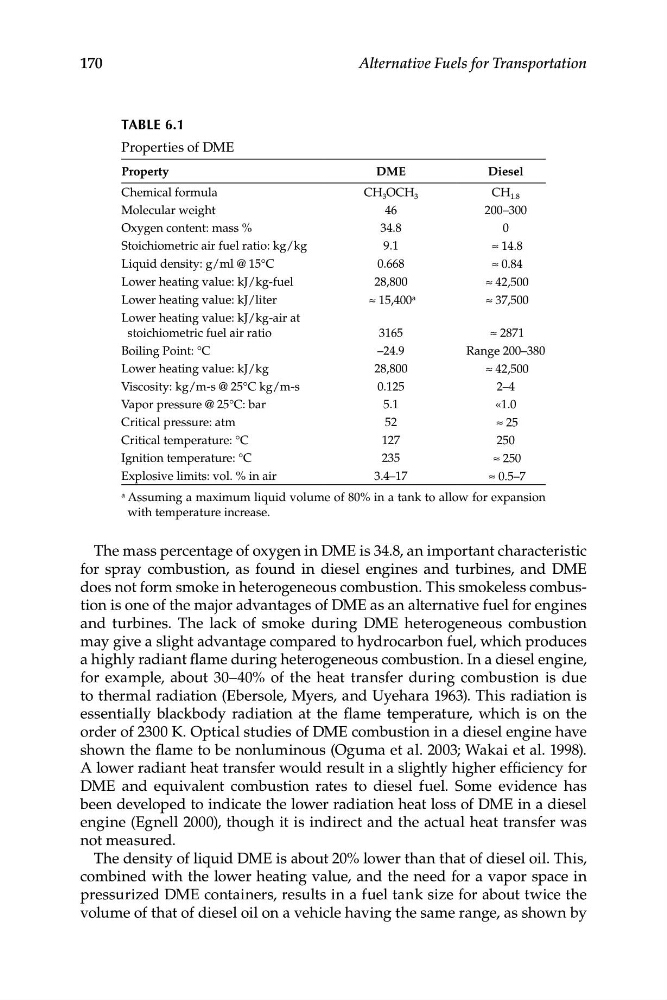
The mass percentage of oxygen in DME is 34.8, an important characteristic
for spray combustion, as found in diesel engines and turbines, and DME
does not form smoke in heterogeneous combustion. This smokeless combustion is one of the major advantages of DME as an alternative fuel for engines
and turbines. The lack of smoke during DME heterogeneous combustion
may give a slight advantage compared to hydrocarbon fuel, which produces
a highly radiant flame during heterogeneous combustion. In a diesel engine,
for example, about 30–40% of the heat transfer during combustion is due
to thermal radiation (Ebersole, Myers, and Uyehara 1963). This radiation is
essentially blackbody radiation at the flame temperature, which is on the
order of 2300 K. Optical studies of DME combustion in a diesel engine have
shown the flame to be nonluminous (Oguma et al. 2003; Wakai et al. 1998).
A lower radiant heat transfer would result in a slightly higher efficiency for
DME and equivalent combustion rates to diesel fuel. Some evidence has
been developed to indicate the lower radiation heat loss of DME in a diesel
engine (Egnell 2000), though it is indirect and the actual heat transfer was
not measured.
The density of liquid DME is about 20% lower than that of diesel oil. This,
combined with the lower heating value, and the need for a vapor space in
pressurized DME containers, results in a fuel tank size for about twice the
volume of that of diesel oil on a vehicle having the same range, as shown by
Alternative Fuels for Transportation
TABLe 6.1
Properties of DME
Property
DME
Diesel
Chemical formula
CH 3 OCH 3
CH 1.8
Molecular weight
46
200–300
Oxygen content: mass %
34.8
0
Stoichiometric air fuel ratio: kg/kg
9.1
≈ 14.8
Liquid density: g/ml @ 15°C
0.668
≈ 0.84
Lower heating value: kJ/kg-fuel
28,800
≈ 42,500
Lower heating value: kJ/liter
≈ 15,400 a
≈ 37,500
Lower heating value: kJ/kg-air at
stoichiometric fuel air ratio
3165
≈ 2871
Boiling Point: °C
–24.9
Range 200–380
Lower heating value: kJ/kg
28,800
≈ 42,500
Viscosity: kg/m-s @ 25°C kg/m-s
0.125
2–4
Vapor pressure @ 25°C: bar
5.1
«1.0
Critical pressure: atm
52
≈ 25
Critical temperature: °C
127
250
Ignition temperature: °C
235
≈ 250
Explosive limits: vol. % in air
3.4–17
≈ 0.5–7
a Assuming a maximum liquid volume of 80% in a tank to allow for expansion
with temperature increase.
The mass percentage of oxygen in DME is 34.8, an important characteristic
for spray combustion, as found in diesel engines and turbines, and DME
does not form smoke in heterogeneous combustion. This smokeless combustion is one of the major advantages of DME as an alternative fuel for engines
and turbines. The lack of smoke during DME heterogeneous combustion
may give a slight advantage compared to hydrocarbon fuel, which produces
a highly radiant flame during heterogeneous combustion. In a diesel engine,
for example, about 30–40% of the heat transfer during combustion is due
to thermal radiation (Ebersole, Myers, and Uyehara 1963). This radiation is
essentially blackbody radiation at the flame temperature, which is on the
order of 2300 K. Optical studies of DME combustion in a diesel engine have
shown the flame to be nonluminous (Oguma et al. 2003; Wakai et al. 1998).
A lower radiant heat transfer would result in a slightly higher efficiency for
DME and equivalent combustion rates to diesel fuel. Some evidence has
been developed to indicate the lower radiation heat loss of DME in a diesel
engine (Egnell 2000), though it is indirect and the actual heat transfer was
not measured.
The density of liquid DME is about 20% lower than that of diesel oil. This,
combined with the lower heating value, and the need for a vapor space in
pressurized DME containers, results in a fuel tank size for about twice the
volume of that of diesel oil on a vehicle having the same range, as shown by