

169
Dimethyl Ether
0
5
10
15
20
–30 –20 –10 0
10 20 30 40 50 60 70
Vapor pressure - atm.
Temperature - °C
Figure 6.2
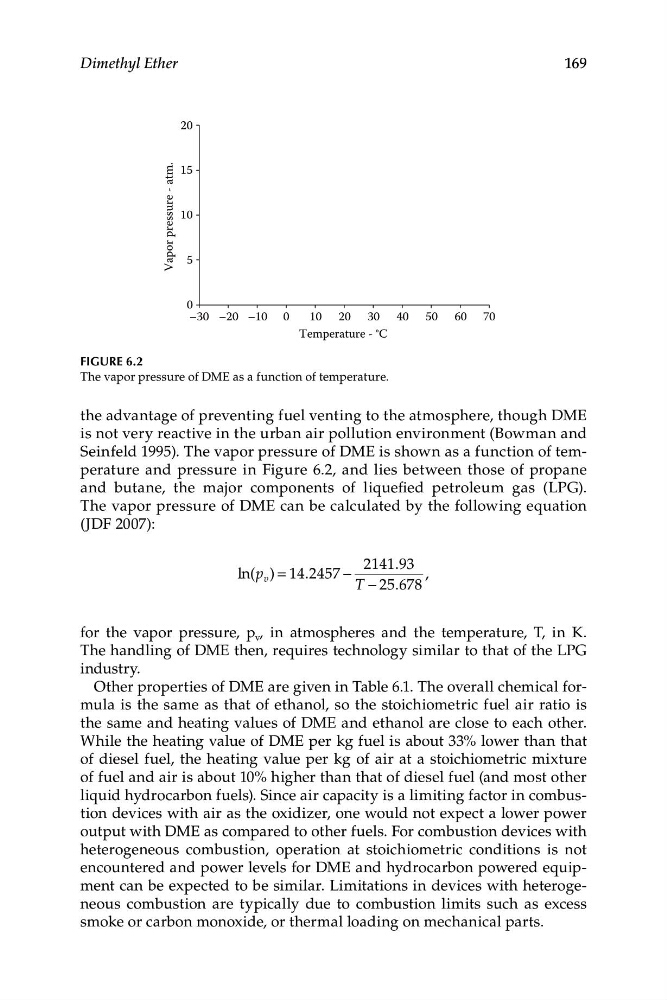
The vapor pressure of DME as a function of temperature.
the advantage of preventing fuel venting to the atmosphere, though DME
is not very reactive in the urban air pollution environment (Bowman and
Seinfeld 1995). The vapor pressure of DME is shown as a function of temperature and pressure in Figure 6.2, and lies between those of propane
and butane, the major components of liquefied petroleum gas (LPG).
The vapor pressure of DME can be calculated by the following equation
(JDF 2007):
.
2141 93
ln( )
v = 14 2457
.
p
−
,
T − .
25 678
for the vapor pressure, p v , in atmospheres and the temperature, T, in K.
The handling of DME then, requires technology similar to that of the LPG
industry.
Other properties of DME are given in Table 6.1. The overall chemical formula is the same as that of ethanol, so the stoichiometric fuel air ratio is
the same and heating values of DME and ethanol are close to each other.
While the heating value of DME per kg fuel is about 33% lower than that
of diesel fuel, the heating value per kg of air at a stoichiometric mixture
of fuel and air is about 10% higher than that of diesel fuel (and most other
liquid hydrocarbon fuels). Since air capacity is a limiting factor in combustion devices with air as the oxidizer, one would not expect a lower power
output with DME as compared to other fuels. For combustion devices with
heterogeneous combustion, operation at stoichiometric conditions is not
encountered and power levels for DME and hydrocarbon powered equipment can be expected to be similar. Limitations in devices with heterogeneous combustion are typically due to combustion limits such as excess
smoke or carbon monoxide, or thermal loading on mechanical parts.
Dimethyl Ether
0
5
10
15
20
–30 –20 –10 0
10 20 30 40 50 60 70
Vapor pressure - atm.
Temperature - °C
Figure 6.2
The vapor pressure of DME as a function of temperature.
the advantage of preventing fuel venting to the atmosphere, though DME
is not very reactive in the urban air pollution environment (Bowman and
Seinfeld 1995). The vapor pressure of DME is shown as a function of temperature and pressure in Figure 6.2, and lies between those of propane
and butane, the major components of liquefied petroleum gas (LPG).
The vapor pressure of DME can be calculated by the following equation
(JDF 2007):
.
2141 93
ln( )
v = 14 2457
.
p
−
,
T − .
25 678
for the vapor pressure, p v , in atmospheres and the temperature, T, in K.
The handling of DME then, requires technology similar to that of the LPG
industry.
Other properties of DME are given in Table 6.1. The overall chemical formula is the same as that of ethanol, so the stoichiometric fuel air ratio is
the same and heating values of DME and ethanol are close to each other.
While the heating value of DME per kg fuel is about 33% lower than that
of diesel fuel, the heating value per kg of air at a stoichiometric mixture
of fuel and air is about 10% higher than that of diesel fuel (and most other
liquid hydrocarbon fuels). Since air capacity is a limiting factor in combustion devices with air as the oxidizer, one would not expect a lower power
output with DME as compared to other fuels. For combustion devices with
heterogeneous combustion, operation at stoichiometric conditions is not
encountered and power levels for DME and hydrocarbon powered equipment can be expected to be similar. Limitations in devices with heterogeneous combustion are typically due to combustion limits such as excess
smoke or carbon monoxide, or thermal loading on mechanical parts.