

152
Alternative Fuels for Transportation
TABLe 5.6
Maximum Power Engine Performance on Diesel Fuel and Enhanced Ethanol
Parameter
D2 a
EE b
Engine speed, rpm
2113
2149
Power, kW
107
63
Fuel consumption, kg/h
28.2
29.3
A/F ratio
24.4
21.1
Indicated thermal efficiency, %
39
44
Brake thermal efficiency, %
32
29
BSFC, g/kW.h
265
466
Ignition delay, crankshaft degrees
3.50
7.00
Start of combustion, deg. before HDC
14
8
Peak combustion pressure, MPa
11.2
8.6
Max. rate of pressure rise, kPa/degrees
466
487
Maximum rate of heat release, kJ/degrees
80.9
118.1
Bosch smoke number
2.4
0
Source: From Goering, C. E., Crowell, T. J., Savage, L. D., Griffith, D. R., and Jarrett, M. W.,
ASABE Transactions, 35, 423–28, 1992.
a Original setting of injector pump.
b Injector pump reset for increased delivery.
Air temperature, 22–23°C.
Barometric pressure, 98.4–99.2 kPa.
Goering et al. (1992) used the IH tractor to evaluate the performance of
ethanol with 4% Avocet compared to the performance of No. 2 diesel fuel.
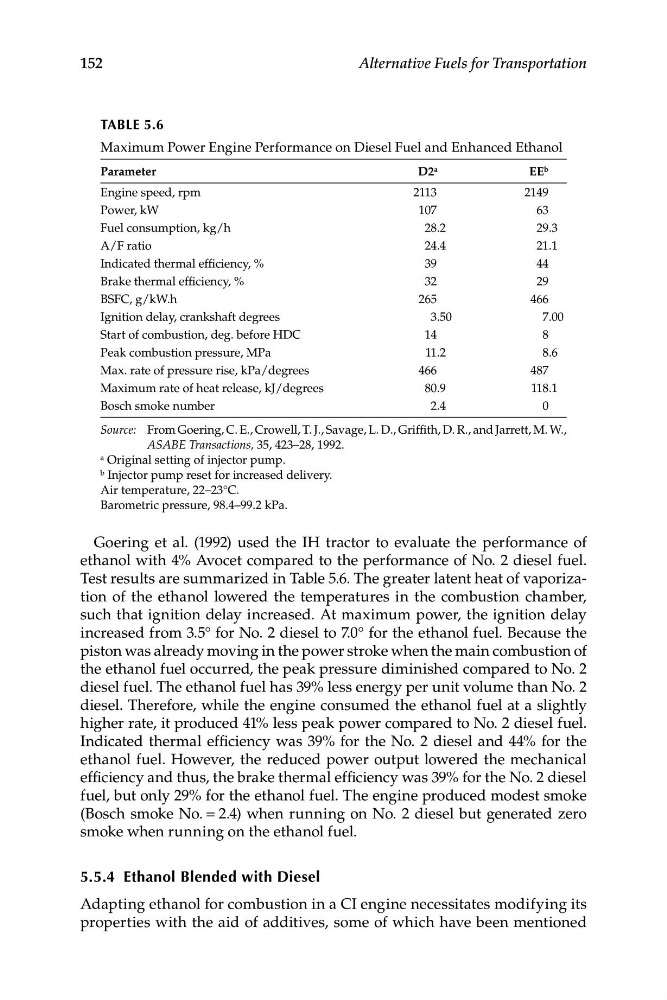
Test results are summarized in Table 5.6. The greater latent heat of vaporization of the ethanol lowered the temperatures in the combustion chamber,
such that ignition delay increased. At maximum power, the ignition delay
increased from 3.5° for No. 2 diesel to 7.0° for the ethanol fuel. Because the
piston was already moving in the power stroke when the main combustion of
the ethanol fuel occurred, the peak pressure diminished compared to No. 2
diesel fuel. The ethanol fuel has 39% less energy per unit volume than No. 2
diesel. Therefore, while the engine consumed the ethanol fuel at a slightly
higher rate, it produced 41% less peak power compared to No. 2 diesel fuel.
Indicated thermal efficiency was 39% for the No. 2 diesel and 44% for the
ethanol fuel. However, the reduced power output lowered the mechanical
efficiency and thus, the brake thermal efficiency was 39% for the No. 2 diesel
fuel, but only 29% for the ethanol fuel. The engine produced modest smoke
(Bosch smoke No. = 2.4) when running on No. 2 diesel but generated zero
smoke when running on the ethanol fuel.
5.5.4 ethanol Blended with Diesel
Adapting ethanol for combustion in a CI engine necessitates modifying its
properties with the aid of additives, some of which have been mentioned
Alternative Fuels for Transportation
TABLe 5.6
Maximum Power Engine Performance on Diesel Fuel and Enhanced Ethanol
Parameter
D2 a
EE b
Engine speed, rpm
2113
2149
Power, kW
107
63
Fuel consumption, kg/h
28.2
29.3
A/F ratio
24.4
21.1
Indicated thermal efficiency, %
39
44
Brake thermal efficiency, %
32
29
BSFC, g/kW.h
265
466
Ignition delay, crankshaft degrees
3.50
7.00
Start of combustion, deg. before HDC
14
8
Peak combustion pressure, MPa
11.2
8.6
Max. rate of pressure rise, kPa/degrees
466
487
Maximum rate of heat release, kJ/degrees
80.9
118.1
Bosch smoke number
2.4
0
Source: From Goering, C. E., Crowell, T. J., Savage, L. D., Griffith, D. R., and Jarrett, M. W.,
ASABE Transactions, 35, 423–28, 1992.
a Original setting of injector pump.
b Injector pump reset for increased delivery.
Air temperature, 22–23°C.
Barometric pressure, 98.4–99.2 kPa.
Goering et al. (1992) used the IH tractor to evaluate the performance of
ethanol with 4% Avocet compared to the performance of No. 2 diesel fuel.
Test results are summarized in Table 5.6. The greater latent heat of vaporization of the ethanol lowered the temperatures in the combustion chamber,
such that ignition delay increased. At maximum power, the ignition delay
increased from 3.5° for No. 2 diesel to 7.0° for the ethanol fuel. Because the
piston was already moving in the power stroke when the main combustion of
the ethanol fuel occurred, the peak pressure diminished compared to No. 2
diesel fuel. The ethanol fuel has 39% less energy per unit volume than No. 2
diesel. Therefore, while the engine consumed the ethanol fuel at a slightly
higher rate, it produced 41% less peak power compared to No. 2 diesel fuel.
Indicated thermal efficiency was 39% for the No. 2 diesel and 44% for the
ethanol fuel. However, the reduced power output lowered the mechanical
efficiency and thus, the brake thermal efficiency was 39% for the No. 2 diesel
fuel, but only 29% for the ethanol fuel. The engine produced modest smoke
(Bosch smoke No. = 2.4) when running on No. 2 diesel but generated zero
smoke when running on the ethanol fuel.
5.5.4 ethanol Blended with Diesel
Adapting ethanol for combustion in a CI engine necessitates modifying its
properties with the aid of additives, some of which have been mentioned