

83
Anhydrous, 0 h
Hydrated, 0 h
Hydrated, 454 h
Emissions
(ppm)
Before Cat
After Cat
Before Cat
After Cat
Before Cat
After Cat
30% Throttle
CO
995
125
133
35
1167
HC
519
75
677
76
6714
90
NO x
55
60
9
56
49
50
100% Throttle
CO
479
71
232
12
147
42
HC
203
103
149
50
186
69
NO x
82
76
75
72
78
73
Ethanol
151
TABLe 5.5
Emissions from a Detroit Diesel Engine Adapted to Run on Ethanol
Source: From Goering, C. E., Parcell, R. T., and Ritter, C. P., ASABE Transactions, 41, 1255–60, 1998.
With permission.
Note: An AC Rochester model HC-1590 HN-6941 catalytic converter was used.
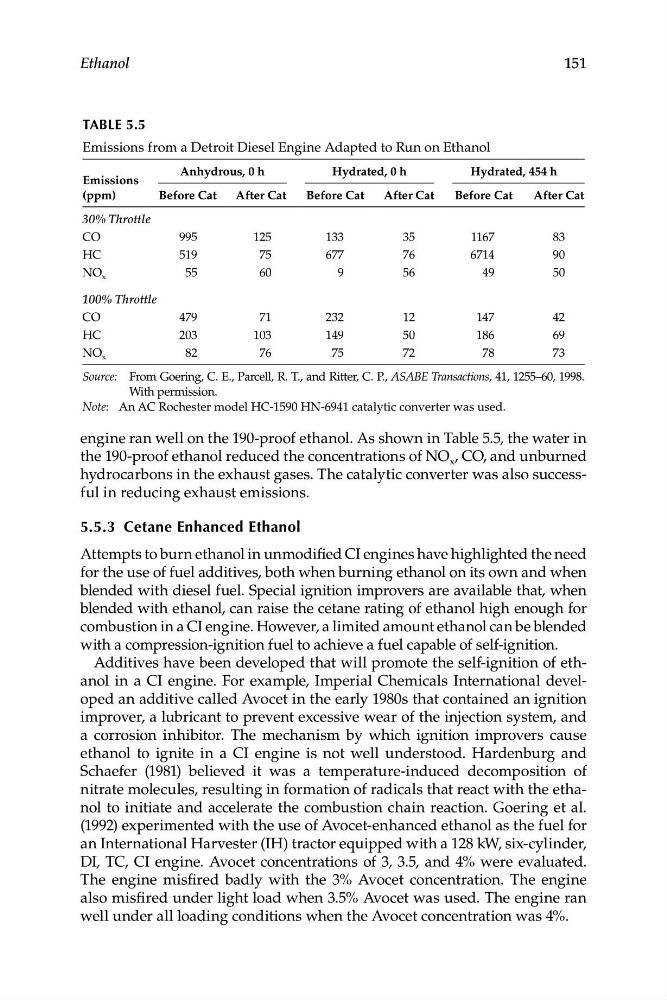
engine ran well on the 190-proof ethanol. As shown in Table 5.5, the water in
the 190-proof ethanol reduced the concentrations of NO x , CO, and unburned
hydrocarbons in the exhaust gases. The catalytic converter was also successful in reducing exhaust emissions.
5.5.3 Cetane enhanced ethanol
Attempts to burn ethanol in unmodified CI engines have highlighted the need
for the use of fuel additives, both when burning ethanol on its own and when
blended with diesel fuel. Special ignition improvers are available that, when
blended with ethanol, can raise the cetane rating of ethanol high enough for
combustion in a CI engine. However, a limited amount ethanol can be blended
with a compression-ignition fuel to achieve a fuel capable of self-ignition.
Additives have been developed that will promote the self-ignition of ethanol in a CI engine. For example, Imperial Chemicals International developed an additive called Avocet in the early 1980s that contained an ignition
improver, a lubricant to prevent excessive wear of the injection system, and
a corrosion inhibitor. The mechanism by which ignition improvers cause
ethanol to ignite in a CI engine is not well understood. Hardenburg and
Schaefer (1981) believed it was a temperature-induced decomposition of
nitrate molecules, resulting in formation of radicals that react with the ethanol to initiate and accelerate the combustion chain reaction. Goering et al.
(1992) experimented with the use of Avocet-enhanced ethanol as the fuel for
an International Harvester (IH) tractor equipped with a 128 kW, six-cylinder,
DI, TC, CI engine. Avocet concentrations of 3, 3.5, and 4% were evaluated.
The engine misfired badly with the 3% Avocet concentration. The engine
also misfired under light load when 3.5% Avocet was used. The engine ran
well under all loading conditions when the Avocet concentration was 4%.
Anhydrous, 0 h
Hydrated, 0 h
Hydrated, 454 h
Emissions
(ppm)
Before Cat
After Cat
Before Cat
After Cat
Before Cat
After Cat
30% Throttle
CO
995
125
133
35
1167
HC
519
75
677
76
6714
90
NO x
55
60
9
56
49
50
100% Throttle
CO
479
71
232
12
147
42
HC
203
103
149
50
186
69
NO x
82
76
75
72
78
73
Ethanol
151
TABLe 5.5
Emissions from a Detroit Diesel Engine Adapted to Run on Ethanol
Source: From Goering, C. E., Parcell, R. T., and Ritter, C. P., ASABE Transactions, 41, 1255–60, 1998.
With permission.
Note: An AC Rochester model HC-1590 HN-6941 catalytic converter was used.
engine ran well on the 190-proof ethanol. As shown in Table 5.5, the water in
the 190-proof ethanol reduced the concentrations of NO x , CO, and unburned
hydrocarbons in the exhaust gases. The catalytic converter was also successful in reducing exhaust emissions.
5.5.3 Cetane enhanced ethanol
Attempts to burn ethanol in unmodified CI engines have highlighted the need
for the use of fuel additives, both when burning ethanol on its own and when
blended with diesel fuel. Special ignition improvers are available that, when
blended with ethanol, can raise the cetane rating of ethanol high enough for
combustion in a CI engine. However, a limited amount ethanol can be blended
with a compression-ignition fuel to achieve a fuel capable of self-ignition.
Additives have been developed that will promote the self-ignition of ethanol in a CI engine. For example, Imperial Chemicals International developed an additive called Avocet in the early 1980s that contained an ignition
improver, a lubricant to prevent excessive wear of the injection system, and
a corrosion inhibitor. The mechanism by which ignition improvers cause
ethanol to ignite in a CI engine is not well understood. Hardenburg and
Schaefer (1981) believed it was a temperature-induced decomposition of
nitrate molecules, resulting in formation of radicals that react with the ethanol to initiate and accelerate the combustion chain reaction. Goering et al.
(1992) experimented with the use of Avocet-enhanced ethanol as the fuel for
an International Harvester (IH) tractor equipped with a 128 kW, six-cylinder,
DI, TC, CI engine. Avocet concentrations of 3, 3.5, and 4% were evaluated.
The engine misfired badly with the 3% Avocet concentration. The engine
also misfired under light load when 3.5% Avocet was used. The engine ran
well under all loading conditions when the Avocet concentration was 4%.