

Ethanol
nozzle
Air
intake
Combustion
chamber
Cylinder
head
Ethanol
147
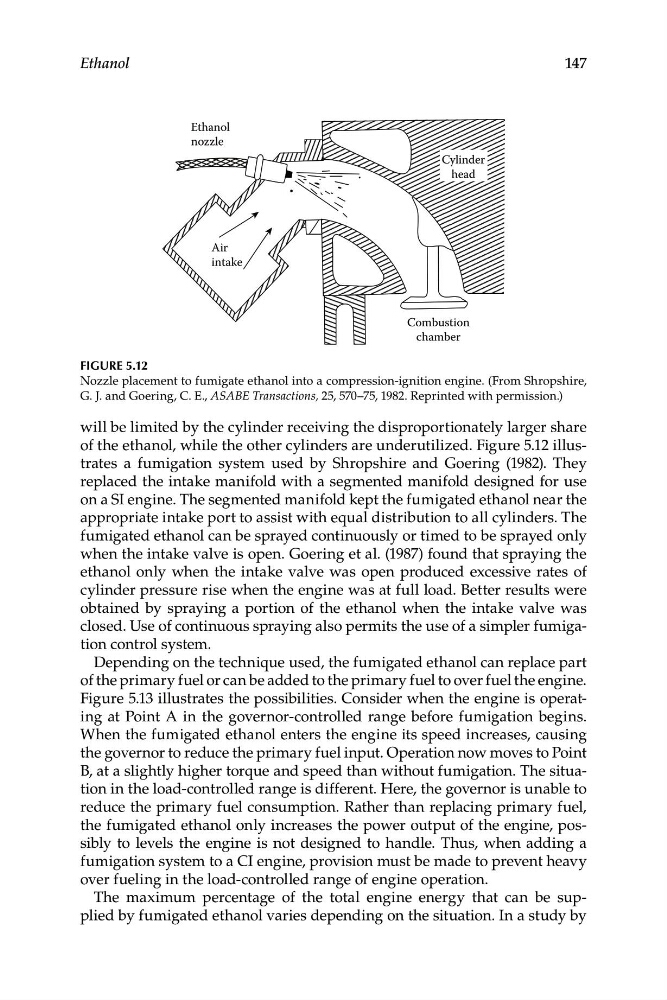
Figure 5.12
Nozzle placement to fumigate ethanol into a compression-ignition engine. (From Shropshire,
G. J. and Goering, C. E., ASABE Transactions, 25, 570–75, 1982. Reprinted with permission.)
will be limited by the cylinder receiving the disproportionately larger share
of the ethanol, while the other cylinders are underutilized. Figure 5.12 illustrates a fumigation system used by Shropshire and Goering (1982). They
replaced the intake manifold with a segmented manifold designed for use
on a SI engine. The segmented manifold kept the fumigated ethanol near the
appropriate intake port to assist with equal distribution to all cylinders. The
fumigated ethanol can be sprayed continuously or timed to be sprayed only
when the intake valve is open. Goering et al. (1987) found that spraying the
ethanol only when the intake valve was open produced excessive rates of
cylinder pressure rise when the engine was at full load. Better results were
obtained by spraying a portion of the ethanol when the intake valve was
closed. Use of continuous spraying also permits the use of a simpler fumigation control system.
Depending on the technique used, the fumigated ethanol can replace part
of the primary fuel or can be added to the primary fuel to over fuel the engine.
Figure 5.13 illustrates the possibilities. Consider when the engine is operating at Point A in the governor-controlled range before fumigation begins.
When the fumigated ethanol enters the engine its speed increases, causing
the governor to reduce the primary fuel input. Operation now moves to Point
B, at a slightly higher torque and speed than without fumigation. The situation in the load-controlled range is different. Here, the governor is unable to
reduce the primary fuel consumption. Rather than replacing primary fuel,
the fumigated ethanol only increases the power output of the engine, possibly to levels the engine is not designed to handle. Thus, when adding a
fumigation system to a CI engine, provision must be made to prevent heavy
over fueling in the load-controlled range of engine operation.
The maximum percentage of the total engine energy that can be supplied by fumigated ethanol varies depending on the situation. In a study by
nozzle
Air
intake
Combustion
chamber
Cylinder
head
Ethanol
147
Figure 5.12
Nozzle placement to fumigate ethanol into a compression-ignition engine. (From Shropshire,
G. J. and Goering, C. E., ASABE Transactions, 25, 570–75, 1982. Reprinted with permission.)
will be limited by the cylinder receiving the disproportionately larger share
of the ethanol, while the other cylinders are underutilized. Figure 5.12 illustrates a fumigation system used by Shropshire and Goering (1982). They
replaced the intake manifold with a segmented manifold designed for use
on a SI engine. The segmented manifold kept the fumigated ethanol near the
appropriate intake port to assist with equal distribution to all cylinders. The
fumigated ethanol can be sprayed continuously or timed to be sprayed only
when the intake valve is open. Goering et al. (1987) found that spraying the
ethanol only when the intake valve was open produced excessive rates of
cylinder pressure rise when the engine was at full load. Better results were
obtained by spraying a portion of the ethanol when the intake valve was
closed. Use of continuous spraying also permits the use of a simpler fumigation control system.
Depending on the technique used, the fumigated ethanol can replace part
of the primary fuel or can be added to the primary fuel to over fuel the engine.
Figure 5.13 illustrates the possibilities. Consider when the engine is operating at Point A in the governor-controlled range before fumigation begins.
When the fumigated ethanol enters the engine its speed increases, causing
the governor to reduce the primary fuel input. Operation now moves to Point
B, at a slightly higher torque and speed than without fumigation. The situation in the load-controlled range is different. Here, the governor is unable to
reduce the primary fuel consumption. Rather than replacing primary fuel,
the fumigated ethanol only increases the power output of the engine, possibly to levels the engine is not designed to handle. Thus, when adding a
fumigation system to a CI engine, provision must be made to prevent heavy
over fueling in the load-controlled range of engine operation.
The maximum percentage of the total engine energy that can be supplied by fumigated ethanol varies depending on the situation. In a study by