

NO
0.4
0.3
0.2
0.1
0.0
0.3
0.2
0.1
0.0
CO (g/Km)
CH (g/km)
x (g/Km)
(a)
(b)
(c)
6
4
2
0
Base
E10
Base
E10
Base
E10
Ethanol
143
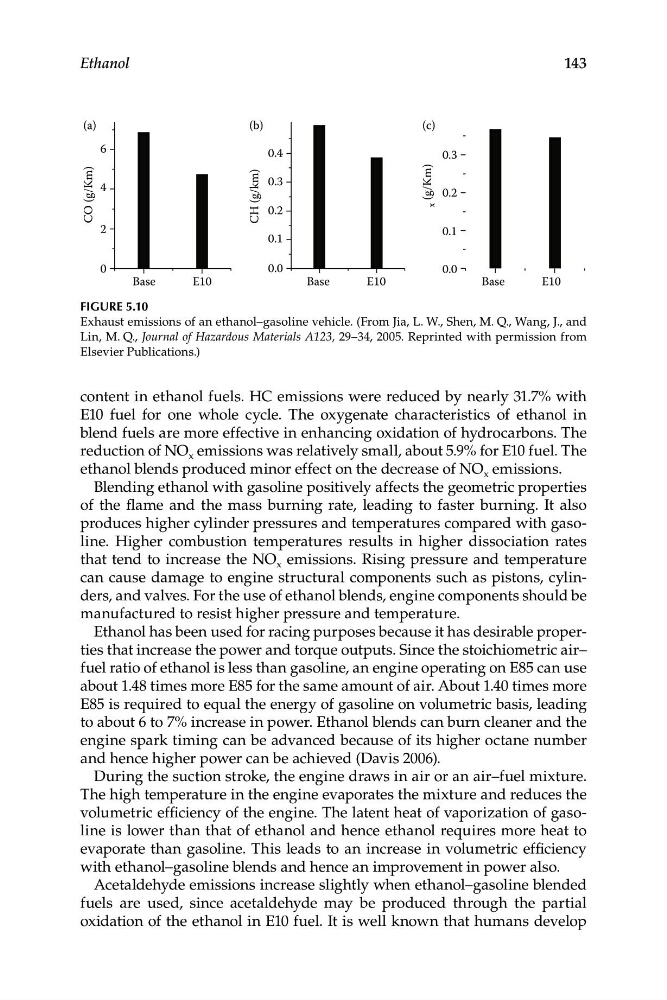
Figure 5.10
Exhaust emissions of an ethanol–gasoline vehicle. (From Jia, L. W., Shen, M. Q., Wang, J., and
Lin, M. Q., Journal of Hazardous Materials A123, 29–34, 2005. Reprinted with permission from
Elsevier Publications.)
content in ethanol fuels. HC emissions were reduced by nearly 31.7% with
E10 fuel for one whole cycle. The oxygenate characteristics of ethanol in
blend fuels are more effective in enhancing oxidation of hydrocarbons. The
reduction of NO x emissions was relatively small, about 5.9% for E10 fuel. The
ethanol blends produced minor effect on the decrease of NO x emissions.
Blending ethanol with gasoline positively affects the geometric properties
of the flame and the mass burning rate, leading to faster burning. It also
produces higher cylinder pressures and temperatures compared with gasoline. Higher combustion temperatures results in higher dissociation rates
that tend to increase the NO x emissions. Rising pressure and temperature
can cause damage to engine structural components such as pistons, cylinders, and valves. For the use of ethanol blends, engine components should be
manufactured to resist higher pressure and temperature.
Ethanol has been used for racing purposes because it has desirable properties that increase the power and torque outputs. Since the stoichiometric air–
fuel ratio of ethanol is less than gasoline, an engine operating on E85 can use
about 1.48 times more E85 for the same amount of air. About 1.40 times more
E85 is required to equal the energy of gasoline on volumetric basis, leading
to about 6 to 7% increase in power. Ethanol blends can burn cleaner and the
engine spark timing can be advanced because of its higher octane number
and hence higher power can be achieved (Davis 2006).
During the suction stroke, the engine draws in air or an air–fuel mixture.
The high temperature in the engine evaporates the mixture and reduces the
volumetric efficiency of the engine. The latent heat of vaporization of gasoline is lower than that of ethanol and hence ethanol requires more heat to
evaporate than gasoline. This leads to an increase in volumetric efficiency
with ethanol–gasoline blends and hence an improvement in power also.
Acetaldehyde emissions increase slightly when ethanol–gasoline blended
fuels are used, since acetaldehyde may be produced through the partial
oxidation of the ethanol in E10 fuel. It is well known that humans develop
0.4
0.3
0.2
0.1
0.0
0.3
0.2
0.1
0.0
CO (g/Km)
CH (g/km)
x (g/Km)
(a)
(b)
(c)
6
4
2
0
Base
E10
Base
E10
Base
E10
Ethanol
143
Figure 5.10
Exhaust emissions of an ethanol–gasoline vehicle. (From Jia, L. W., Shen, M. Q., Wang, J., and
Lin, M. Q., Journal of Hazardous Materials A123, 29–34, 2005. Reprinted with permission from
Elsevier Publications.)
content in ethanol fuels. HC emissions were reduced by nearly 31.7% with
E10 fuel for one whole cycle. The oxygenate characteristics of ethanol in
blend fuels are more effective in enhancing oxidation of hydrocarbons. The
reduction of NO x emissions was relatively small, about 5.9% for E10 fuel. The
ethanol blends produced minor effect on the decrease of NO x emissions.
Blending ethanol with gasoline positively affects the geometric properties
of the flame and the mass burning rate, leading to faster burning. It also
produces higher cylinder pressures and temperatures compared with gasoline. Higher combustion temperatures results in higher dissociation rates
that tend to increase the NO x emissions. Rising pressure and temperature
can cause damage to engine structural components such as pistons, cylinders, and valves. For the use of ethanol blends, engine components should be
manufactured to resist higher pressure and temperature.
Ethanol has been used for racing purposes because it has desirable properties that increase the power and torque outputs. Since the stoichiometric air–
fuel ratio of ethanol is less than gasoline, an engine operating on E85 can use
about 1.48 times more E85 for the same amount of air. About 1.40 times more
E85 is required to equal the energy of gasoline on volumetric basis, leading
to about 6 to 7% increase in power. Ethanol blends can burn cleaner and the
engine spark timing can be advanced because of its higher octane number
and hence higher power can be achieved (Davis 2006).
During the suction stroke, the engine draws in air or an air–fuel mixture.
The high temperature in the engine evaporates the mixture and reduces the
volumetric efficiency of the engine. The latent heat of vaporization of gasoline is lower than that of ethanol and hence ethanol requires more heat to
evaporate than gasoline. This leads to an increase in volumetric efficiency
with ethanol–gasoline blends and hence an improvement in power also.
Acetaldehyde emissions increase slightly when ethanol–gasoline blended
fuels are used, since acetaldehyde may be produced through the partial
oxidation of the ethanol in E10 fuel. It is well known that humans develop