

19%
reduction
28%
reduction
52%
reduction
78%
reduction
86%
reduction
Gasoline
Petroleum
Current
average
Corn ethanol
Natural
gas
Biomass
Sugarcane
Biomass
Cellulosic
Biomass
132
Alternative Fuels for Transportation
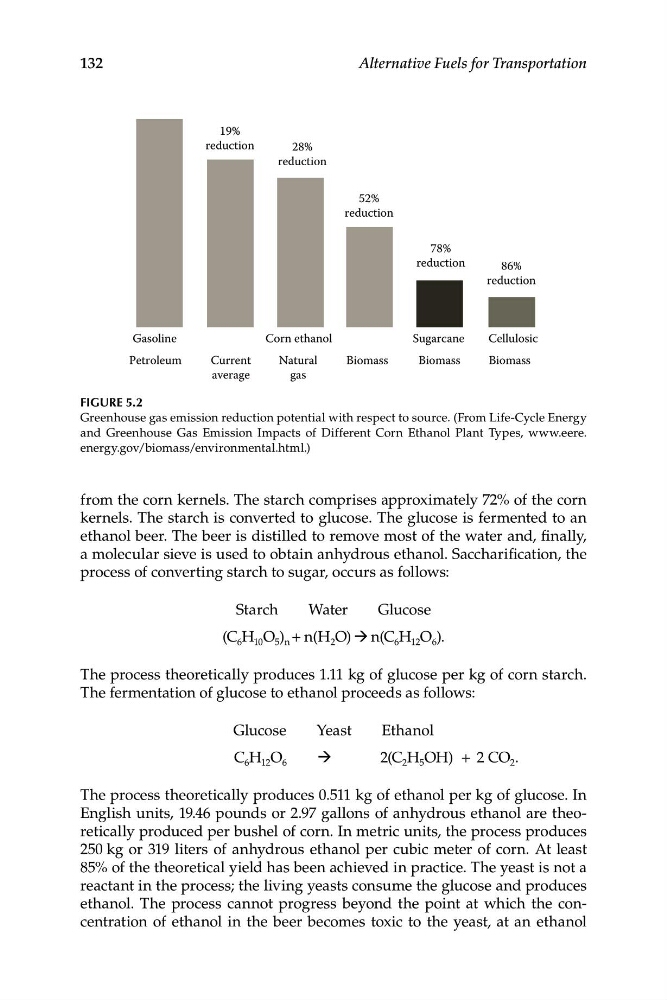
Figure 5.2
Greenhouse gas emission reduction potential with respect to source. (From Life-Cycle Energy
and Greenhouse Gas Emission Impacts of Different Corn Ethanol Plant Types, www.eere.
energy.gov/biomass/environmental.html.)
from the corn kernels. The starch comprises approximately 72% of the corn
kernels. The starch is converted to glucose. The glucose is fermented to an
ethanol beer. The beer is distilled to remove most of the water and, finally,
a molecular sieve is used to obtain anhydrous ethanol. Saccharification, the
process of converting starch to sugar, occurs as follows:
Starch
Water
Glucose
(C 6 H 10 O 5 ) n + n(H 2 O) n(C 6 H 12 O 6 ).
The process theoretically produces 1.11 kg of glucose per kg of corn starch.
The fermentation of glucose to ethanol proceeds as follows:
Glucose
Yeast
Ethanol
C 6 H 12 O 6
2(C 2 H 5 OH) + 2 CO 2 .
The process theoretically produces 0.511 kg of ethanol per kg of glucose. In
English units, 19.46 pounds or 2.97 gallons of anhydrous ethanol are theoretically produced per bushel of corn. In metric units, the process produces
250 k g or 319 liters of anhydrous ethanol per cubic meter of corn. At least
85% of the theoretical yield has been achieved in practice. The yeast is not a
reactant in the process; the living yeasts consume the glucose and produces
ethanol. The process cannot progress beyond the point at which the concentration of ethanol in the beer becomes toxic to the yeast, at an ethanol
reduction
28%
reduction
52%
reduction
78%
reduction
86%
reduction
Gasoline
Petroleum
Current
average
Corn ethanol
Natural
gas
Biomass
Sugarcane
Biomass
Cellulosic
Biomass
132
Alternative Fuels for Transportation
Figure 5.2
Greenhouse gas emission reduction potential with respect to source. (From Life-Cycle Energy
and Greenhouse Gas Emission Impacts of Different Corn Ethanol Plant Types, www.eere.
energy.gov/biomass/environmental.html.)
from the corn kernels. The starch comprises approximately 72% of the corn
kernels. The starch is converted to glucose. The glucose is fermented to an
ethanol beer. The beer is distilled to remove most of the water and, finally,
a molecular sieve is used to obtain anhydrous ethanol. Saccharification, the
process of converting starch to sugar, occurs as follows:
Starch
Water
Glucose
(C 6 H 10 O 5 ) n + n(H 2 O) n(C 6 H 12 O 6 ).
The process theoretically produces 1.11 kg of glucose per kg of corn starch.
The fermentation of glucose to ethanol proceeds as follows:
Glucose
Yeast
Ethanol
C 6 H 12 O 6
2(C 2 H 5 OH) + 2 CO 2 .
The process theoretically produces 0.511 kg of ethanol per kg of glucose. In
English units, 19.46 pounds or 2.97 gallons of anhydrous ethanol are theoretically produced per bushel of corn. In metric units, the process produces
250 k g or 319 liters of anhydrous ethanol per cubic meter of corn. At least
85% of the theoretical yield has been achieved in practice. The yeast is not a
reactant in the process; the living yeasts consume the glucose and produces
ethanol. The process cannot progress beyond the point at which the concentration of ethanol in the beer becomes toxic to the yeast, at an ethanol