

U
S A
B r a z i l
E u r o p e
C h i n a
C a n a d a
T h a i l a n d
C o l o m
b i a
I n d i a
A
u s t r a l i a
O
t h e r
Million gallons
10,000
9000
8000
7000
6000
2007
5000
2008
4000
3000
2000
1000
0
Country
Ethanol
131
5.2 Ethanol Production
Fuel ethanol production is rapidly expanding all over the world. However,
Brazil is the world leader of the production and commercialization of
ethanol as engine fuel. In Brazil, out of the total sugar cane available for
crushing, 45% goes for sugar cane production and the balance, 55%, for
production of ethanol directly from sugar cane. Raw materials for producing ethanol vary from country to country depending upon the availability. As examples, sugar cane is used in Brazil, cereals in the United
States, sugar beets in Europe, and molasses in India. Brazil uses ethanol
as the sole fuel in about 20% of their vehicles and 25% ethanol and 75%
gasoline blends in the remaining vehicles. In 1999, approximately 75% of
all automobiles in Brazil ran on gasoline containing 24% ethanol, with
a total fuel alcohol consumption of 13.8 × 10 6 m 3 /year (EPA 2001). With
the rapidly expanding production of ethanol and its lower cost relative
to petroleum-based fuel in countries such as Brazil, there is increased
interest in using ethanol as a blending component. The world’s ethanol
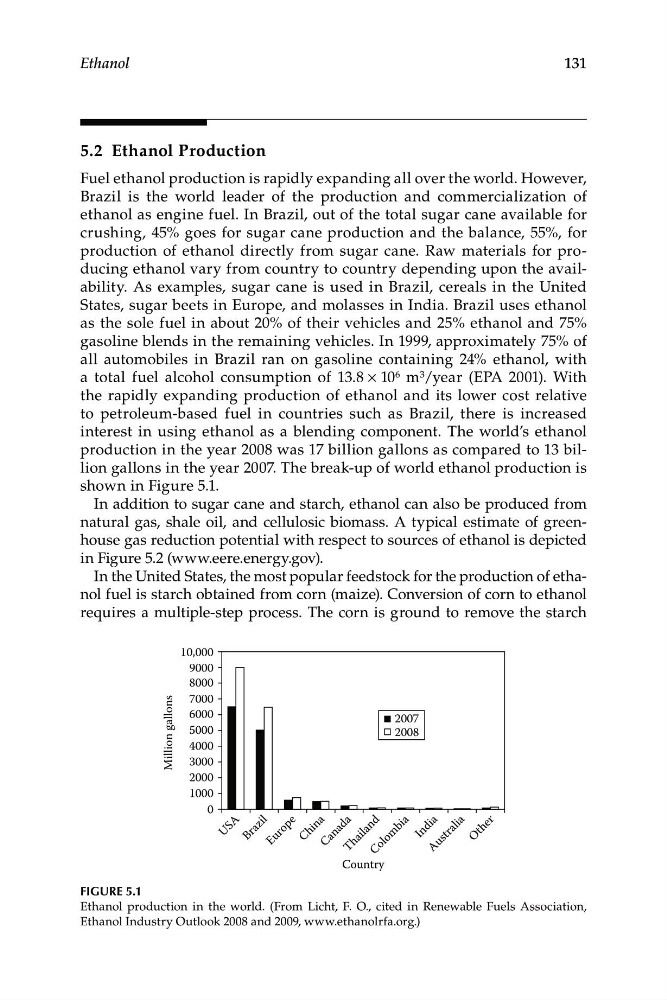
production in the year 2008 was 17 billion gallons as compared to 13 billion gallons in the year 2007. The break-up of world ethanol production is
shown in Figure 5.1.
In addition to sugar cane and starch, ethanol can also be produced from
natural gas, shale oil, and cellulosic biomass. A typical estimate of greenhouse gas reduction potential with respect to sources of ethanol is depicted
in Figure 5.2 (www.eere.energy.gov).
In the United States, the most popular feedstock for the production of ethanol fuel is starch obtained from corn (maize). Conversion of corn to ethanol
requires a multiple-step process. The corn is ground to remove the starch
Figure 5.1
Ethanol production in the world. (From Licht, F. O., cited in Renewable Fuels Association,
Ethanol Industry Outlook 2008 and 2009, www.ethanolrfa.org.)
S A
B r a z i l
E u r o p e
C h i n a
C a n a d a
T h a i l a n d
C o l o m
b i a
I n d i a
A
u s t r a l i a
O
t h e r
Million gallons
10,000
9000
8000
7000
6000
2007
5000
2008
4000
3000
2000
1000
0
Country
Ethanol
131
5.2 Ethanol Production
Fuel ethanol production is rapidly expanding all over the world. However,
Brazil is the world leader of the production and commercialization of
ethanol as engine fuel. In Brazil, out of the total sugar cane available for
crushing, 45% goes for sugar cane production and the balance, 55%, for
production of ethanol directly from sugar cane. Raw materials for producing ethanol vary from country to country depending upon the availability. As examples, sugar cane is used in Brazil, cereals in the United
States, sugar beets in Europe, and molasses in India. Brazil uses ethanol
as the sole fuel in about 20% of their vehicles and 25% ethanol and 75%
gasoline blends in the remaining vehicles. In 1999, approximately 75% of
all automobiles in Brazil ran on gasoline containing 24% ethanol, with
a total fuel alcohol consumption of 13.8 × 10 6 m 3 /year (EPA 2001). With
the rapidly expanding production of ethanol and its lower cost relative
to petroleum-based fuel in countries such as Brazil, there is increased
interest in using ethanol as a blending component. The world’s ethanol
production in the year 2008 was 17 billion gallons as compared to 13 billion gallons in the year 2007. The break-up of world ethanol production is
shown in Figure 5.1.
In addition to sugar cane and starch, ethanol can also be produced from
natural gas, shale oil, and cellulosic biomass. A typical estimate of greenhouse gas reduction potential with respect to sources of ethanol is depicted
in Figure 5.2 (www.eere.energy.gov).
In the United States, the most popular feedstock for the production of ethanol fuel is starch obtained from corn (maize). Conversion of corn to ethanol
requires a multiple-step process. The corn is ground to remove the starch
Figure 5.1
Ethanol production in the world. (From Licht, F. O., cited in Renewable Fuels Association,
Ethanol Industry Outlook 2008 and 2009, www.ethanolrfa.org.)