

Methanol
119
20
25
15
5
0
–5
M0
M5
M10
M15
20° CA BTDC,
(ORG injection timing)
10 Nm
10
Rate of heat release (kJ/deg)
–20
–10
0
1 0
2 0
30
40
Crank angle (deg)
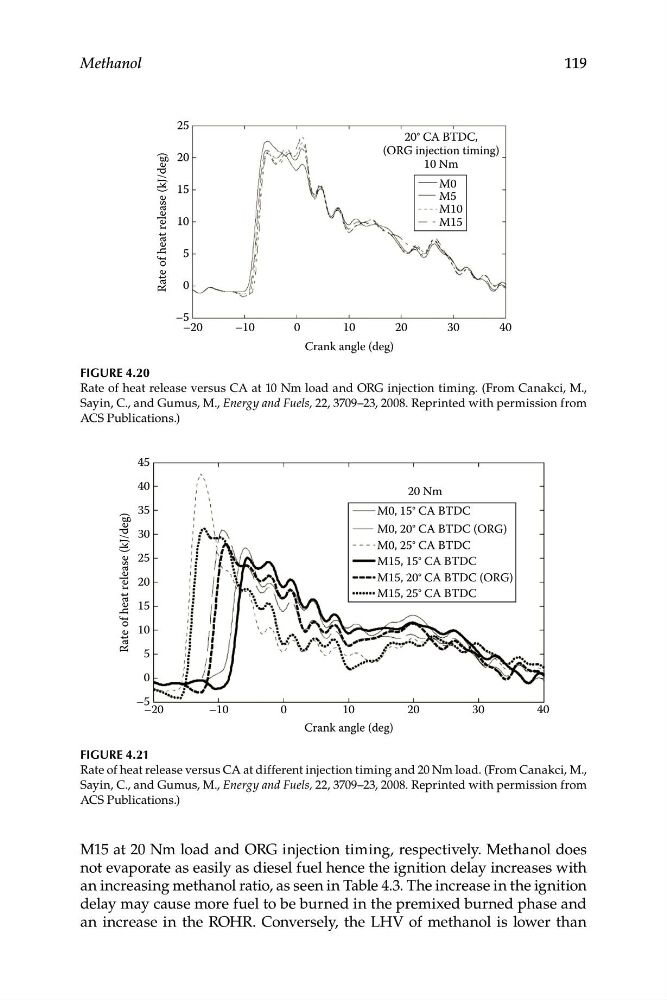
Figure 4.20
Rate of heat release versus CA at 10 Nm load and ORG injection timing. (From Canakci, M.,
Sayin, C., and Gumus, M., Energy and Fuels, 22, 3709–23, 2008. Reprinted with permission from
ACS Publications.)
35
30
25
20
15
10
5
0
–5
40
45
M0, 15° CA BTDC
M0, 20° CA BTDC (ORG)
M0, 25° CA BTDC
M15, 15° CA BTDC
M15, 20° CA BTDC (ORG)
M15, 25° CA BTDC
20 Nm
Rate of heat release (kJ/deg)
–20
–10
0
1 0
2 0
30
40
Crank angle (deg)
Figure 4.21
Rate of heat release versus CA at different injection timing and 20 Nm load. (From Canakci, M .,
Sayin, C., and Gumus, M., Energy and Fuels, 22, 3709–23, 2008. Reprinted with permission from
ACS Publications.)
M15 at 20 Nm load and ORG injection timing, respectively. Methanol does
not evaporate as easily as diesel fuel hence the ignition delay increases with
an increasing methanol ratio, as seen in Table 4.3. The increase in the ignition
delay may cause more fuel to be burned in the premixed burned phase and
an increase in the ROHR. Conversely, the LHV of methanol is lower than
119
20
25
15
5
0
–5
M0
M5
M10
M15
20° CA BTDC,
(ORG injection timing)
10 Nm
10
Rate of heat release (kJ/deg)
–20
–10
0
1 0
2 0
30
40
Crank angle (deg)
Figure 4.20
Rate of heat release versus CA at 10 Nm load and ORG injection timing. (From Canakci, M.,
Sayin, C., and Gumus, M., Energy and Fuels, 22, 3709–23, 2008. Reprinted with permission from
ACS Publications.)
35
30
25
20
15
10
5
0
–5
40
45
M0, 15° CA BTDC
M0, 20° CA BTDC (ORG)
M0, 25° CA BTDC
M15, 15° CA BTDC
M15, 20° CA BTDC (ORG)
M15, 25° CA BTDC
20 Nm
Rate of heat release (kJ/deg)
–20
–10
0
1 0
2 0
30
40
Crank angle (deg)
Figure 4.21
Rate of heat release versus CA at different injection timing and 20 Nm load. (From Canakci, M .,
Sayin, C., and Gumus, M., Energy and Fuels, 22, 3709–23, 2008. Reprinted with permission from
ACS Publications.)
M15 at 20 Nm load and ORG injection timing, respectively. Methanol does
not evaporate as easily as diesel fuel hence the ignition delay increases with
an increasing methanol ratio, as seen in Table 4.3. The increase in the ignition
delay may cause more fuel to be burned in the premixed burned phase and
an increase in the ROHR. Conversely, the LHV of methanol is lower than