

17 Xenobiotic Metabolism by Cytochrome P450 …
355
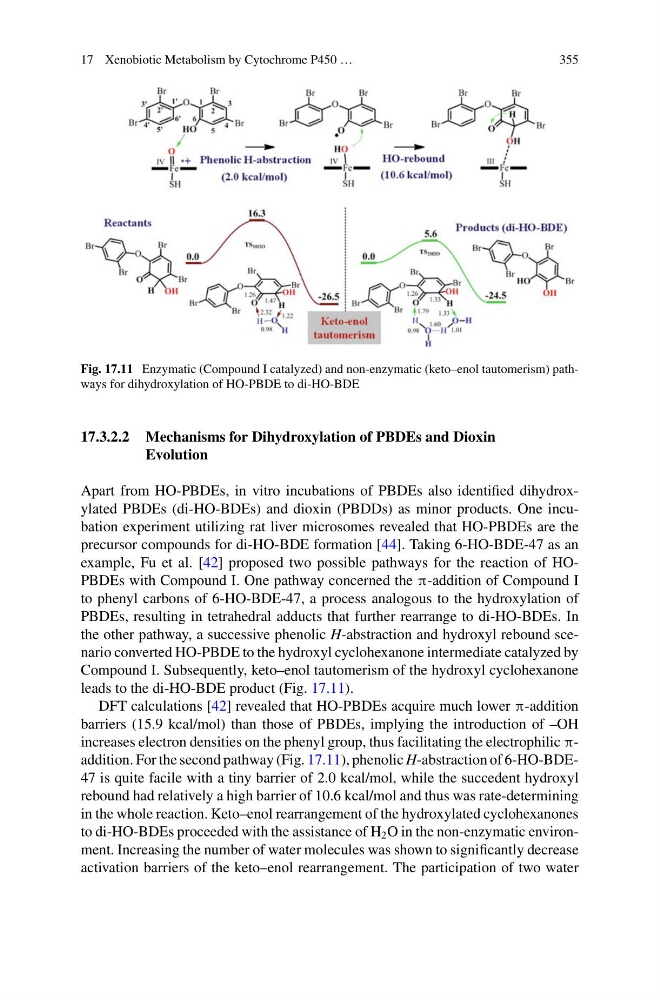
Fig. 17.11 Enzymatic (Compound I catalyzed) and non-enzymatic (keto–enol tautomerism) pathways for dihydroxylation of HO-PBDE to di-HO-BDE
17.3.2.2 Mechanisms for Dihydroxylation of PBDEs and Dioxin
Evolution
Apart from HO-PBDEs, in vitro incubations of PBDEs also identified dihydroxylated PBDEs (di-HO-BDEs) and dioxin (PBDDs) as minor products. One incubation experiment utilizing rat liver microsomes revealed that HO-PBDEs are the
precursor compounds for di-HO-BDE formation [44]. Taking 6-HO-BDE-47 as an
example, Fu et al. [42] proposed two possible pathways for the reaction of HOPBDEs with Compound I. One pathway concerned the π-addition of Compound I
to phenyl carbons of 6-HO-BDE-47, a process analogous to the hydroxylation of
PBDEs, resulting in tetrahedral adducts that further rearrange to di-HO-BDEs. In
the other pathway, a successive phenolic H-abstraction and hydroxyl rebound scenario converted HO-PBDE to the hydroxyl cyclohexanone intermediate catalyzed by
Compound I. Subsequently, keto–enol tautomerism of the hydroxyl cyclohexanone
leads to the di-HO-BDE product (Fig. 17.11).
DFT calculations [42] revealed that HO-PBDEs acquire much lower π-addition
barriers (15.9 kcal/mol) than those of PBDEs, implying the introduction of –OH
increases electron densities on the phenyl group, thus facilitating the electrophilic πaddition. For the second pathway (Fig. 17.11), phenolic H-abstraction of 6-HO-BDE47 is quite facile with a tiny barrier of 2.0 kcal/mol, while the succedent hydroxyl
rebound had relatively a high barrier of 10.6 kcal/mol and thus was rate-determining
in the whole reaction. Keto–enol rearrangement of the hydroxylated cyclohexanones
to di-HO-BDEs proceeded with the assistance of H 2 O in the non-enzymatic environment. Increasing the number of water molecules was shown to significantly decrease
activation barriers of the keto–enol rearrangement. The participation of two water
355
Fig. 17.11 Enzymatic (Compound I catalyzed) and non-enzymatic (keto–enol tautomerism) pathways for dihydroxylation of HO-PBDE to di-HO-BDE
17.3.2.2 Mechanisms for Dihydroxylation of PBDEs and Dioxin
Evolution
Apart from HO-PBDEs, in vitro incubations of PBDEs also identified dihydroxylated PBDEs (di-HO-BDEs) and dioxin (PBDDs) as minor products. One incubation experiment utilizing rat liver microsomes revealed that HO-PBDEs are the
precursor compounds for di-HO-BDE formation [44]. Taking 6-HO-BDE-47 as an
example, Fu et al. [42] proposed two possible pathways for the reaction of HOPBDEs with Compound I. One pathway concerned the π-addition of Compound I
to phenyl carbons of 6-HO-BDE-47, a process analogous to the hydroxylation of
PBDEs, resulting in tetrahedral adducts that further rearrange to di-HO-BDEs. In
the other pathway, a successive phenolic H-abstraction and hydroxyl rebound scenario converted HO-PBDE to the hydroxyl cyclohexanone intermediate catalyzed by
Compound I. Subsequently, keto–enol tautomerism of the hydroxyl cyclohexanone
leads to the di-HO-BDE product (Fig. 17.11).
DFT calculations [42] revealed that HO-PBDEs acquire much lower π-addition
barriers (15.9 kcal/mol) than those of PBDEs, implying the introduction of –OH
increases electron densities on the phenyl group, thus facilitating the electrophilic πaddition. For the second pathway (Fig. 17.11), phenolic H-abstraction of 6-HO-BDE47 is quite facile with a tiny barrier of 2.0 kcal/mol, while the succedent hydroxyl
rebound had relatively a high barrier of 10.6 kcal/mol and thus was rate-determining
in the whole reaction. Keto–enol rearrangement of the hydroxylated cyclohexanones
to di-HO-BDEs proceeded with the assistance of H 2 O in the non-enzymatic environment. Increasing the number of water molecules was shown to significantly decrease
activation barriers of the keto–enol rearrangement. The participation of two water