

354
Z. Fu and J. Chen
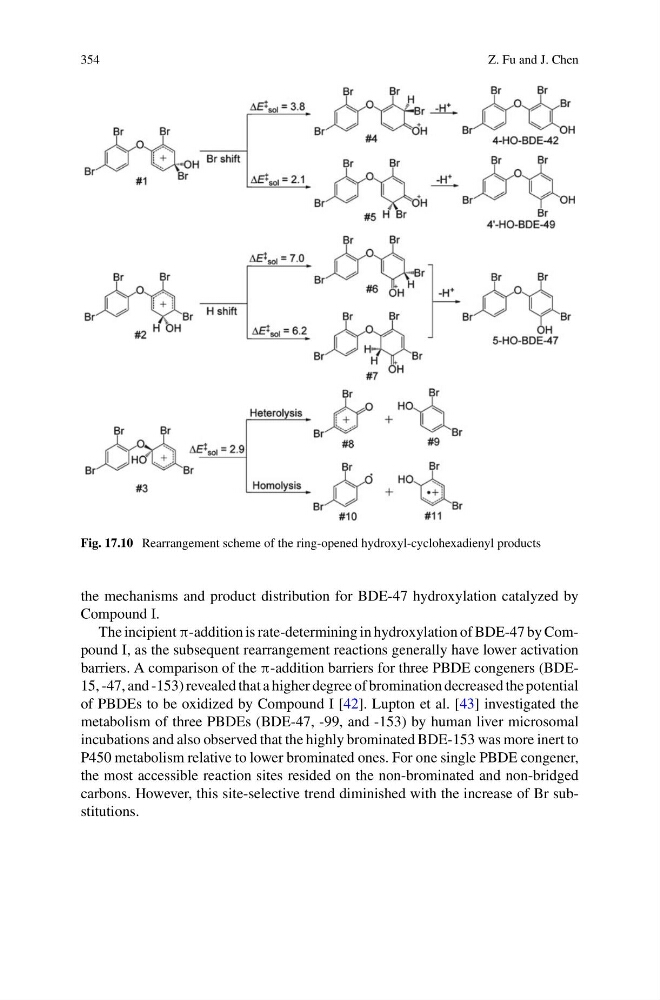
Fig. 17.10 Rearrangement scheme of the ring-opened hydroxyl-cyclohexadienyl products
the mechanisms and product distribution for BDE-47 hydroxylation catalyzed by
Compound I.
The incipient π-addition is rate-determining in hydroxylation of BDE-47 by Compound I, as the subsequent rearrangement reactions generally have lower activation
barriers. A comparison of the π-addition barriers for three PBDE congeners (BDE15, -47, and -153) revealed that a higher degree of bromination decreased the potential
of PBDEs to be oxidized by Compound I [42]. Lupton et al. [43] investigated the
metabolism of three PBDEs (BDE-47, -99, and -153) by human liver microsomal
incubations and also observed that the highly brominated BDE-153 was more inert to
P450 metabolism relative to lower brominated ones. For one single PBDE congener,
the most accessible reaction sites resided on the non-brominated and non-bridged
carbons. However, this site-selective trend diminished with the increase of Br substitutions.
Z. Fu and J. Chen
Fig. 17.10 Rearrangement scheme of the ring-opened hydroxyl-cyclohexadienyl products
the mechanisms and product distribution for BDE-47 hydroxylation catalyzed by
Compound I.
The incipient π-addition is rate-determining in hydroxylation of BDE-47 by Compound I, as the subsequent rearrangement reactions generally have lower activation
barriers. A comparison of the π-addition barriers for three PBDE congeners (BDE15, -47, and -153) revealed that a higher degree of bromination decreased the potential
of PBDEs to be oxidized by Compound I [42]. Lupton et al. [43] investigated the
metabolism of three PBDEs (BDE-47, -99, and -153) by human liver microsomal
incubations and also observed that the highly brominated BDE-153 was more inert to
P450 metabolism relative to lower brominated ones. For one single PBDE congener,
the most accessible reaction sites resided on the non-brominated and non-bridged
carbons. However, this site-selective trend diminished with the increase of Br substitutions.