

16 Molecular Modeling Method Applications …
327
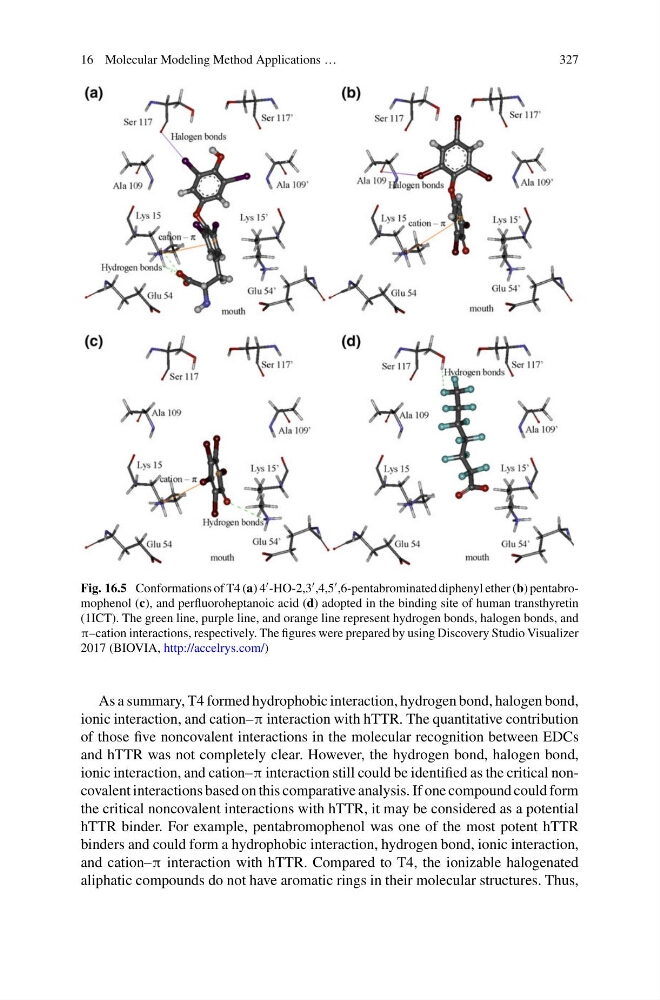
Fig. 16.5 Conformations of T4 (a) 4 -HO-2,3 ,4,5 ,6-pentabrominated diphenyl ether (b) pentabromophenol (c), and perfluoroheptanoic acid (d) adopted in the binding site of human transthyretin
(1ICT). The green line, purple line, and orange line represent hydrogen bonds, halogen bonds, and
π–cation interactions, respectively. The figures were prepared by using Discovery Studio Visualizer
2017 (BIOVIA, http://accelrys.com/)
As a summary, T4 formed hydrophobic interaction, hydrogen bond, halogen bond,
ionic interaction, and cation–π interaction with hTTR. The quantitative contribution
of those five noncovalent interactions in the molecular recognition between EDCs
and hTTR was not completely clear. However, the hydrogen bond, halogen bond,
ionic interaction, and cation–π interaction still could be identified as the critical noncovalent interactions based on this comparative analysis. If one compound could form
the critical noncovalent interactions with hTTR, it may be considered as a potential
hTTR binder. For example, pentabromophenol was one of the most potent hTTR
binders and could form a hydrophobic interaction, hydrogen bond, ionic interaction,
and cation–π interaction with hTTR. Compared to T4, the ionizable halogenated
aliphatic compounds do not have aromatic rings in their molecular structures. Thus,
327
Fig. 16.5 Conformations of T4 (a) 4 -HO-2,3 ,4,5 ,6-pentabrominated diphenyl ether (b) pentabromophenol (c), and perfluoroheptanoic acid (d) adopted in the binding site of human transthyretin
(1ICT). The green line, purple line, and orange line represent hydrogen bonds, halogen bonds, and
π–cation interactions, respectively. The figures were prepared by using Discovery Studio Visualizer
2017 (BIOVIA, http://accelrys.com/)
As a summary, T4 formed hydrophobic interaction, hydrogen bond, halogen bond,
ionic interaction, and cation–π interaction with hTTR. The quantitative contribution
of those five noncovalent interactions in the molecular recognition between EDCs
and hTTR was not completely clear. However, the hydrogen bond, halogen bond,
ionic interaction, and cation–π interaction still could be identified as the critical noncovalent interactions based on this comparative analysis. If one compound could form
the critical noncovalent interactions with hTTR, it may be considered as a potential
hTTR binder. For example, pentabromophenol was one of the most potent hTTR
binders and could form a hydrophobic interaction, hydrogen bond, ionic interaction,
and cation–π interaction with hTTR. Compared to T4, the ionizable halogenated
aliphatic compounds do not have aromatic rings in their molecular structures. Thus,