

326
X. Yang et al.
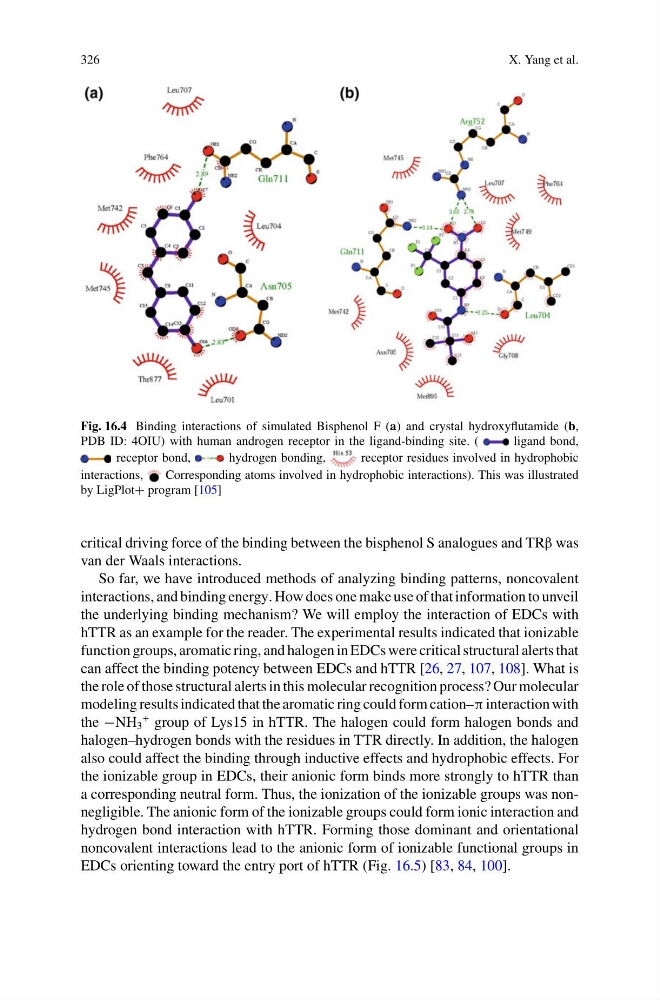
Fig. 16.4 Binding interactions of simulated Bisphenol F (a) and crystal hydroxyflutamide (b,
PDB ID: 4OIU) with human androgen receptor in the ligand-binding site. (
ligand bond,
receptor bond,
hydrogen bonding,
receptor residues involved in hydrophobic
interactions,
Corresponding atoms involved in hydrophobic interactions). This was illustrated
by LigPlot+ program [105]
critical driving force of the binding between the bisphenol S analogues and TRβ was
van der Waals interactions.
So far, we have introduced methods of analyzing binding patterns, noncovalent
interactions, and binding energy. How does one make use of that information to unveil
the underlying binding mechanism? We will employ the interaction of EDCs with
hTTR as an example for the reader. The experimental results indicated that ionizable
function groups, aromatic ring, and halogen in EDCs were critical structural alerts that
can affect the binding potency between EDCs and hTTR [26, 27, 107, 108]. What is
the role of those structural alerts in this molecular recognition process? Our molecular
modeling results indicated that the aromatic ring could form cation–π interaction with
the −NH 3
+ group of Lys15 in hTTR. The halogen could form halogen bonds and
halogen–hydrogen bonds with the residues in TTR directly. In addition, the halogen
also could affect the binding through inductive effects and hydrophobic effects. For
the ionizable group in EDCs, their anionic form binds more strongly to hTTR than
a corresponding neutral form. Thus, the ionization of the ionizable groups was nonnegligible. The anionic form of the ionizable groups could form ionic interaction and
hydrogen bond interaction with hTTR. Forming those dominant and orientational
noncovalent interactions lead to the anionic form of ionizable functional groups in
EDCs orienting toward the entry port of hTTR (Fig. 16.5) [83, 84, 100].
X. Yang et al.
Fig. 16.4 Binding interactions of simulated Bisphenol F (a) and crystal hydroxyflutamide (b,
PDB ID: 4OIU) with human androgen receptor in the ligand-binding site. (
ligand bond,
receptor bond,
hydrogen bonding,
receptor residues involved in hydrophobic
interactions,
Corresponding atoms involved in hydrophobic interactions). This was illustrated
by LigPlot+ program [105]
critical driving force of the binding between the bisphenol S analogues and TRβ was
van der Waals interactions.
So far, we have introduced methods of analyzing binding patterns, noncovalent
interactions, and binding energy. How does one make use of that information to unveil
the underlying binding mechanism? We will employ the interaction of EDCs with
hTTR as an example for the reader. The experimental results indicated that ionizable
function groups, aromatic ring, and halogen in EDCs were critical structural alerts that
can affect the binding potency between EDCs and hTTR [26, 27, 107, 108]. What is
the role of those structural alerts in this molecular recognition process? Our molecular
modeling results indicated that the aromatic ring could form cation–π interaction with
the −NH 3
+ group of Lys15 in hTTR. The halogen could form halogen bonds and
halogen–hydrogen bonds with the residues in TTR directly. In addition, the halogen
also could affect the binding through inductive effects and hydrophobic effects. For
the ionizable group in EDCs, their anionic form binds more strongly to hTTR than
a corresponding neutral form. Thus, the ionization of the ionizable groups was nonnegligible. The anionic form of the ionizable groups could form ionic interaction and
hydrogen bond interaction with hTTR. Forming those dominant and orientational
noncovalent interactions lead to the anionic form of ionizable functional groups in
EDCs orienting toward the entry port of hTTR (Fig. 16.5) [83, 84, 100].