

318
X. Yang et al.
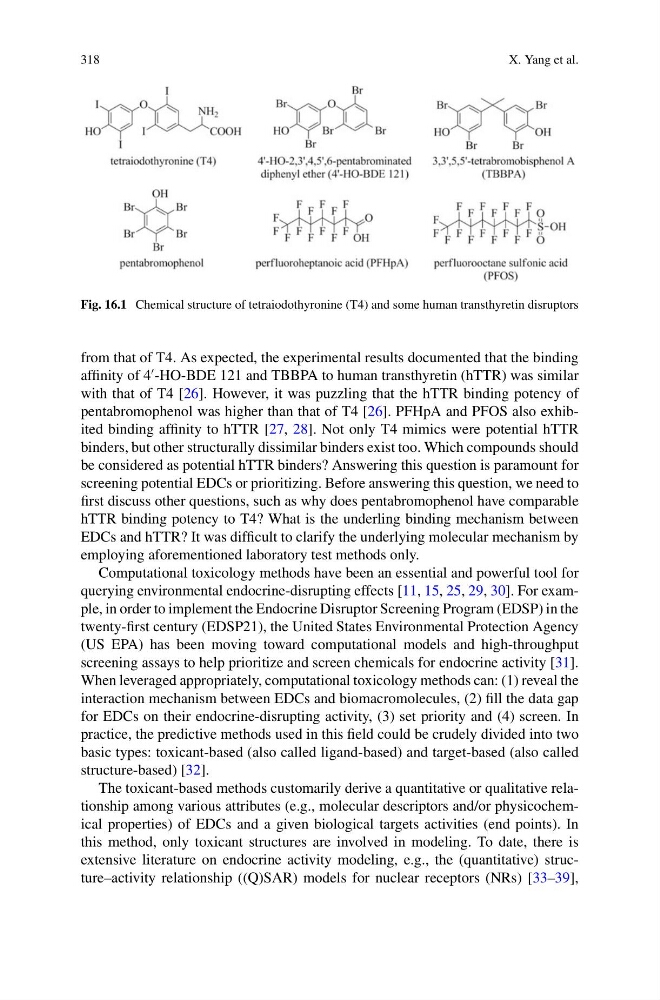
Fig. 16.1 Chemical structure of tetraiodothyronine (T4) and some human transthyretin disruptors
from that of T4. As expected, the experimental results documented that the binding
affinity of 4
-HO-BDE 121 and TBBPA to human transthyretin (hTTR) was similar
with that of T4 [26]. However, it was puzzling that the hTTR binding potency of
pentabromophenol was higher than that of T4 [26]. PFHpA and PFOS also exhibited binding affinity to hTTR [27, 28]. Not only T4 mimics were potential hTTR
binders, but other structurally dissimilar binders exist too. Which compounds should
be considered as potential hTTR binders? Answering this question is paramount for
screening potential EDCs or prioritizing. Before answering this question, we need to
first discuss other questions, such as why does pentabromophenol have comparable
hTTR binding potency to T4? What is the underling binding mechanism between
EDCs and hTTR? It was difficult to clarify the underlying molecular mechanism by
employing aforementioned laboratory test methods only.
Computational toxicology methods have been an essential and powerful tool for
querying environmental endocrine-disrupting effects [11, 15, 25, 29, 30]. For example, in order to implement the Endocrine Disruptor Screening Program (EDSP) in the
twenty-first century (EDSP21), the United States Environmental Protection Agency
(US EPA) has been moving toward computational models and high-throughput
screening assays to help prioritize and screen chemicals for endocrine activity [31].
When leveraged appropriately, computational toxicology methods can: (1) reveal the
interaction mechanism between EDCs and biomacromolecules, (2) fill the data gap
for EDCs on their endocrine-disrupting activity, (3) set priority and (4) screen. In
practice, the predictive methods used in this field could be crudely divided into two
basic types: toxicant-based (also called ligand-based) and target-based (also called
structure-based) [32].
The toxicant-based methods customarily derive a quantitative or qualitative relationship among various attributes (e.g., molecular descriptors and/or physicochemical properties) of EDCs and a given biological targets activities (end points). In
this method, only toxicant structures are involved in modeling. To date, there is
extensive literature on endocrine activity modeling, e.g., the (quantitative) structure–activity relationship ((Q)SAR) models for nuclear receptors (NRs) [33–39],
X. Yang et al.
Fig. 16.1 Chemical structure of tetraiodothyronine (T4) and some human transthyretin disruptors
from that of T4. As expected, the experimental results documented that the binding
affinity of 4
-HO-BDE 121 and TBBPA to human transthyretin (hTTR) was similar
with that of T4 [26]. However, it was puzzling that the hTTR binding potency of
pentabromophenol was higher than that of T4 [26]. PFHpA and PFOS also exhibited binding affinity to hTTR [27, 28]. Not only T4 mimics were potential hTTR
binders, but other structurally dissimilar binders exist too. Which compounds should
be considered as potential hTTR binders? Answering this question is paramount for
screening potential EDCs or prioritizing. Before answering this question, we need to
first discuss other questions, such as why does pentabromophenol have comparable
hTTR binding potency to T4? What is the underling binding mechanism between
EDCs and hTTR? It was difficult to clarify the underlying molecular mechanism by
employing aforementioned laboratory test methods only.
Computational toxicology methods have been an essential and powerful tool for
querying environmental endocrine-disrupting effects [11, 15, 25, 29, 30]. For example, in order to implement the Endocrine Disruptor Screening Program (EDSP) in the
twenty-first century (EDSP21), the United States Environmental Protection Agency
(US EPA) has been moving toward computational models and high-throughput
screening assays to help prioritize and screen chemicals for endocrine activity [31].
When leveraged appropriately, computational toxicology methods can: (1) reveal the
interaction mechanism between EDCs and biomacromolecules, (2) fill the data gap
for EDCs on their endocrine-disrupting activity, (3) set priority and (4) screen. In
practice, the predictive methods used in this field could be crudely divided into two
basic types: toxicant-based (also called ligand-based) and target-based (also called
structure-based) [32].
The toxicant-based methods customarily derive a quantitative or qualitative relationship among various attributes (e.g., molecular descriptors and/or physicochemical properties) of EDCs and a given biological targets activities (end points). In
this method, only toxicant structures are involved in modeling. To date, there is
extensive literature on endocrine activity modeling, e.g., the (quantitative) structure–activity relationship ((Q)SAR) models for nuclear receptors (NRs) [33–39],