

270
M. Chen et al.
MOA-DILI [69], integrating the MOA and structural information to enhance DILI
prediction.
Different from a conventional QSAR model, the modified model will utilize MOA
information to categorize drugs, i.e., drugs would be categorized into active or inactive group for each specific MOA. The underlying hypothesis is that MOA-specific
drugs would share similar DILI mechanisms and thus would be predicted by the
same QSAR models. In other words, we will develop one model to distinguish DILI
drugs from all MOA active drugs and another model to separate DILI drugs from all
MOA inactive drugs. Finally, these two QSAR models, for active and inactive drugs,
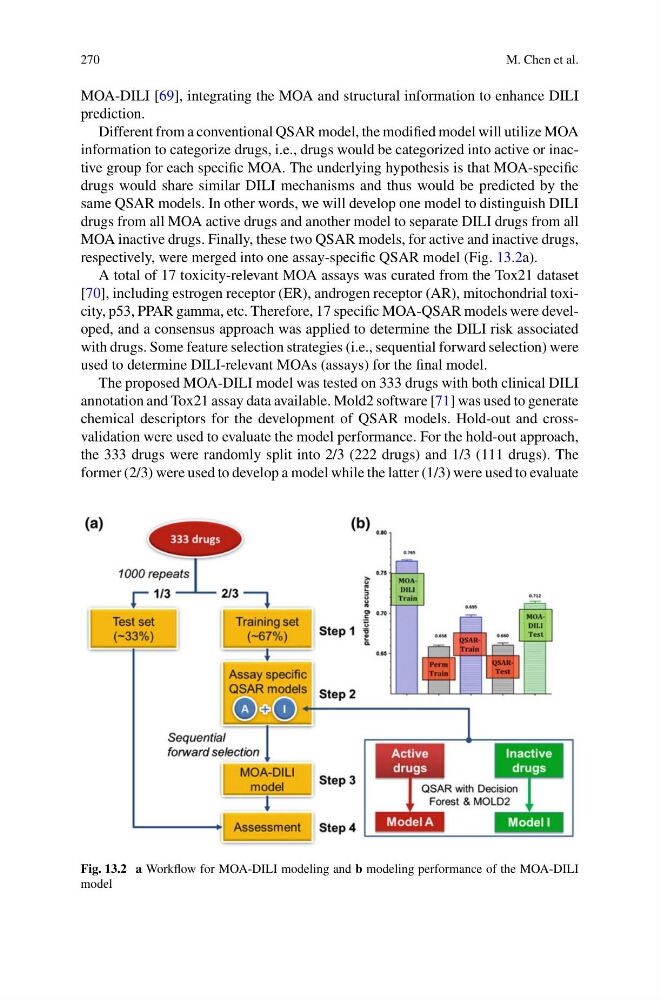
respectively, were merged into one assay-specific QSAR model (Fig. 13.2a).
A total of 17 toxicity-relevant MOA assays was curated from the Tox21 dataset
[70], including estrogen receptor (ER), androgen receptor (AR), mitochondrial toxicity, p53, PPAR gamma, etc. Therefore, 17 specific MOA-QSAR models were developed, and a consensus approach was applied to determine the DILI risk associated
with drugs. Some feature selection strategies (i.e., sequential forward selection) were
used to determine DILI-relevant MOAs (assays) for the final model.
The proposed MOA-DILI model was tested on 333 drugs with both clinical DILI
annotation and Tox21 assay data available. Mold2 software [71] was used to generate
chemical descriptors for the development of QSAR models. Hold-out and crossvalidation were used to evaluate the model performance. For the hold-out approach,
the 333 drugs were randomly split into 2/3 (222 drugs) and 1/3 (111 drugs). The
former (2/3) were used to develop a model while the latter (1/3) were used to evaluate
Fig. 13.2 a Workflow for MOA-DILI modeling and b modeling performance of the MOA-DILI
model
M. Chen et al.
MOA-DILI [69], integrating the MOA and structural information to enhance DILI
prediction.
Different from a conventional QSAR model, the modified model will utilize MOA
information to categorize drugs, i.e., drugs would be categorized into active or inactive group for each specific MOA. The underlying hypothesis is that MOA-specific
drugs would share similar DILI mechanisms and thus would be predicted by the
same QSAR models. In other words, we will develop one model to distinguish DILI
drugs from all MOA active drugs and another model to separate DILI drugs from all
MOA inactive drugs. Finally, these two QSAR models, for active and inactive drugs,
respectively, were merged into one assay-specific QSAR model (Fig. 13.2a).
A total of 17 toxicity-relevant MOA assays was curated from the Tox21 dataset
[70], including estrogen receptor (ER), androgen receptor (AR), mitochondrial toxicity, p53, PPAR gamma, etc. Therefore, 17 specific MOA-QSAR models were developed, and a consensus approach was applied to determine the DILI risk associated
with drugs. Some feature selection strategies (i.e., sequential forward selection) were
used to determine DILI-relevant MOAs (assays) for the final model.
The proposed MOA-DILI model was tested on 333 drugs with both clinical DILI
annotation and Tox21 assay data available. Mold2 software [71] was used to generate
chemical descriptors for the development of QSAR models. Hold-out and crossvalidation were used to evaluate the model performance. For the hold-out approach,
the 333 drugs were randomly split into 2/3 (222 drugs) and 1/3 (111 drugs). The
former (2/3) were used to develop a model while the latter (1/3) were used to evaluate
Fig. 13.2 a Workflow for MOA-DILI modeling and b modeling performance of the MOA-DILI
model