

12 Application of Computational Methods for the Safety Assessment …
247
Identifiers (DSSTox GSIDs), Cosmetic Ingredient (CosIng) reference numbers) are
tracked to allow data cross-referencing between CERES and the source databases.
External chemicals and their structures are linked to CERES chemicals through the
CRS-IDs. This setup allows cheminformatics analyses to be performed across all
chemicals in CERES.
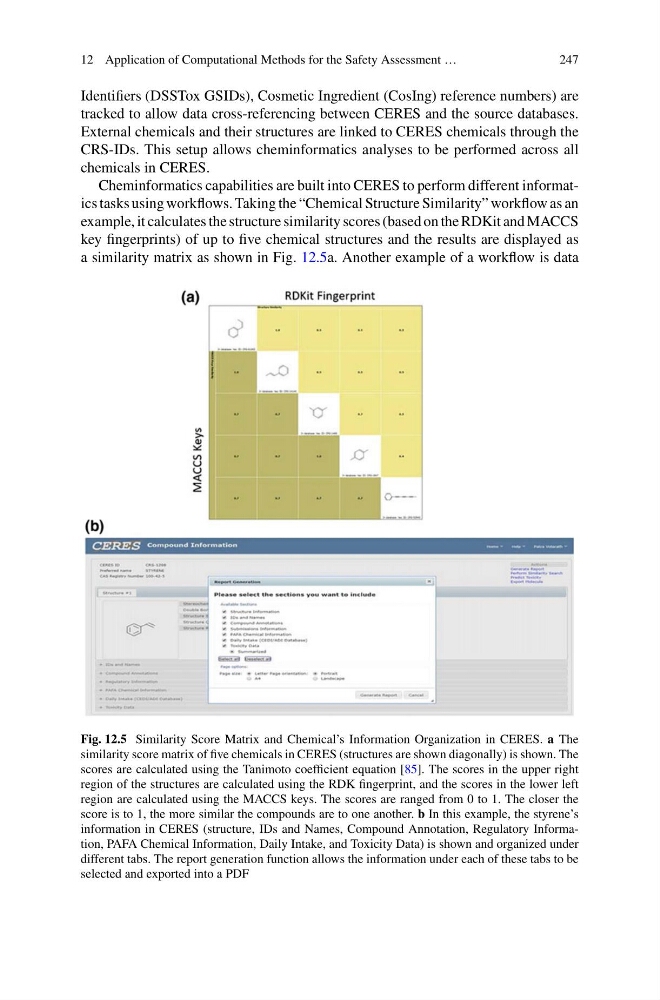
Cheminformatics capabilities are built into CERES to perform different informatics tasks using workflows. Taking the “Chemical Structure Similarity” workflow as an
example, it calculates the structure similarity scores (based on the RDKit and MACCS
key fingerprints) of up to five chemical structures and the results are displayed as
a similarity matrix as shown in Fig. 12.5a. Another example of a workflow is data
Fig. 12.5 Similarity Score Matrix and Chemical’s Information Organization in CERES. a The
similarity score matrix of five chemicals in CERES (structures are shown diagonally) is shown. The
scores are calculated using the Tanimoto coefficient equation [85]. The scores in the upper right
region of the structures are calculated using the RDK fingerprint, and the scores in the lower left
region are calculated using the MACCS keys. The scores are ranged from 0 to 1. The closer the
score is to 1, the more similar the compounds are to one another. b In this example, the styrene’s
information in CERES (structure, IDs and Names, Compound Annotation, Regulatory Information, PAFA Chemical Information, Daily Intake, and Toxicity Data) is shown and organized under
different tabs. The report generation function allows the information under each of these tabs to be
selected and exported into a PDF
247
Identifiers (DSSTox GSIDs), Cosmetic Ingredient (CosIng) reference numbers) are
tracked to allow data cross-referencing between CERES and the source databases.
External chemicals and their structures are linked to CERES chemicals through the
CRS-IDs. This setup allows cheminformatics analyses to be performed across all
chemicals in CERES.
Cheminformatics capabilities are built into CERES to perform different informatics tasks using workflows. Taking the “Chemical Structure Similarity” workflow as an
example, it calculates the structure similarity scores (based on the RDKit and MACCS
key fingerprints) of up to five chemical structures and the results are displayed as
a similarity matrix as shown in Fig. 12.5a. Another example of a workflow is data
Fig. 12.5 Similarity Score Matrix and Chemical’s Information Organization in CERES. a The
similarity score matrix of five chemicals in CERES (structures are shown diagonally) is shown. The
scores are calculated using the Tanimoto coefficient equation [85]. The scores in the upper right
region of the structures are calculated using the RDK fingerprint, and the scores in the lower left
region are calculated using the MACCS keys. The scores are ranged from 0 to 1. The closer the
score is to 1, the more similar the compounds are to one another. b In this example, the styrene’s
information in CERES (structure, IDs and Names, Compound Annotation, Regulatory Information, PAFA Chemical Information, Daily Intake, and Toxicity Data) is shown and organized under
different tabs. The report generation function allows the information under each of these tabs to be
selected and exported into a PDF