

11 Applicability Domain: Towards a More Formal …
221
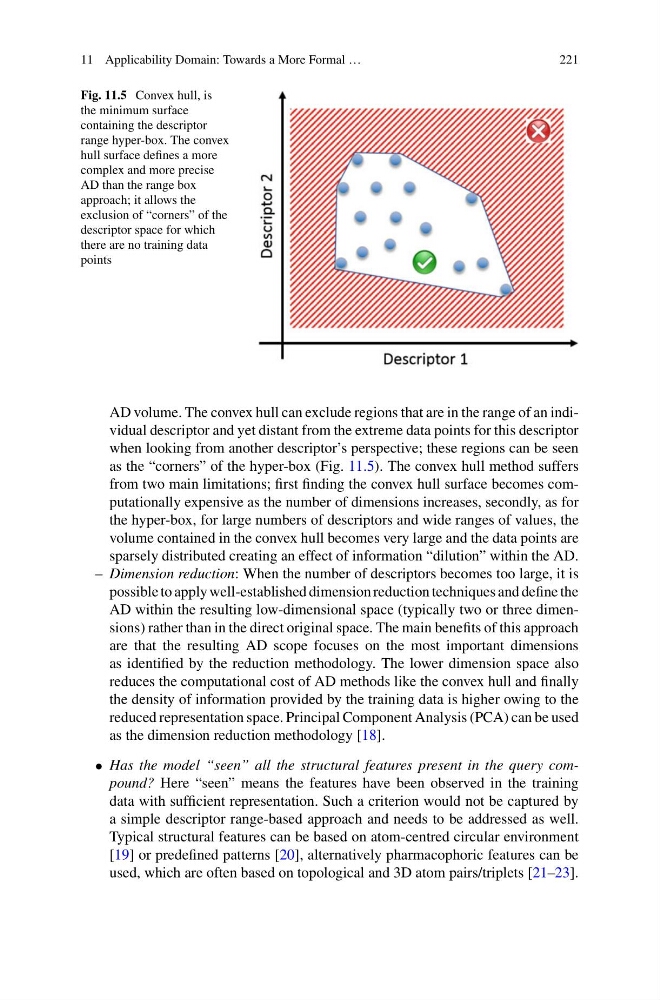
Fig. 11.5 Convex hull, is
the minimum surface
containing the descriptor
range hyper-box. The convex
hull surface defines a more
complex and more precise
AD than the range box
approach; it allows the
exclusion of “corners” of the
descriptor space for which
there are no training data
points
AD volume. The convex hull can exclude regions that are in the range of an individual descriptor and yet distant from the extreme data points for this descriptor
when looking from another descriptor’s perspective; these regions can be seen
as the “corners” of the hyper-box (Fig. 11.5). The convex hull method suffers
from two main limitations; first finding the convex hull surface becomes computationally expensive as the number of dimensions increases, secondly, as for
the hyper-box, for large numbers of descriptors and wide ranges of values, the
volume contained in the convex hull becomes very large and the data points are
sparsely distributed creating an effect of information “dilution” within the AD.
– Dimension reduction: When the number of descriptors becomes too large, it is
possible to apply well-established dimension reduction techniques and define the
AD within the resulting low-dimensional space (typically two or three dimensions) rather than in the direct original space. The main benefits of this approach
are that the resulting AD scope focuses on the most important dimensions
as identified by the reduction methodology. The lower dimension space also
reduces the computational cost of AD methods like the convex hull and finally
the density of information provided by the training data is higher owing to the
reduced representation space. Principal Component Analysis (PCA) can be used
as the dimension reduction methodology [18].
• Has the model “seen” all the structural features present in the query compound? Here “seen” means the features have been observed in the training
data with sufficient representation. Such a criterion would not be captured by
a simple descriptor range-based approach and needs to be addressed as well.
Typical structural features can be based on atom-centred circular environment
[19] or predefined patterns [20], alternatively pharmacophoric features can be
used, which are often based on topological and 3D atom pairs/triplets [21–23].
221
Fig. 11.5 Convex hull, is
the minimum surface
containing the descriptor
range hyper-box. The convex
hull surface defines a more
complex and more precise
AD than the range box
approach; it allows the
exclusion of “corners” of the
descriptor space for which
there are no training data
points
AD volume. The convex hull can exclude regions that are in the range of an individual descriptor and yet distant from the extreme data points for this descriptor
when looking from another descriptor’s perspective; these regions can be seen
as the “corners” of the hyper-box (Fig. 11.5). The convex hull method suffers
from two main limitations; first finding the convex hull surface becomes computationally expensive as the number of dimensions increases, secondly, as for
the hyper-box, for large numbers of descriptors and wide ranges of values, the
volume contained in the convex hull becomes very large and the data points are
sparsely distributed creating an effect of information “dilution” within the AD.
– Dimension reduction: When the number of descriptors becomes too large, it is
possible to apply well-established dimension reduction techniques and define the
AD within the resulting low-dimensional space (typically two or three dimensions) rather than in the direct original space. The main benefits of this approach
are that the resulting AD scope focuses on the most important dimensions
as identified by the reduction methodology. The lower dimension space also
reduces the computational cost of AD methods like the convex hull and finally
the density of information provided by the training data is higher owing to the
reduced representation space. Principal Component Analysis (PCA) can be used
as the dimension reduction methodology [18].
• Has the model “seen” all the structural features present in the query compound? Here “seen” means the features have been observed in the training
data with sufficient representation. Such a criterion would not be captured by
a simple descriptor range-based approach and needs to be addressed as well.
Typical structural features can be based on atom-centred circular environment
[19] or predefined patterns [20], alternatively pharmacophoric features can be
used, which are often based on topological and 3D atom pairs/triplets [21–23].