

10 Applications of Molecular Dynamics Simulations …
205
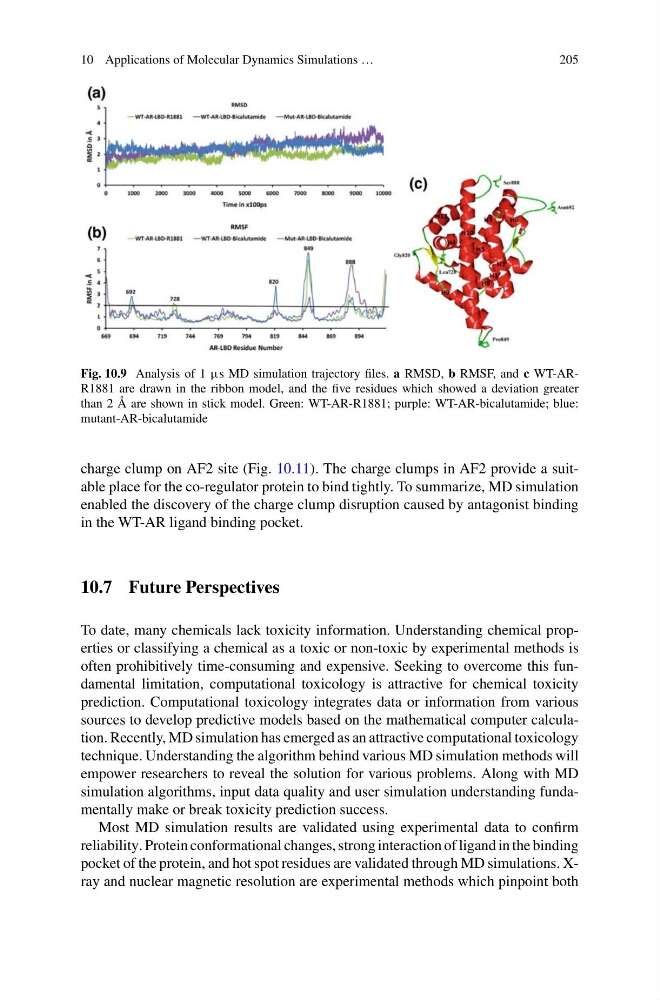
Fig. 10.9 Analysis of 1 μs MD simulation trajectory files. a RMSD, b RMSF, and c WT-ARR1881 are drawn in the ribbon model, and the five residues which showed a deviation greater
than 2 Å are shown in stick model. Green: WT-AR-R1881; purple: WT-AR-bicalutamide; blue:
mutant-AR-bicalutamide
charge clump on AF2 site (Fig. 10.11). The charge clumps in AF2 provide a suitable place for the co-regulator protein to bind tightly. To summarize, MD simulation
enabled the discovery of the charge clump disruption caused by antagonist binding
in the WT-AR ligand binding pocket.
10.7 Future Perspectives
To date, many chemicals lack toxicity information. Understanding chemical properties or classifying a chemical as a toxic or non-toxic by experimental methods is
often prohibitively time-consuming and expensive. Seeking to overcome this fundamental limitation, computational toxicology is attractive for chemical toxicity
prediction. Computational toxicology integrates data or information from various
sources to develop predictive models based on the mathematical computer calculation. Recently, MD simulation has emerged as an attractive computational toxicology
technique. Understanding the algorithm behind various MD simulation methods will
empower researchers to reveal the solution for various problems. Along with MD
simulation algorithms, input data quality and user simulation understanding fundamentally make or break toxicity prediction success.
Most MD simulation results are validated using experimental data to confirm
reliability. Protein conformational changes, strong interaction of ligand in the binding
pocket of the protein, and hot spot residues are validated through MD simulations. Xray and nuclear magnetic resolution are experimental methods which pinpoint both
205
Fig. 10.9 Analysis of 1 μs MD simulation trajectory files. a RMSD, b RMSF, and c WT-ARR1881 are drawn in the ribbon model, and the five residues which showed a deviation greater
than 2 Å are shown in stick model. Green: WT-AR-R1881; purple: WT-AR-bicalutamide; blue:
mutant-AR-bicalutamide
charge clump on AF2 site (Fig. 10.11). The charge clumps in AF2 provide a suitable place for the co-regulator protein to bind tightly. To summarize, MD simulation
enabled the discovery of the charge clump disruption caused by antagonist binding
in the WT-AR ligand binding pocket.
10.7 Future Perspectives
To date, many chemicals lack toxicity information. Understanding chemical properties or classifying a chemical as a toxic or non-toxic by experimental methods is
often prohibitively time-consuming and expensive. Seeking to overcome this fundamental limitation, computational toxicology is attractive for chemical toxicity
prediction. Computational toxicology integrates data or information from various
sources to develop predictive models based on the mathematical computer calculation. Recently, MD simulation has emerged as an attractive computational toxicology
technique. Understanding the algorithm behind various MD simulation methods will
empower researchers to reveal the solution for various problems. Along with MD
simulation algorithms, input data quality and user simulation understanding fundamentally make or break toxicity prediction success.
Most MD simulation results are validated using experimental data to confirm
reliability. Protein conformational changes, strong interaction of ligand in the binding
pocket of the protein, and hot spot residues are validated through MD simulations. Xray and nuclear magnetic resolution are experimental methods which pinpoint both