

84
X. Wang et al.
7.2.2 VAE
VAE is a deep generation model, which is mainly used for data compression and
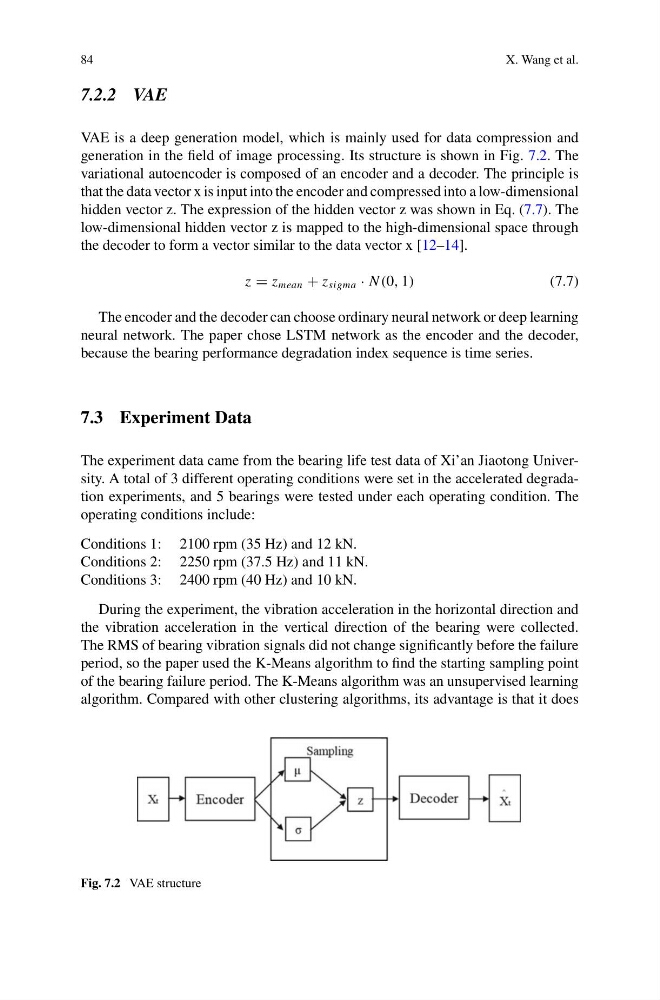
generation in the field of image processing. Its structure is shown in Fig. 7.2. The
variational autoencoder is composed of an encoder and a decoder. The principle is
that the data vector x is input into the encoder and compressed into a low-dimensional
hidden vector z. The expression of the hidden vector z was shown in Eq. (7.7). The
low-dimensional hidden vector z is mapped to the high-dimensional space through
the decoder to form a vector similar to the data vector x [12–14].
z = z mean + z sigma · N (0, 1)
(7.7)
The encoder and the decoder can choose ordinary neural network or deep learning
neural network. The paper chose LSTM network as the encoder and the decoder,
because the bearing performance degradation index sequence is time series.
7.3 Experiment Data
The experiment data came from the bearing life test data of Xi’an Jiaotong University. A total of 3 different operating conditions were set in the accelerated degradation experiments, and 5 bearings were tested under each operating condition. The
operating conditions include:
Conditions 1: 2100 rpm (35 Hz) and 12 kN.
Conditions 2: 2250 rpm (37.5 Hz) and 11 kN.
Conditions 3: 2400 rpm (40 Hz) and 10 kN.
During the experiment, the vibration acceleration in the horizontal direction and
the vibration acceleration in the vertical direction of the bearing were collected.
The RMS of bearing vibration signals did not change significantly before the failure
period, so the paper used the K-Means algorithm to find the starting sampling point
of the bearing failure period. The K-Means algorithm was an unsupervised learning
algorithm. Compared with other clustering algorithms, its advantage is that it does
Fig. 7.2 VAE structure
X. Wang et al.
7.2.2 VAE
VAE is a deep generation model, which is mainly used for data compression and
generation in the field of image processing. Its structure is shown in Fig. 7.2. The
variational autoencoder is composed of an encoder and a decoder. The principle is
that the data vector x is input into the encoder and compressed into a low-dimensional
hidden vector z. The expression of the hidden vector z was shown in Eq. (7.7). The
low-dimensional hidden vector z is mapped to the high-dimensional space through
the decoder to form a vector similar to the data vector x [12–14].
z = z mean + z sigma · N (0, 1)
(7.7)
The encoder and the decoder can choose ordinary neural network or deep learning
neural network. The paper chose LSTM network as the encoder and the decoder,
because the bearing performance degradation index sequence is time series.
7.3 Experiment Data
The experiment data came from the bearing life test data of Xi’an Jiaotong University. A total of 3 different operating conditions were set in the accelerated degradation experiments, and 5 bearings were tested under each operating condition. The
operating conditions include:
Conditions 1: 2100 rpm (35 Hz) and 12 kN.
Conditions 2: 2250 rpm (37.5 Hz) and 11 kN.
Conditions 3: 2400 rpm (40 Hz) and 10 kN.
During the experiment, the vibration acceleration in the horizontal direction and
the vibration acceleration in the vertical direction of the bearing were collected.
The RMS of bearing vibration signals did not change significantly before the failure
period, so the paper used the K-Means algorithm to find the starting sampling point
of the bearing failure period. The K-Means algorithm was an unsupervised learning
algorithm. Compared with other clustering algorithms, its advantage is that it does
Fig. 7.2 VAE structure