

78
Q. Liu et al.
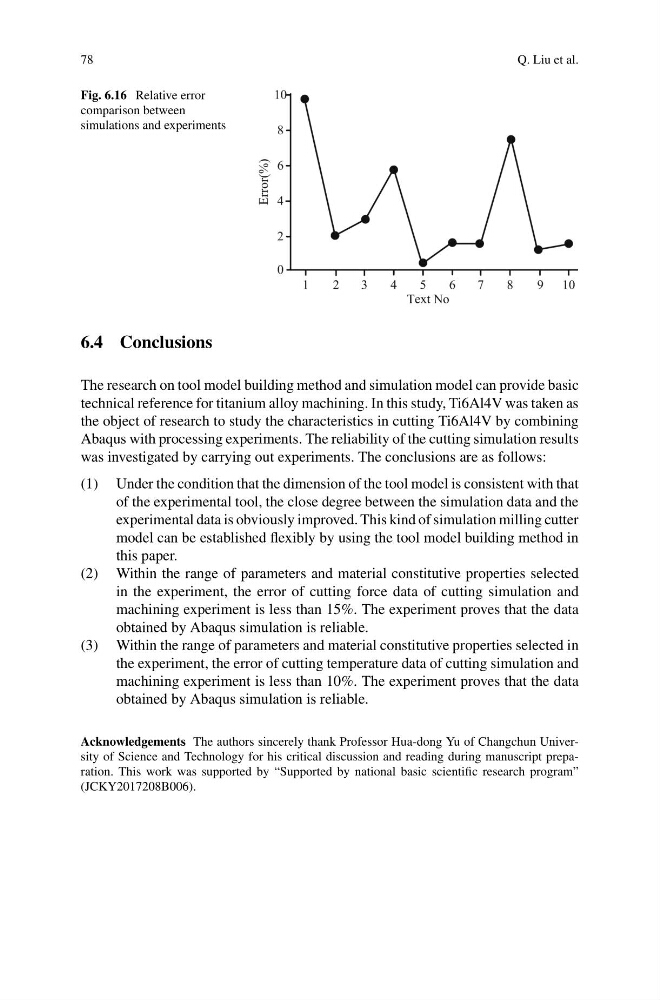
Fig. 6.16 Relative error
comparison between
simulations and experiments
6.4 Conclusions
The research on tool model building method and simulation model can provide basic
technical reference for titanium alloy machining. In this study, Ti6Al4V was taken as
the object of research to study the characteristics in cutting Ti6Al4V by combining
Abaqus with processing experiments. The reliability of the cutting simulation results
was investigated by carrying out experiments. The conclusions are as follows:
(1) Under the condition that the dimension of the tool model is consistent with that
of the experimental tool, the close degree between the simulation data and the
experimental data is obviously improved. This kind of simulation milling cutter
model can be established flexibly by using the tool model building method in
this paper.
(2) Within the range of parameters and material constitutive properties selected
in the experiment, the error of cutting force data of cutting simulation and
machining experiment is less than 15%. The experiment proves that the data
obtained by Abaqus simulation is reliable.
(3) Within the range of parameters and material constitutive properties selected in
the experiment, the error of cutting temperature data of cutting simulation and
machining experiment is less than 10%. The experiment proves that the data
obtained by Abaqus simulation is reliable.
Acknowledgements The authors sincerely thank Professor Hua-dong Yu of Changchun University of Science and Technology for his critical discussion and reading during manuscript preparation. This work was supported by “Supported by national basic scientific research program”
(JCKY2017208B006).
Q. Liu et al.
Fig. 6.16 Relative error
comparison between
simulations and experiments
6.4 Conclusions
The research on tool model building method and simulation model can provide basic
technical reference for titanium alloy machining. In this study, Ti6Al4V was taken as
the object of research to study the characteristics in cutting Ti6Al4V by combining
Abaqus with processing experiments. The reliability of the cutting simulation results
was investigated by carrying out experiments. The conclusions are as follows:
(1) Under the condition that the dimension of the tool model is consistent with that
of the experimental tool, the close degree between the simulation data and the
experimental data is obviously improved. This kind of simulation milling cutter
model can be established flexibly by using the tool model building method in
this paper.
(2) Within the range of parameters and material constitutive properties selected
in the experiment, the error of cutting force data of cutting simulation and
machining experiment is less than 15%. The experiment proves that the data
obtained by Abaqus simulation is reliable.
(3) Within the range of parameters and material constitutive properties selected in
the experiment, the error of cutting temperature data of cutting simulation and
machining experiment is less than 10%. The experiment proves that the data
obtained by Abaqus simulation is reliable.
Acknowledgements The authors sincerely thank Professor Hua-dong Yu of Changchun University of Science and Technology for his critical discussion and reading during manuscript preparation. This work was supported by “Supported by national basic scientific research program”
(JCKY2017208B006).