

6 Tool Model Building and Research on Cutting Simulation …
77
Table 6.6 Temperature comparison between experimental, simulated and statistical values
Std Order
Cutting parameters
Simulation
Experiments
Error
(%)
n (r/min)
F (mm/min)
a p (mm)
Temperature
(°C)
Temperature
(°C)
1
4000
400
0.04
90.26
100
9.7
2
8000
400
0.04
286.1
280
2.1
3
12,000
400
0.04
582.8
601
3
4
16,000
400
0.04
1411
1499
5.9
5
16,000
200
0.04
342.4
351
0.3
6
16,000
600
0.04
1038
1022
1.6
7
16,000
800
0.04
1683
1657
1.6
8
16,000
400
0.02
116.3
126
7.7
9
16,000
400
0.06
1156
1170
1.2
10
16,000
400
0.08
2299
2267
1.4
temperature increase occurred because of shear slip of the metal plastic deformation
[3].
In the milling process, temperature was found to change with cutting thickness
because the instantaneous cutting thickness of the tool spiral edge varied. As the
milling cutter rotated during machining, the corresponding cutting thickness being
machined by spiral edge was different. Meanwhile, the temperature streamline in the
temperature rise area was non-uniform, and the cutting temperature along the helix
changed continuously. Therefore, the temperature conduction of the spiral edge in
the process of machining can be simplified as a length change.
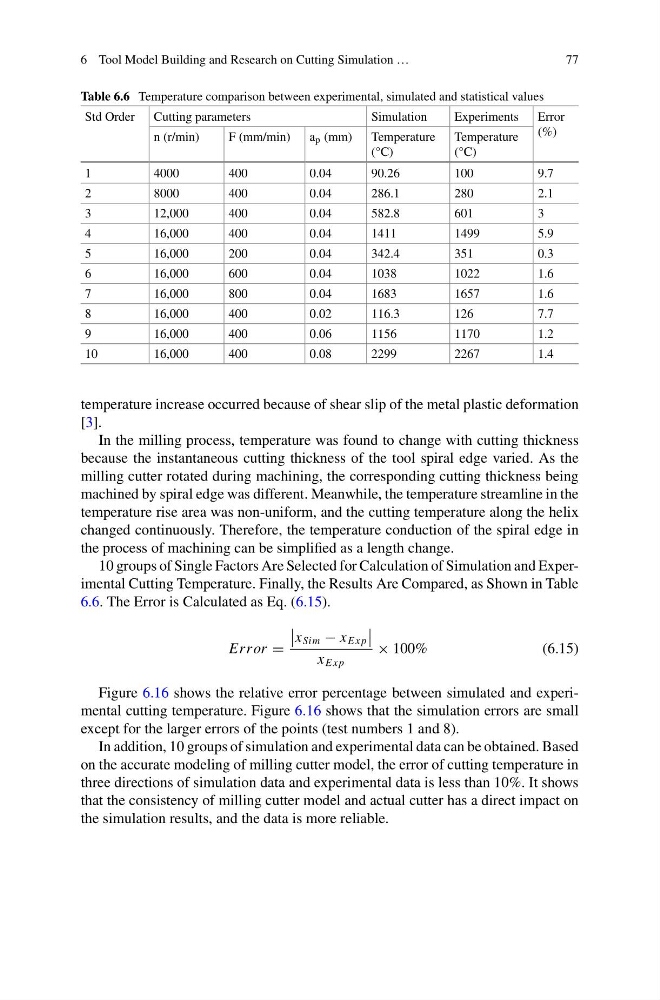
10 groups of Single Factors Are Selected for Calculation of Simulation and Experimental Cutting Temperature. Finally, the Results Are Compared, as Shown in Table
6.6. The Error is Calculated as Eq. (6.15).
Error =
x Sim − x Exp
x Exp
× 100%
(6.15)
Figure 6.16 shows the relative error percentage between simulated and experimental cutting temperature. Figure 6.16 shows that the simulation errors are small
except for the larger errors of the points (test numbers 1 and 8).
In addition, 10 groups of simulation and experimental data can be obtained. Based
on the accurate modeling of milling cutter model, the error of cutting temperature in
three directions of simulation data and experimental data is less than 10%. It shows
that the consistency of milling cutter model and actual cutter has a direct impact on
the simulation results, and the data is more reliable.
77
Table 6.6 Temperature comparison between experimental, simulated and statistical values
Std Order
Cutting parameters
Simulation
Experiments
Error
(%)
n (r/min)
F (mm/min)
a p (mm)
Temperature
(°C)
Temperature
(°C)
1
4000
400
0.04
90.26
100
9.7
2
8000
400
0.04
286.1
280
2.1
3
12,000
400
0.04
582.8
601
3
4
16,000
400
0.04
1411
1499
5.9
5
16,000
200
0.04
342.4
351
0.3
6
16,000
600
0.04
1038
1022
1.6
7
16,000
800
0.04
1683
1657
1.6
8
16,000
400
0.02
116.3
126
7.7
9
16,000
400
0.06
1156
1170
1.2
10
16,000
400
0.08
2299
2267
1.4
temperature increase occurred because of shear slip of the metal plastic deformation
[3].
In the milling process, temperature was found to change with cutting thickness
because the instantaneous cutting thickness of the tool spiral edge varied. As the
milling cutter rotated during machining, the corresponding cutting thickness being
machined by spiral edge was different. Meanwhile, the temperature streamline in the
temperature rise area was non-uniform, and the cutting temperature along the helix
changed continuously. Therefore, the temperature conduction of the spiral edge in
the process of machining can be simplified as a length change.
10 groups of Single Factors Are Selected for Calculation of Simulation and Experimental Cutting Temperature. Finally, the Results Are Compared, as Shown in Table
6.6. The Error is Calculated as Eq. (6.15).
Error =
x Sim − x Exp
x Exp
× 100%
(6.15)
Figure 6.16 shows the relative error percentage between simulated and experimental cutting temperature. Figure 6.16 shows that the simulation errors are small
except for the larger errors of the points (test numbers 1 and 8).
In addition, 10 groups of simulation and experimental data can be obtained. Based
on the accurate modeling of milling cutter model, the error of cutting temperature in
three directions of simulation data and experimental data is less than 10%. It shows
that the consistency of milling cutter model and actual cutter has a direct impact on
the simulation results, and the data is more reliable.