

2 Peridynamic Simulation for Thermal and Mechanical Behavior …
27
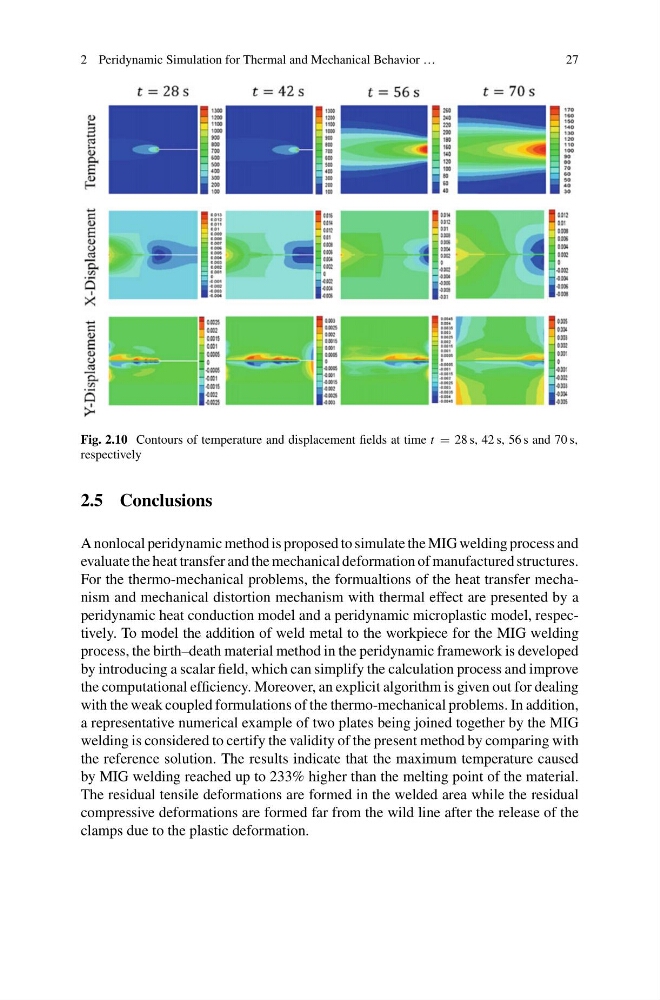
Fig. 2.10 Contours of temperature and displacement fields at time t = 28 s, 42 s, 56 s and 70 s,
respectively
2.5 Conclusions
A nonlocal peridynamic method is proposed to simulate the MIG welding process and
evaluate the heat transfer and the mechanical deformation of manufactured structures.
For the thermo-mechanical problems, the formualtions of the heat transfer mechanism and mechanical distortion mechanism with thermal effect are presented by a
peridynamic heat conduction model and a peridynamic microplastic model, respectively. To model the addition of weld metal to the workpiece for the MIG welding
process, the birth–death material method in the peridynamic framework is developed
by introducing a scalar field, which can simplify the calculation process and improve
the computational efficiency. Moreover, an explicit algorithm is given out for dealing
with the weak coupled formulations of the thermo-mechanical problems. In addition,
a representative numerical example of two plates being joined together by the MIG
welding is considered to certify the validity of the present method by comparing with
the reference solution. The results indicate that the maximum temperature caused
by MIG welding reached up to 233% higher than the melting point of the material.
The residual tensile deformations are formed in the welded area while the residual
compressive deformations are formed far from the wild line after the release of the
clamps due to the plastic deformation.
27
Fig. 2.10 Contours of temperature and displacement fields at time t = 28 s, 42 s, 56 s and 70 s,
respectively
2.5 Conclusions
A nonlocal peridynamic method is proposed to simulate the MIG welding process and
evaluate the heat transfer and the mechanical deformation of manufactured structures.
For the thermo-mechanical problems, the formualtions of the heat transfer mechanism and mechanical distortion mechanism with thermal effect are presented by a
peridynamic heat conduction model and a peridynamic microplastic model, respectively. To model the addition of weld metal to the workpiece for the MIG welding
process, the birth–death material method in the peridynamic framework is developed
by introducing a scalar field, which can simplify the calculation process and improve
the computational efficiency. Moreover, an explicit algorithm is given out for dealing
with the weak coupled formulations of the thermo-mechanical problems. In addition,
a representative numerical example of two plates being joined together by the MIG
welding is considered to certify the validity of the present method by comparing with
the reference solution. The results indicate that the maximum temperature caused
by MIG welding reached up to 233% higher than the melting point of the material.
The residual tensile deformations are formed in the welded area while the residual
compressive deformations are formed far from the wild line after the release of the
clamps due to the plastic deformation.