

2 Peridynamic Simulation for Thermal and Mechanical Behavior …
21
where σ y is the normal stress at yield in the continuum mechanics, A is the crosssection area for 1D and h is the thickness for 2D.
In addition, the both the displacement and force boundary conditions are demonstrated with the fictitious material points consistent with the thermal boundary
conditions.
2.3 Numerical Simulation of MIG Welding
The MIG welding process is modelled in an alternative algorithm of decoupled
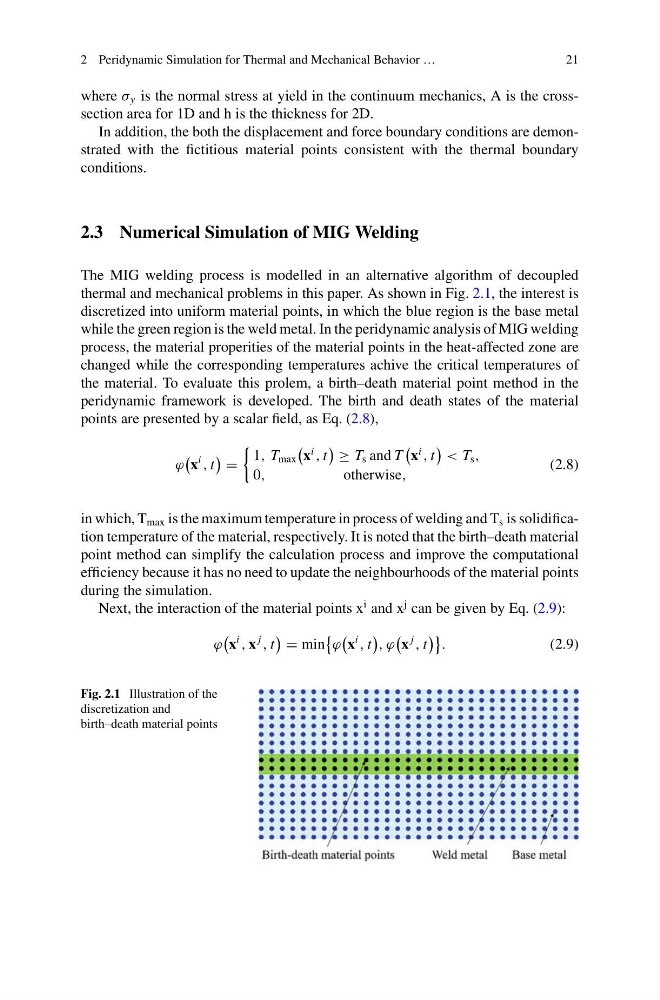
thermal and mechanical problems in this paper. As shown in Fig. 2.1, the interest is
discretized into uniform material points, in which the blue region is the base metal
while the green region is the weld metal. In the peridynamic analysis of MIG welding
process, the material properities of the material points in the heat-affected zone are
changed while the corresponding temperatures achive the critical temperatures of
the material. To evaluate this prolem, a birth–death material point method in the
peridynamic framework is developed. The birth and death states of the material
points are presented by a scalar field, as Eq. (2.8),
ϕ
x
i
, t
=
1, T max
x
i
, t
≥ T s and T
x
i
, t
< T s ,
0,
otherwise,
(2.8)
in which, T max is the maximum temperature in process of welding and T s is solidification temperature of the material, respectively. It is noted that the birth–death material
point method can simplify the calculation process and improve the computational
efficiency because it has no need to update the neighbourhoods of the material points
during the simulation.
Next, the interaction of the material points x
i and x
j can be given by Eq. (2.9):
ϕ
x
i
, x
j
, t
= min
ϕ
x
i
, t
, ϕ
x
j
, t
.
(2.9)
Fig. 2.1 Illustration of the
discretization and
birth–death material points
21
where σ y is the normal stress at yield in the continuum mechanics, A is the crosssection area for 1D and h is the thickness for 2D.
In addition, the both the displacement and force boundary conditions are demonstrated with the fictitious material points consistent with the thermal boundary
conditions.
2.3 Numerical Simulation of MIG Welding
The MIG welding process is modelled in an alternative algorithm of decoupled
thermal and mechanical problems in this paper. As shown in Fig. 2.1, the interest is
discretized into uniform material points, in which the blue region is the base metal
while the green region is the weld metal. In the peridynamic analysis of MIG welding
process, the material properities of the material points in the heat-affected zone are
changed while the corresponding temperatures achive the critical temperatures of
the material. To evaluate this prolem, a birth–death material point method in the
peridynamic framework is developed. The birth and death states of the material
points are presented by a scalar field, as Eq. (2.8),
ϕ
x
i
, t
=
1, T max
x
i
, t
≥ T s and T
x
i
, t
< T s ,
0,
otherwise,
(2.8)
in which, T max is the maximum temperature in process of welding and T s is solidification temperature of the material, respectively. It is noted that the birth–death material
point method can simplify the calculation process and improve the computational
efficiency because it has no need to update the neighbourhoods of the material points
during the simulation.
Next, the interaction of the material points x
i and x
j can be given by Eq. (2.9):
ϕ
x
i
, x
j
, t
= min
ϕ
x
i
, t
, ϕ
x
j
, t
.
(2.9)
Fig. 2.1 Illustration of the
discretization and
birth–death material points