

286
F. Lin et al.
polynomials; C
(r )
im , ¯
C
(r )
jn , and C −
(r )
kp
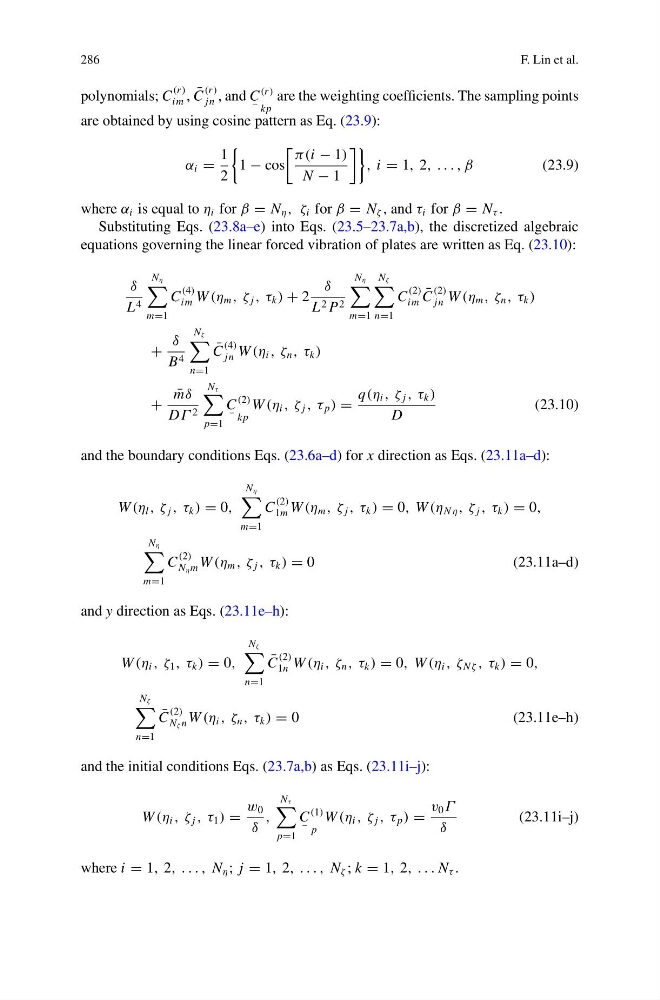
are the weighting coefficients. The sampling points
are obtained by using cosine pattern as Eq. (23.9):
α i =
1
2
1 − cos
π(i − 1)
N − 1
, i = 1, 2, . . . , β
(23.9)
where α i is equal to η i for β = N η , ζ i for β = N ζ , and τ i for β = N τ .
Substituting Eqs. (23.8a–e) into Eqs. (23.5–23.7a,b), the discretized algebraic
equations governing the linear forced vibration of plates are written as Eq. (23.10):
δ
L 4
N η
m=1
C
(4)
im W (η m , ζ j , τ k ) + 2
δ
L 2 P 2
N η
m=1
N ζ
n=1
C
(2)
im
¯
C
(2)
jn W (η m , ζ n , τ k )
+
δ
B 4
N ζ
n=1
¯
C
(4)
jn W (η i , ζ n , τ k )
+
¯
mδ
DΓ 2
N τ
p=1
C −
(2)
kp
W (η i , ζ j , τ p ) =
q(η i , ζ j , τ k )
D
(23.10)
and the boundary conditions Eqs. (23.6a–d) for x direction as Eqs. (23.11a–d):
W (η l , ζ j , τ k ) = 0,
N η
m=1
C
(2)
1m W (η m , ζ j , τ k ) = 0, W (η N η , ζ j , τ k ) = 0,
N η
m=1
C
(2)
N η m W (η m , ζ j , τ k ) = 0
(23.11a–d)
and y direction as Eqs. (23.11e–h):
W (η i , ζ 1 , τ k ) = 0,
N ζ
n=1
¯
C
(2)
1n W (η i , ζ n , τ k ) = 0, W (η i , ζ N ζ , τ k ) = 0,
N ζ
n=1
¯
C
(2)
N ζ n W (η i , ζ n , τ k ) = 0
(23.11e–h)
and the initial conditions Eqs. (23.7a,b) as Eqs. (23.11i–j):
W (η i , ζ j , τ 1 ) =
w 0
δ
,
N τ
p=1
C −
(1)
p
W (η i , ζ j , τ p ) =
v 0 Γ
δ
(23.11i–j)
where i = 1, 2, . . . , N η ; j = 1, 2, . . . , N ζ ; k = 1, 2, . . . N τ .
F. Lin et al.
polynomials; C
(r )
im , ¯
C
(r )
jn , and C −
(r )
kp
are the weighting coefficients. The sampling points
are obtained by using cosine pattern as Eq. (23.9):
α i =
1
2
1 − cos
π(i − 1)
N − 1
, i = 1, 2, . . . , β
(23.9)
where α i is equal to η i for β = N η , ζ i for β = N ζ , and τ i for β = N τ .
Substituting Eqs. (23.8a–e) into Eqs. (23.5–23.7a,b), the discretized algebraic
equations governing the linear forced vibration of plates are written as Eq. (23.10):
δ
L 4
N η
m=1
C
(4)
im W (η m , ζ j , τ k ) + 2
δ
L 2 P 2
N η
m=1
N ζ
n=1
C
(2)
im
¯
C
(2)
jn W (η m , ζ n , τ k )
+
δ
B 4
N ζ
n=1
¯
C
(4)
jn W (η i , ζ n , τ k )
+
¯
mδ
DΓ 2
N τ
p=1
C −
(2)
kp
W (η i , ζ j , τ p ) =
q(η i , ζ j , τ k )
D
(23.10)
and the boundary conditions Eqs. (23.6a–d) for x direction as Eqs. (23.11a–d):
W (η l , ζ j , τ k ) = 0,
N η
m=1
C
(2)
1m W (η m , ζ j , τ k ) = 0, W (η N η , ζ j , τ k ) = 0,
N η
m=1
C
(2)
N η m W (η m , ζ j , τ k ) = 0
(23.11a–d)
and y direction as Eqs. (23.11e–h):
W (η i , ζ 1 , τ k ) = 0,
N ζ
n=1
¯
C
(2)
1n W (η i , ζ n , τ k ) = 0, W (η i , ζ N ζ , τ k ) = 0,
N ζ
n=1
¯
C
(2)
N ζ n W (η i , ζ n , τ k ) = 0
(23.11e–h)
and the initial conditions Eqs. (23.7a,b) as Eqs. (23.11i–j):
W (η i , ζ j , τ 1 ) =
w 0
δ
,
N τ
p=1
C −
(1)
p
W (η i , ζ j , τ p ) =
v 0 Γ
δ
(23.11i–j)
where i = 1, 2, . . . , N η ; j = 1, 2, . . . , N ζ ; k = 1, 2, . . . N τ .