

276
X. Zhang and Q. Zhang
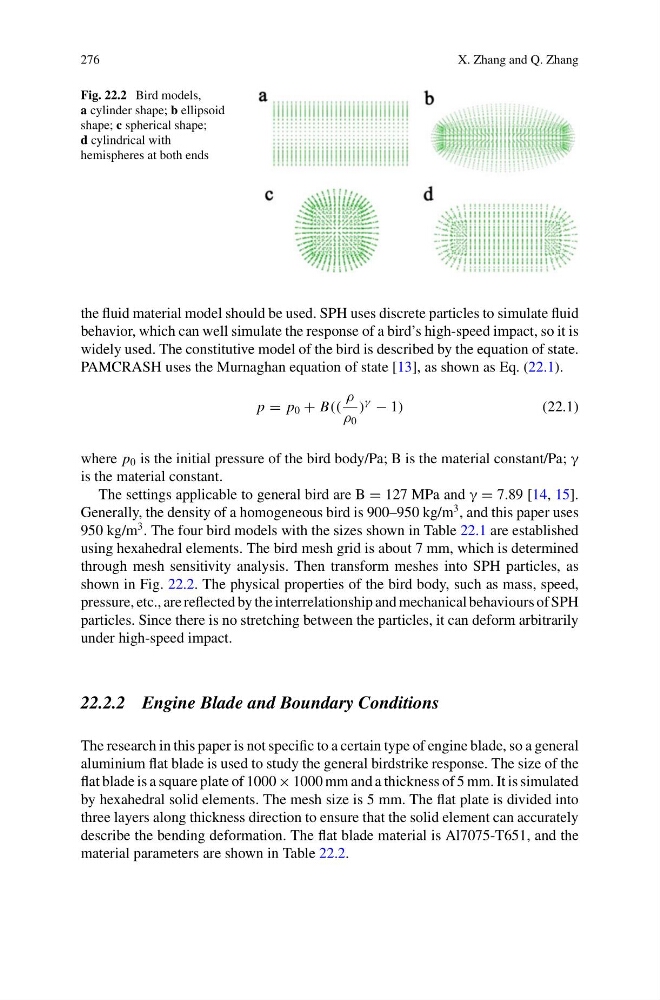
Fig. 22.2 Bird models,
a cylinder shape; b ellipsoid
shape; c spherical shape;
d cylindrical with
hemispheres at both ends
the fluid material model should be used. SPH uses discrete particles to simulate fluid
behavior, which can well simulate the response of a bird’s high-speed impact, so it is
widely used. The constitutive model of the bird is described by the equation of state.
PAMCRASH uses the Murnaghan equation of state [13], as shown as Eq. (22.1).
p = p 0 + B((
ρ
ρ 0
)
γ
− 1)
(22.1)
where p 0 is the initial pressure of the bird body/Pa; B is the material constant/Pa; γ
is the material constant.
The settings applicable to general bird are B = 127 MPa and γ = 7.89 [14, 15].
Generally, the density of a homogeneous bird is 900–950 kg/m
3 , and this paper uses
950 kg/m
3 . The four bird models with the sizes shown in Table 22.1 are established
using hexahedral elements. The bird mesh grid is about 7 mm, which is determined
through mesh sensitivity analysis. Then transform meshes into SPH particles, as
shown in Fig. 22.2. The physical properties of the bird body, such as mass, speed,
pressure, etc., are reflected by the interrelationship and mechanical behaviours of SPH
particles. Since there is no stretching between the particles, it can deform arbitrarily
under high-speed impact.
22.2.2 Engine Blade and Boundary Conditions
The research in this paper is not specific to a certain type of engine blade, so a general
aluminium flat blade is used to study the general birdstrike response. The size of the
flat blade is a square plate of 1000 × 1000 mm and a thickness of 5 mm. It is simulated
by hexahedral solid elements. The mesh size is 5 mm. The flat plate is divided into
three layers along thickness direction to ensure that the solid element can accurately
describe the bending deformation. The flat blade material is Al7075-T651, and the
material parameters are shown in Table 22.2.
X. Zhang and Q. Zhang
Fig. 22.2 Bird models,
a cylinder shape; b ellipsoid
shape; c spherical shape;
d cylindrical with
hemispheres at both ends
the fluid material model should be used. SPH uses discrete particles to simulate fluid
behavior, which can well simulate the response of a bird’s high-speed impact, so it is
widely used. The constitutive model of the bird is described by the equation of state.
PAMCRASH uses the Murnaghan equation of state [13], as shown as Eq. (22.1).
p = p 0 + B((
ρ
ρ 0
)
γ
− 1)
(22.1)
where p 0 is the initial pressure of the bird body/Pa; B is the material constant/Pa; γ
is the material constant.
The settings applicable to general bird are B = 127 MPa and γ = 7.89 [14, 15].
Generally, the density of a homogeneous bird is 900–950 kg/m
3 , and this paper uses
950 kg/m
3 . The four bird models with the sizes shown in Table 22.1 are established
using hexahedral elements. The bird mesh grid is about 7 mm, which is determined
through mesh sensitivity analysis. Then transform meshes into SPH particles, as
shown in Fig. 22.2. The physical properties of the bird body, such as mass, speed,
pressure, etc., are reflected by the interrelationship and mechanical behaviours of SPH
particles. Since there is no stretching between the particles, it can deform arbitrarily
under high-speed impact.
22.2.2 Engine Blade and Boundary Conditions
The research in this paper is not specific to a certain type of engine blade, so a general
aluminium flat blade is used to study the general birdstrike response. The size of the
flat blade is a square plate of 1000 × 1000 mm and a thickness of 5 mm. It is simulated
by hexahedral solid elements. The mesh size is 5 mm. The flat plate is divided into
three layers along thickness direction to ensure that the solid element can accurately
describe the bending deformation. The flat blade material is Al7075-T651, and the
material parameters are shown in Table 22.2.