

248
F. Liang et al.
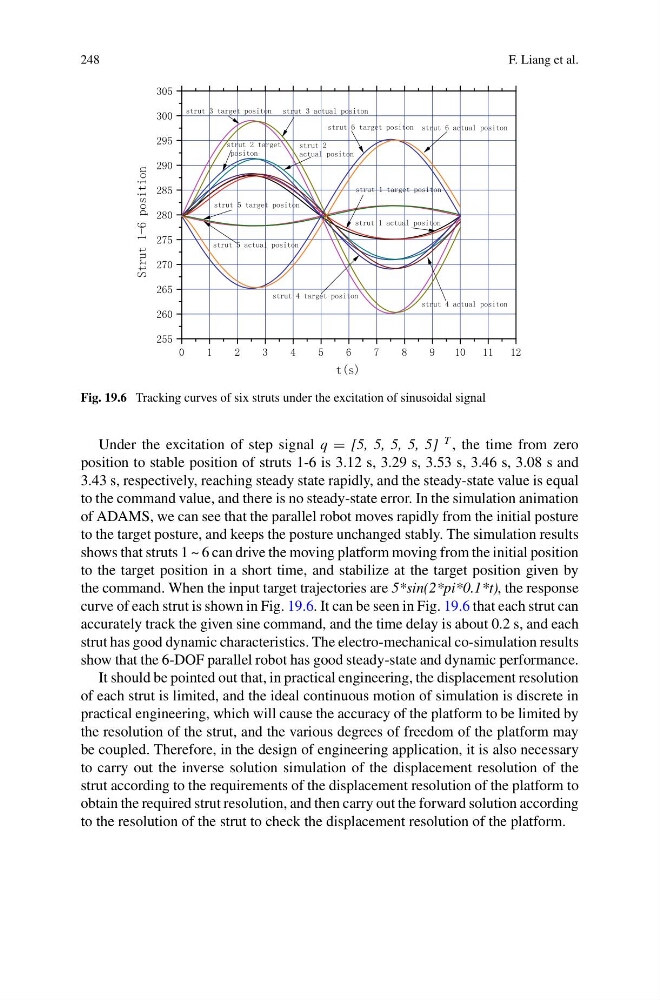
Fig. 19.6 Tracking curves of six struts under the excitation of sinusoidal signal
Under the excitation of step signal q = [5, 5, 5, 5, 5]
T , the time from zero
position to stable position of struts 1-6 is 3.12 s, 3.29 s, 3.53 s, 3.46 s, 3.08 s and
3.43 s, respectively, reaching steady state rapidly, and the steady-state value is equal
to the command value, and there is no steady-state error. In the simulation animation
of ADAMS, we can see that the parallel robot moves rapidly from the initial posture
to the target posture, and keeps the posture unchanged stably. The simulation results
shows that struts 1 ~ 6 can drive the moving platform moving from the initial position
to the target position in a short time, and stabilize at the target position given by
the command. When the input target trajectories are 5*sin(2*pi*0.1*t), the response
curve of each strut is shown in Fig. 19.6. It can be seen in Fig. 19.6 that each strut can
accurately track the given sine command, and the time delay is about 0.2 s, and each
strut has good dynamic characteristics. The electro-mechanical co-simulation results
show that the 6-DOF parallel robot has good steady-state and dynamic performance.
It should be pointed out that, in practical engineering, the displacement resolution
of each strut is limited, and the ideal continuous motion of simulation is discrete in
practical engineering, which will cause the accuracy of the platform to be limited by
the resolution of the strut, and the various degrees of freedom of the platform may
be coupled. Therefore, in the design of engineering application, it is also necessary
to carry out the inverse solution simulation of the displacement resolution of the
strut according to the requirements of the displacement resolution of the platform to
obtain the required strut resolution, and then carry out the forward solution according
to the resolution of the strut to check the displacement resolution of the platform.
F. Liang et al.
Fig. 19.6 Tracking curves of six struts under the excitation of sinusoidal signal
Under the excitation of step signal q = [5, 5, 5, 5, 5]
T , the time from zero
position to stable position of struts 1-6 is 3.12 s, 3.29 s, 3.53 s, 3.46 s, 3.08 s and
3.43 s, respectively, reaching steady state rapidly, and the steady-state value is equal
to the command value, and there is no steady-state error. In the simulation animation
of ADAMS, we can see that the parallel robot moves rapidly from the initial posture
to the target posture, and keeps the posture unchanged stably. The simulation results
shows that struts 1 ~ 6 can drive the moving platform moving from the initial position
to the target position in a short time, and stabilize at the target position given by
the command. When the input target trajectories are 5*sin(2*pi*0.1*t), the response
curve of each strut is shown in Fig. 19.6. It can be seen in Fig. 19.6 that each strut can
accurately track the given sine command, and the time delay is about 0.2 s, and each
strut has good dynamic characteristics. The electro-mechanical co-simulation results
show that the 6-DOF parallel robot has good steady-state and dynamic performance.
It should be pointed out that, in practical engineering, the displacement resolution
of each strut is limited, and the ideal continuous motion of simulation is discrete in
practical engineering, which will cause the accuracy of the platform to be limited by
the resolution of the strut, and the various degrees of freedom of the platform may
be coupled. Therefore, in the design of engineering application, it is also necessary
to carry out the inverse solution simulation of the displacement resolution of the
strut according to the requirements of the displacement resolution of the platform to
obtain the required strut resolution, and then carry out the forward solution according
to the resolution of the strut to check the displacement resolution of the platform.