

18 The Effect of Surface Ultrasonic Rolling Processing …
229
Fig. 18.7 X-ray
diffractometer (XRD)
patterns of samples at
different rolling static loads
Microhardness / (HV )
0.3
Depth/(μm)
untreated
600 N
800 N
1000 N
1200 N
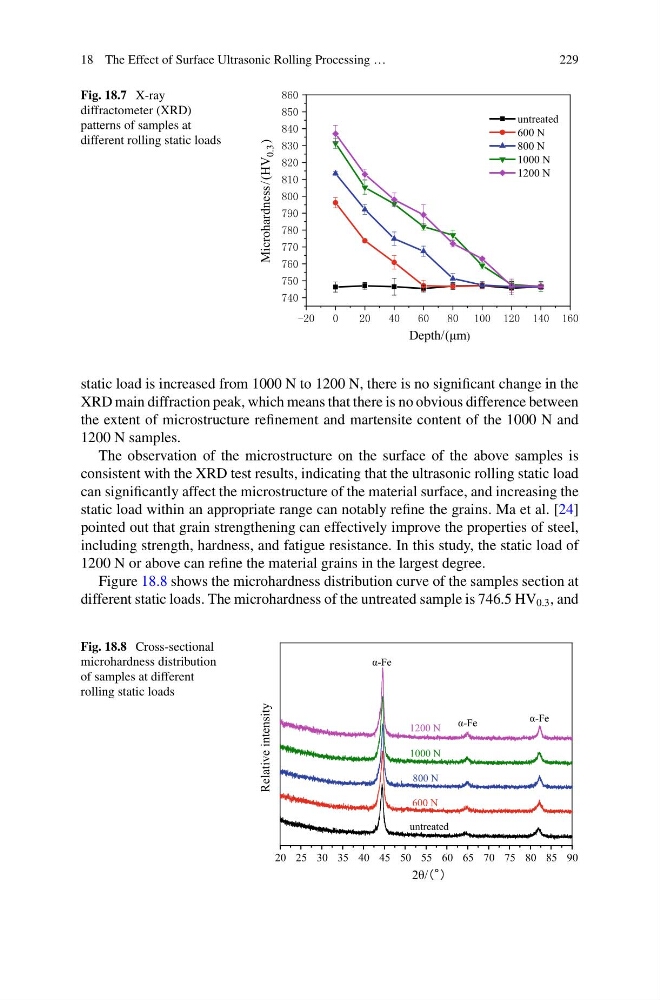
static load is increased from 1000 N to 1200 N, there is no significant change in the
XRD main diffraction peak, which means that there is no obvious difference between
the extent of microstructure refinement and martensite content of the 1000 N and
1200 N samples.
The observation of the microstructure on the surface of the above samples is
consistent with the XRD test results, indicating that the ultrasonic rolling static load
can significantly affect the microstructure of the material surface, and increasing the
static load within an appropriate range can notably refine the grains. Ma et al. [24]
pointed out that grain strengthening can effectively improve the properties of steel,
including strength, hardness, and fatigue resistance. In this study, the static load of
1200 N or above can refine the material grains in the largest degree.
Figure 18.8 shows the microhardness distribution curve of the samples section at
different static loads. The microhardness of the untreated sample is 746.5 HV 0.3 , and
Fig. 18.8 Cross-sectional
microhardness distribution
of samples at different
rolling static loads
20 25 30 35 40 45 50 55 60 65 70 75 80 85 90
Relative intensity
2θ/
α-Fe
α-Fe
α-Fe
untreated
600 N
800 N
1000 N
1200 N
229
Fig. 18.7 X-ray
diffractometer (XRD)
patterns of samples at
different rolling static loads
Microhardness / (HV )
0.3
Depth/(μm)
untreated
600 N
800 N
1000 N
1200 N
static load is increased from 1000 N to 1200 N, there is no significant change in the
XRD main diffraction peak, which means that there is no obvious difference between
the extent of microstructure refinement and martensite content of the 1000 N and
1200 N samples.
The observation of the microstructure on the surface of the above samples is
consistent with the XRD test results, indicating that the ultrasonic rolling static load
can significantly affect the microstructure of the material surface, and increasing the
static load within an appropriate range can notably refine the grains. Ma et al. [24]
pointed out that grain strengthening can effectively improve the properties of steel,
including strength, hardness, and fatigue resistance. In this study, the static load of
1200 N or above can refine the material grains in the largest degree.
Figure 18.8 shows the microhardness distribution curve of the samples section at
different static loads. The microhardness of the untreated sample is 746.5 HV 0.3 , and
Fig. 18.8 Cross-sectional
microhardness distribution
of samples at different
rolling static loads
20 25 30 35 40 45 50 55 60 65 70 75 80 85 90
Relative intensity
2θ/
α-Fe
α-Fe
α-Fe
untreated
600 N
800 N
1000 N
1200 N