

18 The Effect of Surface Ultrasonic Rolling Processing …
223
Microstructure and fatigue behavior of valve train tappet material will be explored,
and the crack propagation and fatigue damage form of strengthening surface will be
discussed. Finally, the optimal SURP process parameters for tappet material will be
given.
18.2 Organization of the Experiment
The tappet material used in the experiment is GCr15 alloy steel, and its composition
is shown in Table 18.1. The raw material is an extruded rod-shaped material with
diameter of ϕ50, and SURP is applied on the samples with ϕ45 × 6 mm, which is
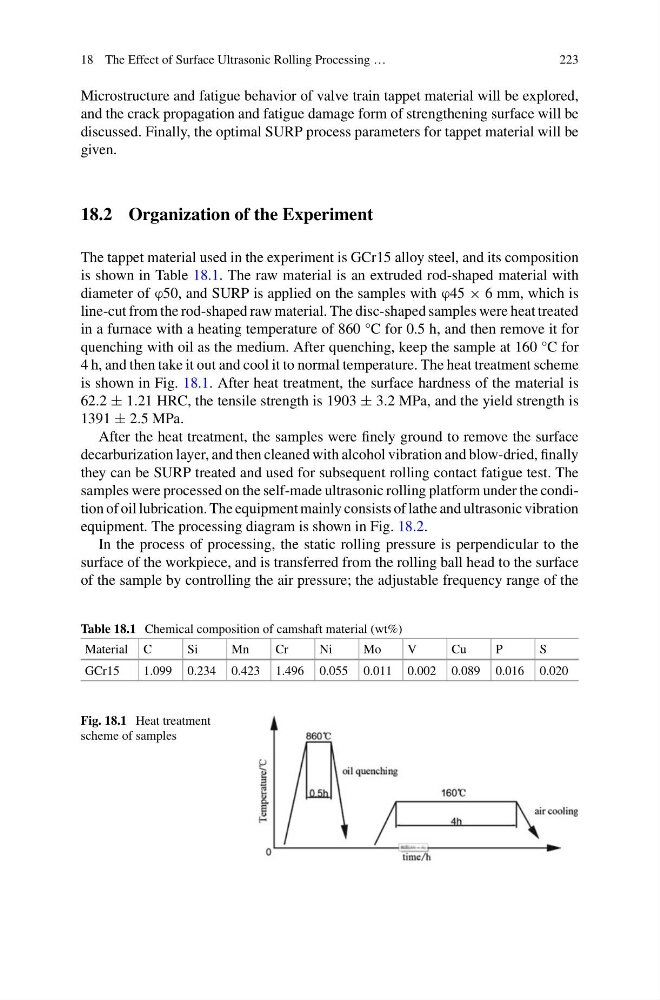
line-cut from the rod-shaped raw material. The disc-shaped samples were heat treated
in a furnace with a heating temperature of 860 °C for 0.5 h, and then remove it for
quenching with oil as the medium. After quenching, keep the sample at 160 °C for
4 h, and then take it out and cool it to normal temperature. The heat treatment scheme
is shown in Fig. 18.1. After heat treatment, the surface hardness of the material is
62.2 ± 1.21 HRC, the tensile strength is 1903 ± 3.2 MPa, and the yield strength is
1391 ± 2.5 MPa.
After the heat treatment, the samples were finely ground to remove the surface
decarburization layer, and then cleaned with alcohol vibration and blow-dried, finally
they can be SURP treated and used for subsequent rolling contact fatigue test. The
samples were processed on the self-made ultrasonic rolling platform under the condition of oil lubrication. The equipment mainly consists of lathe and ultrasonic vibration
equipment. The processing diagram is shown in Fig. 18.2.
In the process of processing, the static rolling pressure is perpendicular to the
surface of the workpiece, and is transferred from the rolling ball head to the surface
of the sample by controlling the air pressure; the adjustable frequency range of the
Table 18.1 Chemical composition of camshaft material (wt%)
Material C
Si
Mn
Cr
Ni
Mo
V
Cu
P
S
GCr15
1.099 0.234 0.423 1.496 0.055 0.011 0.002 0.089 0.016 0.020
Fig. 18.1 Heat treatment
scheme of samples
223
Microstructure and fatigue behavior of valve train tappet material will be explored,
and the crack propagation and fatigue damage form of strengthening surface will be
discussed. Finally, the optimal SURP process parameters for tappet material will be
given.
18.2 Organization of the Experiment
The tappet material used in the experiment is GCr15 alloy steel, and its composition
is shown in Table 18.1. The raw material is an extruded rod-shaped material with
diameter of ϕ50, and SURP is applied on the samples with ϕ45 × 6 mm, which is
line-cut from the rod-shaped raw material. The disc-shaped samples were heat treated
in a furnace with a heating temperature of 860 °C for 0.5 h, and then remove it for
quenching with oil as the medium. After quenching, keep the sample at 160 °C for
4 h, and then take it out and cool it to normal temperature. The heat treatment scheme
is shown in Fig. 18.1. After heat treatment, the surface hardness of the material is
62.2 ± 1.21 HRC, the tensile strength is 1903 ± 3.2 MPa, and the yield strength is
1391 ± 2.5 MPa.
After the heat treatment, the samples were finely ground to remove the surface
decarburization layer, and then cleaned with alcohol vibration and blow-dried, finally
they can be SURP treated and used for subsequent rolling contact fatigue test. The
samples were processed on the self-made ultrasonic rolling platform under the condition of oil lubrication. The equipment mainly consists of lathe and ultrasonic vibration
equipment. The processing diagram is shown in Fig. 18.2.
In the process of processing, the static rolling pressure is perpendicular to the
surface of the workpiece, and is transferred from the rolling ball head to the surface
of the sample by controlling the air pressure; the adjustable frequency range of the
Table 18.1 Chemical composition of camshaft material (wt%)
Material C
Si
Mn
Cr
Ni
Mo
V
Cu
P
S
GCr15
1.099 0.234 0.423 1.496 0.055 0.011 0.002 0.089 0.016 0.020
Fig. 18.1 Heat treatment
scheme of samples