

15 Simulation of Multi-step Tube Hot Gas Forming Process …
191
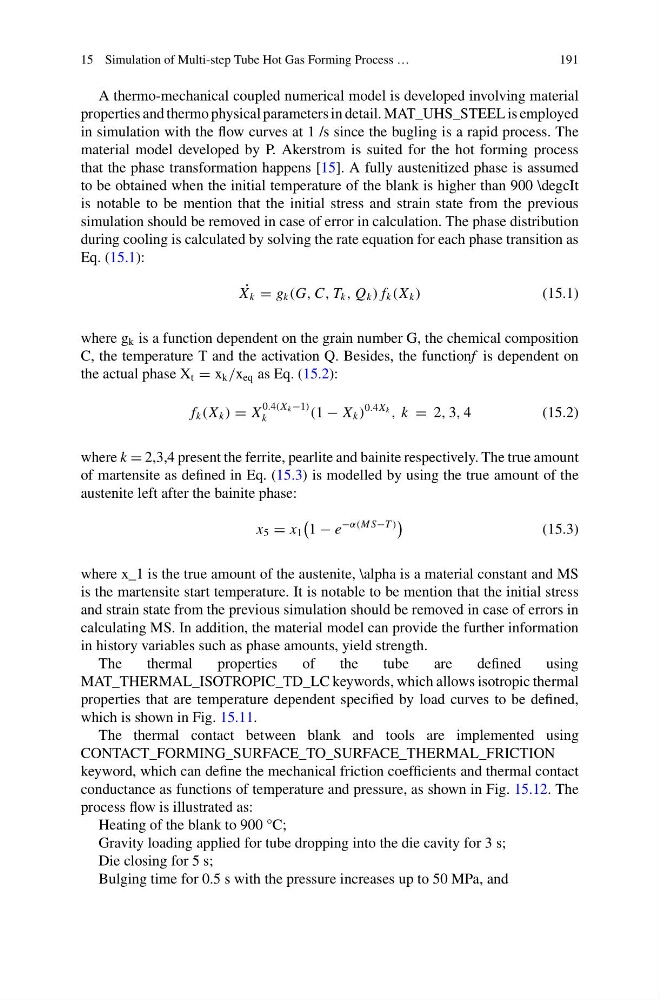
A thermo-mechanical coupled numerical model is developed involving material
properties and thermo physical parameters in detail. MAT_UHS_STEEL is employed
in simulation with the flow curves at 1 /s since the bugling is a rapid process. The
material model developed by P. Akerstrom is suited for the hot forming process
that the phase transformation happens [15]. A fully austenitized phase is assumed
to be obtained when the initial temperature of the blank is higher than 900 \degcIt
is notable to be mention that the initial stress and strain state from the previous
simulation should be removed in case of error in calculation. The phase distribution
during cooling is calculated by solving the rate equation for each phase transition as
Eq. (15.1):
˙
X k = g k (G, C, T k , Q k ) f k (X k )
(15.1)
where g k is a function dependent on the grain number G, the chemical composition
C, the temperature T and the activation Q. Besides, the functionf is dependent on
the actual phase X t = x k /x eq as Eq. (15.2):
f k (X k ) = X
0.4(X k −1)
k
(1 − X k )
0.4X k , k = 2, 3, 4
(15.2)
where k = 2,3,4 present the ferrite, pearlite and bainite respectively. The true amount
of martensite as defined in Eq. (15.3) is modelled by using the true amount of the
austenite left after the bainite phase:
x 5 = x 1
1 − e
−α(M S−T )
(15.3)
where x_1 is the true amount of the austenite, \alpha is a material constant and MS
is the martensite start temperature. It is notable to be mention that the initial stress
and strain state from the previous simulation should be removed in case of errors in
calculating MS. In addition, the material model can provide the further information
in history variables such as phase amounts, yield strength.
The
thermal
properties
of
the
tube
are
defined
using
MAT_THERMAL_ISOTROPIC_TD_LC keywords, which allows isotropic thermal
properties that are temperature dependent specified by load curves to be defined,
which is shown in Fig. 15.11.
The thermal contact between blank and tools are implemented using
CONTACT_FORMING_SURFACE_TO_SURFACE_THERMAL_FRICTION
keyword, which can define the mechanical friction coefficients and thermal contact
conductance as functions of temperature and pressure, as shown in Fig. 15.12. The
process flow is illustrated as:
Heating of the blank to 900 °C;
Gravity loading applied for tube dropping into the die cavity for 3 s;
Die closing for 5 s;
Bulging time for 0.5 s with the pressure increases up to 50 MPa, and
191
A thermo-mechanical coupled numerical model is developed involving material
properties and thermo physical parameters in detail. MAT_UHS_STEEL is employed
in simulation with the flow curves at 1 /s since the bugling is a rapid process. The
material model developed by P. Akerstrom is suited for the hot forming process
that the phase transformation happens [15]. A fully austenitized phase is assumed
to be obtained when the initial temperature of the blank is higher than 900 \degcIt
is notable to be mention that the initial stress and strain state from the previous
simulation should be removed in case of error in calculation. The phase distribution
during cooling is calculated by solving the rate equation for each phase transition as
Eq. (15.1):
˙
X k = g k (G, C, T k , Q k ) f k (X k )
(15.1)
where g k is a function dependent on the grain number G, the chemical composition
C, the temperature T and the activation Q. Besides, the functionf is dependent on
the actual phase X t = x k /x eq as Eq. (15.2):
f k (X k ) = X
0.4(X k −1)
k
(1 − X k )
0.4X k , k = 2, 3, 4
(15.2)
where k = 2,3,4 present the ferrite, pearlite and bainite respectively. The true amount
of martensite as defined in Eq. (15.3) is modelled by using the true amount of the
austenite left after the bainite phase:
x 5 = x 1
1 − e
−α(M S−T )
(15.3)
where x_1 is the true amount of the austenite, \alpha is a material constant and MS
is the martensite start temperature. It is notable to be mention that the initial stress
and strain state from the previous simulation should be removed in case of errors in
calculating MS. In addition, the material model can provide the further information
in history variables such as phase amounts, yield strength.
The
thermal
properties
of
the
tube
are
defined
using
MAT_THERMAL_ISOTROPIC_TD_LC keywords, which allows isotropic thermal
properties that are temperature dependent specified by load curves to be defined,
which is shown in Fig. 15.11.
The thermal contact between blank and tools are implemented using
CONTACT_FORMING_SURFACE_TO_SURFACE_THERMAL_FRICTION
keyword, which can define the mechanical friction coefficients and thermal contact
conductance as functions of temperature and pressure, as shown in Fig. 15.12. The
process flow is illustrated as:
Heating of the blank to 900 °C;
Gravity loading applied for tube dropping into the die cavity for 3 s;
Die closing for 5 s;
Bulging time for 0.5 s with the pressure increases up to 50 MPa, and