

1 Controlled and Localized Electrochemical Microfabrication …
9
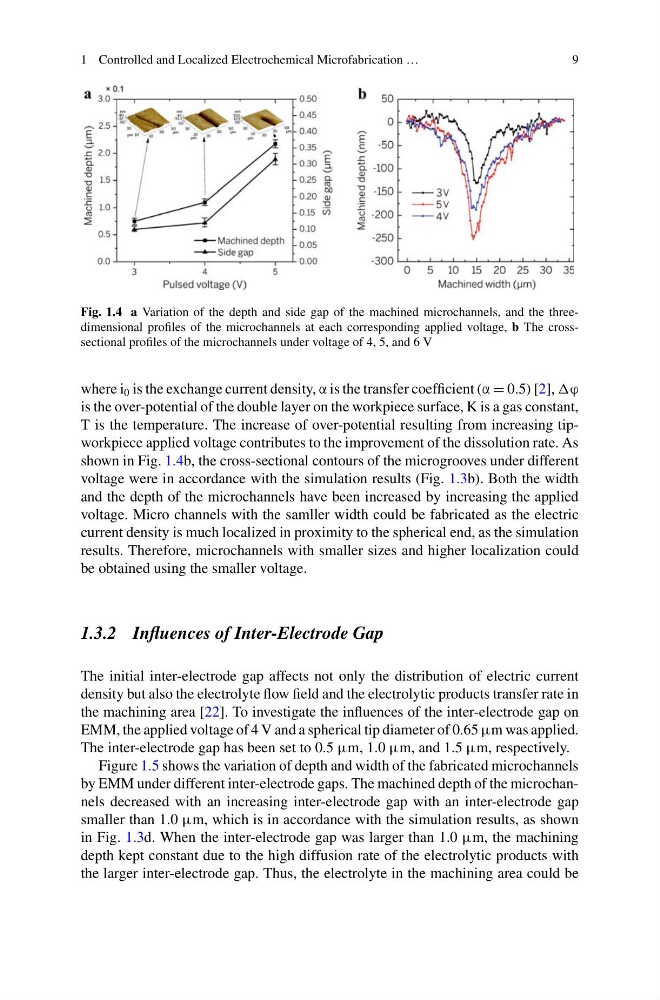
Fig. 1.4 a Variation of the depth and side gap of the machined microchannels, and the threedimensional profiles of the microchannels at each corresponding applied voltage, b The crosssectional profiles of the microchannels under voltage of 4, 5, and 6 V
where i 0 is the exchange current density, α is the transfer coefficient (α = 0.5) [2], ϕ
is the over-potential of the double layer on the workpiece surface, K is a gas constant,
T is the temperature. The increase of over-potential resulting from increasing tipworkpiece applied voltage contributes to the improvement of the dissolution rate. As
shown in Fig. 1.4b, the cross-sectional contours of the microgrooves under different
voltage were in accordance with the simulation results (Fig. 1.3b). Both the width
and the depth of the microchannels have been increased by increasing the applied
voltage. Micro channels with the samller width could be fabricated as the electric
current density is much localized in proximity to the spherical end, as the simulation
results. Therefore, microchannels with smaller sizes and higher localization could
be obtained using the smaller voltage.
1.3.2 Influences of Inter-Electrode Gap
The initial inter-electrode gap affects not only the distribution of electric current
density but also the electrolyte flow field and the electrolytic products transfer rate in
the machining area [22]. To investigate the influences of the inter-electrode gap on
EMM, the applied voltage of 4 V and a spherical tip diameter of 0.65 μm was applied.
The inter-electrode gap has been set to 0.5 μm, 1.0 μm, and 1.5 μm, respectively.
Figure 1.5 shows the variation of depth and width of the fabricated microchannels
by EMM under different inter-electrode gaps. The machined depth of the microchannels decreased with an increasing inter-electrode gap with an inter-electrode gap
smaller than 1.0 μm, which is in accordance with the simulation results, as shown
in Fig. 1.3d. When the inter-electrode gap was larger than 1.0 μm, the machining
depth kept constant due to the high diffusion rate of the electrolytic products with
the larger inter-electrode gap. Thus, the electrolyte in the machining area could be
9
Fig. 1.4 a Variation of the depth and side gap of the machined microchannels, and the threedimensional profiles of the microchannels at each corresponding applied voltage, b The crosssectional profiles of the microchannels under voltage of 4, 5, and 6 V
where i 0 is the exchange current density, α is the transfer coefficient (α = 0.5) [2], ϕ
is the over-potential of the double layer on the workpiece surface, K is a gas constant,
T is the temperature. The increase of over-potential resulting from increasing tipworkpiece applied voltage contributes to the improvement of the dissolution rate. As
shown in Fig. 1.4b, the cross-sectional contours of the microgrooves under different
voltage were in accordance with the simulation results (Fig. 1.3b). Both the width
and the depth of the microchannels have been increased by increasing the applied
voltage. Micro channels with the samller width could be fabricated as the electric
current density is much localized in proximity to the spherical end, as the simulation
results. Therefore, microchannels with smaller sizes and higher localization could
be obtained using the smaller voltage.
1.3.2 Influences of Inter-Electrode Gap
The initial inter-electrode gap affects not only the distribution of electric current
density but also the electrolyte flow field and the electrolytic products transfer rate in
the machining area [22]. To investigate the influences of the inter-electrode gap on
EMM, the applied voltage of 4 V and a spherical tip diameter of 0.65 μm was applied.
The inter-electrode gap has been set to 0.5 μm, 1.0 μm, and 1.5 μm, respectively.
Figure 1.5 shows the variation of depth and width of the fabricated microchannels
by EMM under different inter-electrode gaps. The machined depth of the microchannels decreased with an increasing inter-electrode gap with an inter-electrode gap
smaller than 1.0 μm, which is in accordance with the simulation results, as shown
in Fig. 1.3d. When the inter-electrode gap was larger than 1.0 μm, the machining
depth kept constant due to the high diffusion rate of the electrolytic products with
the larger inter-electrode gap. Thus, the electrolyte in the machining area could be